Jackson Police Chief to Present New Pay Scale Aimed at Fixing Salary Gaps and Stopping Departures
Chief J.T. Moore's proposal would address trainees out-earning their trainers and same-rank officers on different pay. If approved, it takes effect Oct. 1, and no employee's hourly rate would drop.
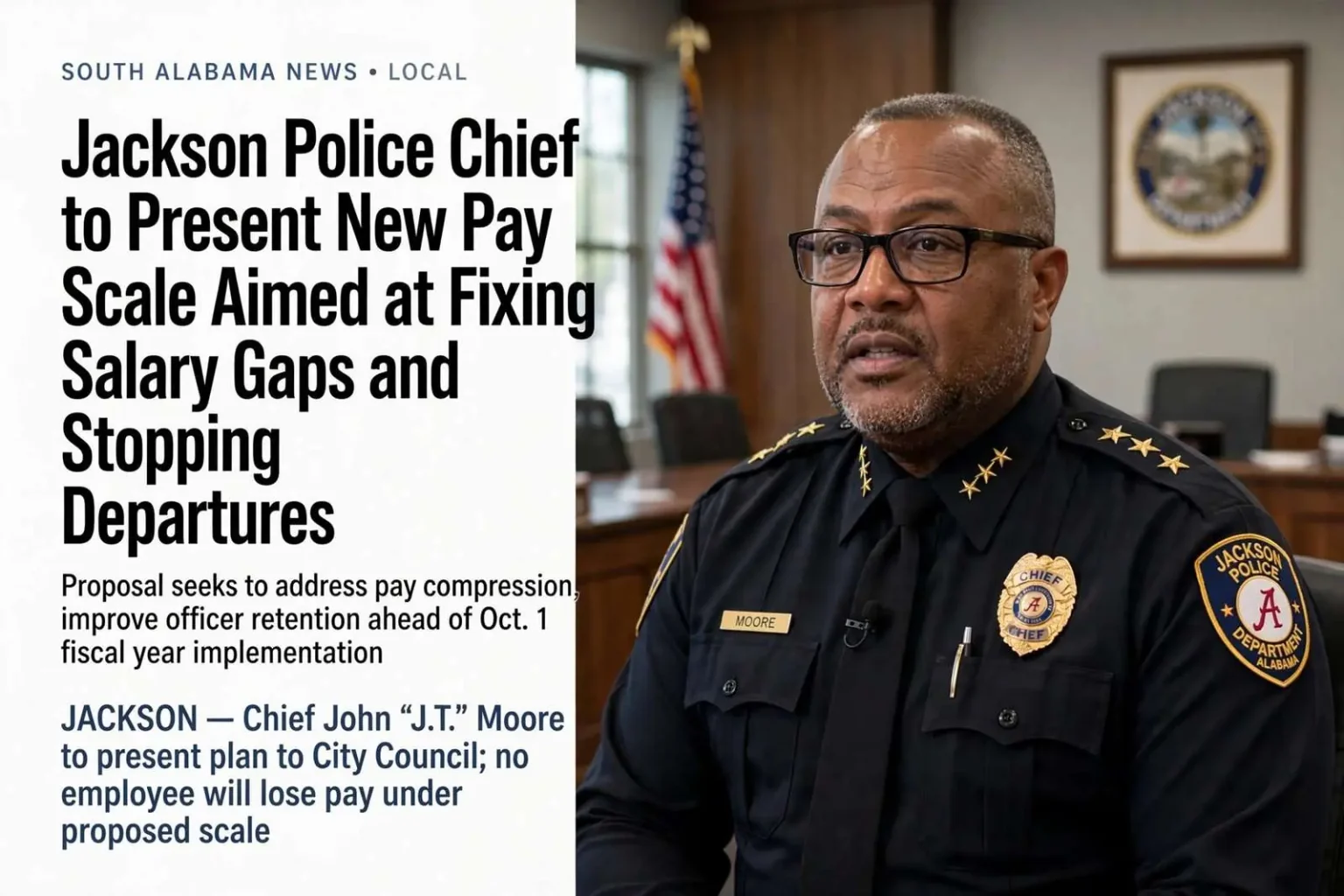
JACKSON — The Jackson Police Department is preparing a new pay scale designed to address salary disparities within the department, improve officer retention and help employees keep pace with the rising cost of living.
The Proposal
Jackson Police Chief John “J.T.” Moore is expected to present the proposed pay scale to the Jackson City Council at its next meeting.
If approved, the new compensation and evaluation plan is scheduled to take effect at the beginning of the new fiscal year on Oct. 1. According to the department, the plan was finalized in late August following coordination between Moore and city leadership.
The Problems It Addresses
The proposed changes target several specific issues with the department’s current pay structure:
Situations in which trainees earn more per hour than the officers training them. Employees holding the same rank receiving different rates of pay. And a pay structure that has become too heavily weighted toward higher-ranking positions.
Each of those is a recognizable symptom of pay compression — the condition that develops when a department raises starting pay to compete for new hires without correspondingly adjusting the rates of officers already on staff. Over several hiring cycles, the entry rate creeps upward while existing employees stay where they are, until a new officer can be hired at or above the rate of the veteran assigned to train them.
The effect on morale is direct, and so is the effect on retention. An officer who discovers that their trainee earns more per hour has a concrete, verifiable reason to look elsewhere.
Same-rank pay disparities produce a similar problem for a different reason: they typically reflect the individual circumstances of when each officer was hired rather than any difference in responsibility, and they are difficult to defend to the officers on the lower end.
No One Loses Money
Under the proposal, no employee will lose money on an hourly basis. The new pay scale is designed to keep employees at their current hourly rate or increase it.
That constraint is standard in restructuring plans of this kind, and it is also what makes them expensive. Correcting compression without reducing anyone’s pay means raising the people who are behind rather than lowering the people who are ahead, which is why such plans are typically timed to the start of a fiscal year when new budget authority takes effect.
The Departures That Prompted It
The department currently has 27 full- and part-time employees. Five employees have recently left for opportunities elsewhere or to pursue career advancement.
Five departures from a 27-person department is a substantial share of the workforce. For a small agency, each loss means fewer officers available for shift coverage and the cost of recruiting, hiring and training a replacement — an investment that runs into thousands of dollars and months of time before a new officer works independently.
One Departure the Chief Is Proud Of
One of those departures was Sgt. Hiram Gunter, who accepted the position of police chief for the Town of Fulton.
“It gives me great pleasure to see one of our own move into a management position and still be in Clarke County,” Moore said.
Moore said the department’s ability to produce experienced officers who advance into leadership positions is a point of pride.
“This is the type of officer the Jackson Police Department produces,” Moore said. “We remain the top agency in the county for experience and talent.”
That framing captures the double-edged position of a small department that trains well. Producing officers ready for command elsewhere is a credit to the agency and a drain on it at the same time.
The Council Discussion That Preceded It
The issue of police pay was raised during the council’s Aug. 25 meeting, when former Jackson officer Buzz Jordan urged city leaders to consider raises for officers amid the recent departures.
“The hardest job I’ve ever done was being a police officer,” Jordan told the council at that meeting, describing the dangers officers face while serving the community. Council members echoed his appreciation for the department but took no action at the time.
What Happens Next
Moore’s presentation to the council is the next step. Approval would be required before the plan could take effect with the new fiscal year on Oct. 1.
South Alabama News will report the council’s decision.