
Jarrod Parker named to All-Time Mobile BayBears Team
Right-hander Jarrod Parker, the ninth overall pick in the 2007 MLB Draft, has been named to the All-Time Mobile BayBears Team as the team ends its 23-year.
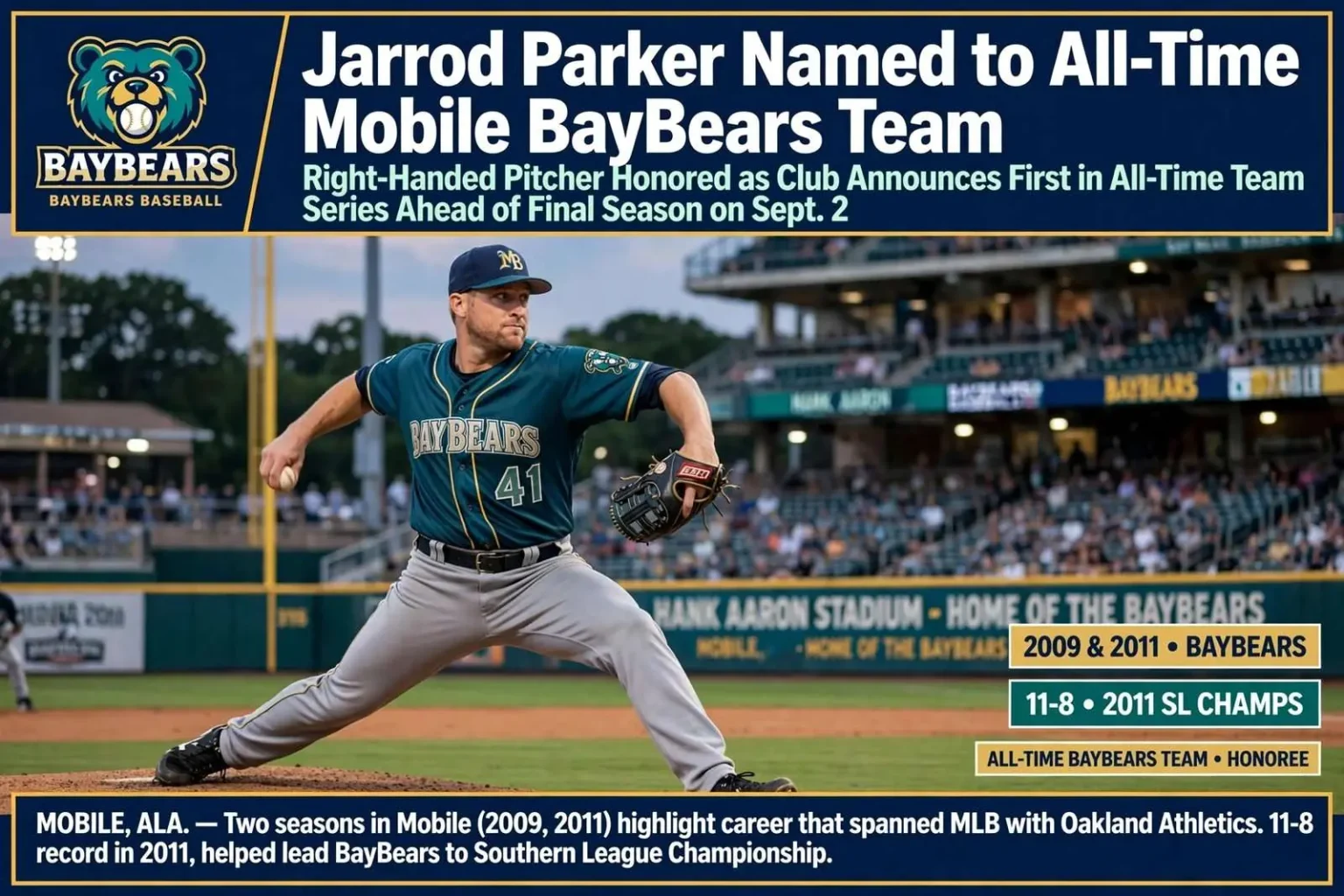
MOBILE, Ala. — As the Mobile BayBears prepare to close out a 23-year run on the Gulf Coast, the team is naming its All-Time BayBears Team, with members revealed one at a time in the weeks ahead of the final game on Sept. 2. The selections are based on a player’s or coach’s overall career, not just their time in a BayBears uniform, a distinction that matters for the latest honoree: right-handed pitcher Jarrod Parker, who took the mound in Mobile in 2009 and 2011 but built his reputation across a career that spanned the minor and major leagues.
The honor arrives at a bittersweet moment for baseball fans across south Alabama. The BayBears, who have played at Hank Aaron Stadium in Mobile since the franchise relocated to the city in 1997, are wrapping up their final season before the club’s eventual departure, ending more than two decades of Double-A baseball on the Gulf Coast. For longtime season-ticket holders, the All-Time Team series has become a farewell tour of its own, an occasion to relive the championship seasons, the future major league stars who passed through, and the players who defined eras of BayBears baseball.
The franchise’s place in Mobile’s larger baseball story gives the tribute added weight. Mobile has long been one of the most productive baseball cities in America relative to its size, producing Hall of Famers including Hank Aaron, Satchel Paige, Willie McCovey and Ozzie Smith. Generations of local fans grew up following the city’s minor league clubs long before the BayBears arrived, and the team’s 23-year run carried that tradition forward for a new era of families who came to the ballpark on the city’s west side each summer.
During its time in Mobile, the BayBears served as the Double-A affiliate for major league organizations including the San Diego Padres, the Arizona Diamondbacks and the Los Angeles Angels, and the club captured Southern League championships along the way, including a title in 2011. The roster lists from those seasons read like a who’s-who of players who would go on to contribute at the sport’s highest level. That pipeline — from Hank Aaron Stadium to big league ballparks — is precisely what the All-Time BayBears Team is meant to celebrate, honoring careers that intersected with the Port City on their way up.
Parker’s candidacy rests on a stretch of dominance that Mobile fans witnessed firsthand and on a major league career that validated everything they saw. His two seasons in a BayBears uniform bracketed one of the most serious injuries a pitcher can face, and his comeback from it remains one of the more compelling arcs connected to the franchise. The club’s decision to judge honorees on their full careers rather than their Mobile statistics alone made Parker an obvious choice once his complete body of work was considered.
From First-Round Pick to the Port City
Parker’s path to Mobile began in Kentucky, where he starred at Owensboro High School and established himself as one of the most advanced high school pitching prospects in the country. The Arizona Diamondbacks selected him with the ninth overall pick in the 2007 MLB Draft, a slot that carried both significant expectations and a significant signing bonus. Scouts consistently praised his poise, his command and a plus fastball-changeup combination that allowed him to retire hitters well beyond his age level.
He moved quickly through Arizona’s minor league system, a sign of how highly the organization regarded him, and he arrived in Mobile in 2009 as one of the youngest players in the Southern League. For a pitcher still in his teens and early twenties to hold his own at Double-A — the level where organizations traditionally send their top prospects to be tested — marked Parker as the kind of arm around which a franchise could plan. BayBears fans who came out that summer were watching a future front-of-the-rotation starter take his lumps and log his innings at the Double-A level.
Then came the setback that would define the next two years of his career. In late July of the 2009 season, Parker injured his elbow, an injury serious enough that it required Tommy John surgery, the ligament reconstruction procedure that has sidelined — and in many cases ended — the careers of countless pitchers. The surgery forced him to miss the entire 2010 season, a lost year spent rehabbing while his teammates continued the grind of a minor league schedule without him.
The 2011 Comeback Season in Mobile
When Parker returned to Mobile in 2011, he did so with questions attached. Pitchers returning from Tommy John surgery are typically monitored carefully, with organizations limiting workloads and watching closely for any sign that the rebuilt elbow is not holding up. Parker answered every question decisively. Over the course of the season he went 11-8 for the BayBears, logging the kind of durable, effective campaign that convinced Arizona’s decision-makers he was ready for the next challenge.
The 2011 season also delivered a team achievement that Mobile fans still remember. The BayBears won the Southern League championship that year, adding another title to the franchise’s history and capping a summer in which the pitching staff, Parker included, set the tone for the club. The performance was enough that when major league rosters expanded in September, the Diamondbacks called Parker up, giving him his first taste of the major leagues and including him in the club’s pennant race.
That trajectory — drafted high, tested at Double-A, sidelined by surgery, returned to win a championship and reach the majors within the same season — made Parker’s time in Mobile a defining chapter of his career even though his biggest professional moments were still ahead. It also set the stage for the trade that would send him out of the Diamondbacks organization and into the role for which baseball fans nationwide came to know him.
After the 2011 championship season, Parker was traded to the Oakland Athletics, the small-market club known for identifying and developing young pitching talent. The move gave Parker a fresh start in the American League West and placed him in an organization that had a track record of getting the most from pitchers who had come up through competitive minor league environments like the one he had experienced in the Southern League.
Parker repaid Oakland’s confidence immediately. In 2012, his first full major league season, he went 13-8 for the A’s and established himself as a fixture in the club’s rotation. The season coincided with one of the most memorable runs in recent Athletics history, as Oakland surged to the AL West title with a series of late-inning comebacks that captivated the league. Parker’s steadiness every fifth day was a significant part of that run, and for a first full season in the majors, it was exactly the kind of performance the Diamondbacks had projected when they made him a top-ten pick.
The 2013 season that followed was, by many measures, the best of Parker’s career. He posted a 12-8 record and set a franchise record with 19 consecutive starts without a loss, a streak that placed him among the most reliable pitchers in the American League and etched his name into the Athletics record book. Streaks of that length require not just talent but consistency across months of a grueling schedule, and Parker’s run stood as a testament to the durability he had rebuilt after his elbow surgery in Mobile.
By the end of that season, Parker had compiled a two-year major league record of 25-16 across roughly 63 starts, numbers that made him one of the youngest established starters in the league and a foundational piece of Oakland’s plans. When the 2014 season approached, the Athletics projected him as their opening-day starter, the highest honor a rotation can bestow and a clear signal of how far he had climbed from the prospect who first appeared at Hank Aaron Stadium in 2009.
The Injury That Ended the Comeback
It never happened. During spring training in 2014, Parker was injured, and the diagnosis was devastating: a second Tommy John surgery was required, this time on the same elbow that had already been reconstructed once. Repeat elbow ligament surgery is among the most challenging scenarios in sports medicine, with longer recoveries and far lower odds of a full return to prior form. Parker, who had already proven he could come back once, now faced the steepest climb of his professional life.
The second surgery ultimately proved to be the end of the line. Parker never pitched in the major leagues again, a fact that still stings for the fans who watched his career unfold and for the Athletics organization that had built its rotation plans around him. He attempted comebacks in subsequent years, including time in other organizations as he worked to return to a big league mound, but the elbow never allowed him to recapture the form that had produced back-to-back winning seasons in Oakland.
For baseball observers, Parker’s story is often cited in discussions about the physical toll of pitching and the unpredictable nature of prospect development. His career arc — a first-round selection, a surgery at the Double-A level, a championship comeback, two strong major league seasons, a franchise record, and then a second surgery that ended everything — compresses the entire promise and peril of a pitching career into a handful of years. It is precisely that kind of full arc that the BayBears’ All-Time Team criteria were designed to honor.
What the Honor Means in Mobile
For Mobile fans, Parker’s selection to the All-Time BayBears Team is a reminder of what they were able to watch in person during those two seasons. The 2011 championship club remains one of the high points in franchise history, and Parker was central to it. The honor also connects the BayBears’ farewell season to the city’s deep baseball lineage, adding another chapter to a local story that runs from the Negro Leagues era through Hank Aaron’s rise and into the modern minor league game.
The All-Time Team reveals will continue in the days leading up to the final game on Sept. 2, with the club announcing honorees one at a time. Each reveal has generated conversation among fans on social media and at the ballpark, as supporters debate which pitchers, hitters and coaches from 23 seasons deserve recognition. Parker’s inclusion sets a standard for the honorees to come: careers judged in full, with the Mobile chapters placed in the context of everything that followed.
As the franchise’s final homestand approaches, the Parker announcement underscores the bittersweet nature of the season. The BayBears will play their last game on Sept. 2, closing a run that began in 1997 and gave south Alabama a generation of summer nights at the ballpark. The players being honored — Parker chief among them — are the reason those nights mattered, and the All-Time BayBears Team ensures that even after the final out, the best of those careers will remain part of Mobile’s baseball memory.