Jazz Appreciation Month: Remembering Mobile-Born Jazz Great Ward Swingle
For Jazz Appreciation Month, a look at Ward Swingle, the Mobile-born pianist who founded the Grammy-winning Swingle Singers and reshaped vocal jazz.
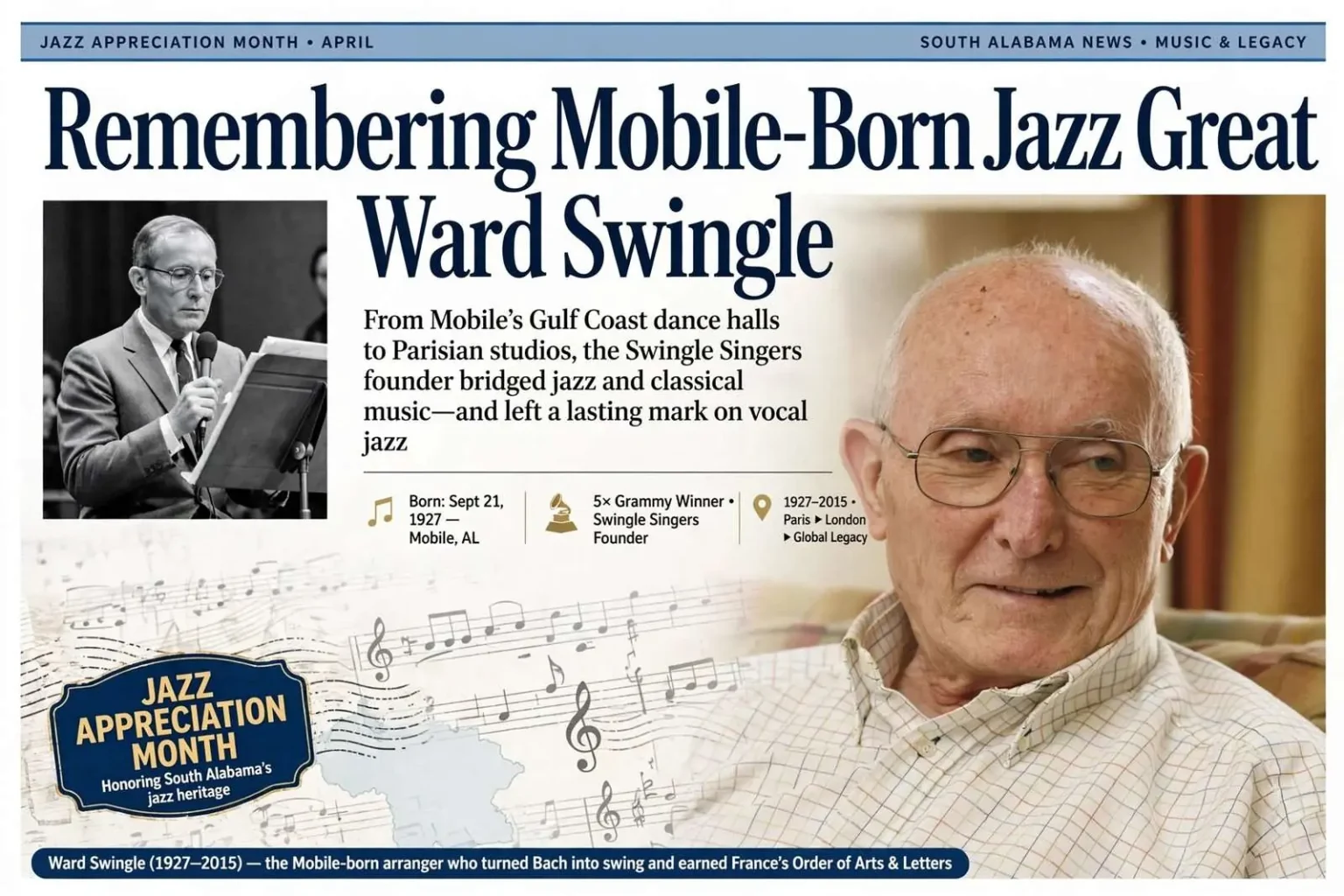
Each April, Jazz Appreciation Month gives South Alabama a reason to look back at the musicians the region produced who went on to shape jazz far beyond the Port City. Few did it more distinctively than Ward Swingle, a Mobile-born pianist, vocalist and arranger whose Paris-based vocal ensemble, the Swingle Singers, became one of the most honored groups in jazz and choral music. Over a career that stretched from Gulf Coast dance halls to recording studios on two continents, Swingle built a bridge between jazz and classical music that audiences around the world are still crossing.
Jazz Appreciation Month, an annual observance launched to spotlight jazz as an original American art form, arrives each April with concerts, school programs, and retrospectives across the country. In south Alabama, the month carries a particular resonance: Mobile’s musical soil — shaped by Mardi Gras traditions, church choirs, and a thriving mid-century club scene — produced an outsized share of the region’s working musicians, and Swingle’s trajectory from local sideman to international bandleader remains among the most remarkable the city has seen.
A Mobile upbringing, a national education
Swingle was born in Mobile on September 21, 1927, and showed musical talent early, learning clarinet, oboe and piano as a child. The breadth of that training mattered; a multi-instrumentalist’s ear for timbre and line would become the signature of his later arranging, where voices were treated like instruments in a band. Before finishing high school, he was already playing in local big bands around the Mobile area, the kind of dance-hall and swing outfits that gave a generation of Gulf Coast musicians their start.
Those early gigs put the teenage Swingle in front of ballroom crowds and hotel dance floors, learning on the job how an arrangement works, how a band breathes, and how an audience responds. The Mobile scene he came up in was a working one: touring bands passed through the Port City, local players filled the gaps between them, and a young musician with chops could find steady work long before he could vote.
He went on to study at the Cincinnati Conservatory of Music, graduating summa cum laude in 1950, adding formal depth to the instinct the big-band circuit had already sharpened. A Fulbright scholarship took him to France in 1951, where he studied piano under the noted German pianist Walter Gieseking and worked as a rehearsal pianist for Les Ballets de Paris. The Fulbright years did what they were designed to do — they planted an American musician in European musical life at a moment when the two worlds were beginning to trade influences in both directions.
Swingle spent the 1950s establishing himself in the Paris music scene, including as a founding member of the vocal jazz group Les Double Six. That ensemble, which applied jazz vocalese techniques to recorded solos by American masters, gave Swingle his first experience treating the human voice as a jazz instrument — a seed that would grow into the work that made him famous.
Founding the Swingle Singers
In 1962, Swingle formed his own ensemble in Paris, applying scat-singing techniques to the works of Bach and other classical composers. The approach — wordless vocal harmonies layered over swinging jazz rhythm, backed by a jazz rhythm section — was unlike anything else on record at the time. Where other groups had folded classical quotations into jazz, the Swingle Singers did the reverse: they took concert-hall masterpieces and made them swing, note for note, without adding a single lyric.
The formula proved instantly popular. The group’s early albums won five Grammy Awards and introduced millions of listeners to a genre-blurring style that borrowed equally from the concert hall and the jazz club. Record buyers who had never voluntarily listened to Bach found themselves wearing out recordings of his keyboard works set to walking bass and brushed drums, and classical audiences discovered scat singing without ever setting foot in a jazz club. That two-way traffic — each audience pulled across the line into the other’s territory — was the quiet achievement underneath the awards.
Swingle disbanded the original Paris lineup in 1973 and started a second iteration of the group, known as Swingle II, in London, broadening the repertoire into contemporary and avant-garde material. The London-based version of the ensemble continued the same essential experiment — voices as instruments — while testing it against newer compositional territory, from modern classical works to original arrangements that abandoned the baroque safety net entirely.
He returned to the United States in 1984, where he continued composing, arranging and conducting choirs, and published his vocal arrangements through his own company, Swingle Music. The later decades of his career were spent as much in the classroom and the rehearsal hall as the studio: choirs across America and Europe sang his arrangements, and his published catalog became standard repertoire for vocal groups exploring the space between jazz and classical music.
The durability of that catalog is itself a measure of his influence. School and university ensembles that have never thought of themselves as jazz groups regularly program Swingle arrangements, and the scat-over-Bach format he pioneered has been imitated by countless a cappella and vocal jazz outfits in the decades since. Every college choir that swings a Renaissance motet is working in territory Swingle mapped first.
Recognition and legacy
In 2004, the French government named Swingle an Officer of the Order of Arts and Letters in recognition of his contribution to French musical culture, a notable honor for a musician who got his start playing in Mobile’s big bands decades earlier. The decoration acknowledged how thoroughly his work had become part of the French musical landscape he had adopted in 1951 — fitting for a man whose most famous ensemble was founded in Paris and whose recordings are counted among the classic sessions of French jazz.
He died in January 2015 in England, survived by his wife, three children and three grandchildren. Obituaries on both sides of the Atlantic treated him as one of the pivotal figures of vocal jazz, an arranger whose specific invention — the swing-baroque album — opened a genre that performers continue to explore. The Swingle Singers organization he founded carried on as well, maintaining an international touring schedule long after his retirement from the group he named.
For Mobile, his story fits a pattern the city’s music historians know well. The Gulf Coast produced musicians who carried the region’s sound into jazz, rhythm and blues, and popular music, often getting their first professional experience in the dance bands and clubs that once lined the local scene. Swingle’s route ran through Cincinnati, Paris, and London, but it began with a Mobile kid learning clarinet, oboe, and piano, and gigging with local bands before he finished high school.
What his story means for the region
Swingle’s career is a reminder of how far the region’s musical talent has traveled. The infrastructure that raised him — school music programs, working venues, a culture that treated performance as both craft and entertainment — no longer looks the same as it did in the 1940s, but the example matters for the musicians coming up in Mobile now: a local player with disciplined training and a distinctive idea can build a career that reshapes an entire genre.
His music also offers a natural entry point for Jazz Appreciation Month itself. April’s observances exist to connect audiences with the art form’s history and its living practitioners, and few artists make the case for jazz’s reach more vividly than a Mobile-born arranger whose Bach recordings won Grammys in the 1960s and whose arrangements are still sung by choirs today.
The sound that changed vocal music
Understanding what made the Swingle Singers radical requires hearing what came before them. Vocal jazz in the early 1960s largely meant close-harmony groups singing standards with lyrics, or solo singers backed by big bands. Nobody had committed an entire record to instrumental classical music performed entirely by voices swinging like a small jazz combo. The debut recordings did exactly that, and the precision required — each singer executing lines written for violin, flute, or harpsichord at jazz tempo — set a technical bar that vocal groups have measured themselves against ever since.
The arrangements worked because they respected both source materials. Swingle never treated the classical skeletons as jokes; the counterpoint remained intact, the phrasing stayed true to the score, and the swing came from rhythm and articulation rather than parody. That seriousness earned the group credibility in both worlds, which is why conservatory ensembles and jazz festivals alike claimed the recordings as their own.
The Grammy recognition reflected that crossover reach. Awards for the early albums put the group on American television stages and international tours, and their catalog became a fixture in record collections for listeners who owned nothing else that resembled it. For a vocal ensemble formed barely a year after its founder had been working as a rehearsal pianist, the ascent was meteoric by any industry standard.
Mobile’s musical lineage
Placing Swingle in context requires remembering what Mobile’s music community looked like in the 1930s and 1940s. The city sustained a full entertainment economy — hotels, ballrooms, social clubs, and the Mardi Gras season’s constant demand for live bands — and it produced working musicians at a rate that rivaled much larger Southern cities. Young players who came of age in that circuit learned sight-reading, ensemble discipline, and crowd craft in a single education that no conservatory could fully replicate.
Swingle’s path through that world, then through a rigorous conservatory and a Fulbright year abroad, traces the route many Mobile musicians of his generation followed partway: local start, formal training, then departure for bigger markets. What distinguishes him is where the departure led. Few artists from any city have invented a performing format so distinctive that it continues to define a niche eight decades after its founder first sat down at a Mobile piano.
Educators across south Alabama have made use of that legacy during Jazz Appreciation Month, pointing students to recordings that demonstrate how genres blur when musicians refuse to stay in one lane. The Swingle Singers’ catalog remains among the most accessible introductions to jazz for listeners raised on classical music, and among the most persuasive arguments for musical training that crosses styles — a fitting monument for a musician whose first instrument lessons were here on the Gulf Coast.
As Jazz Appreciation Month continues, his story remains one of Mobile’s clearest connections to the international jazz world — a local kid on piano and clarinet who ended up rewriting how audiences heard both jazz and classical music, and whose sound, half a century after the first Swingle Singers album, remains instantly recognizable the moment it starts.