
Judge Denies Marco Perez’s Request for Pretrial Immunity in Officer Sean Tuder Killing
A Mobile Circuit judge denied Marco Perez's request for pretrial immunity in the capital murder case of Officer Sean Tuder, rejecting his Stand Your Ground.
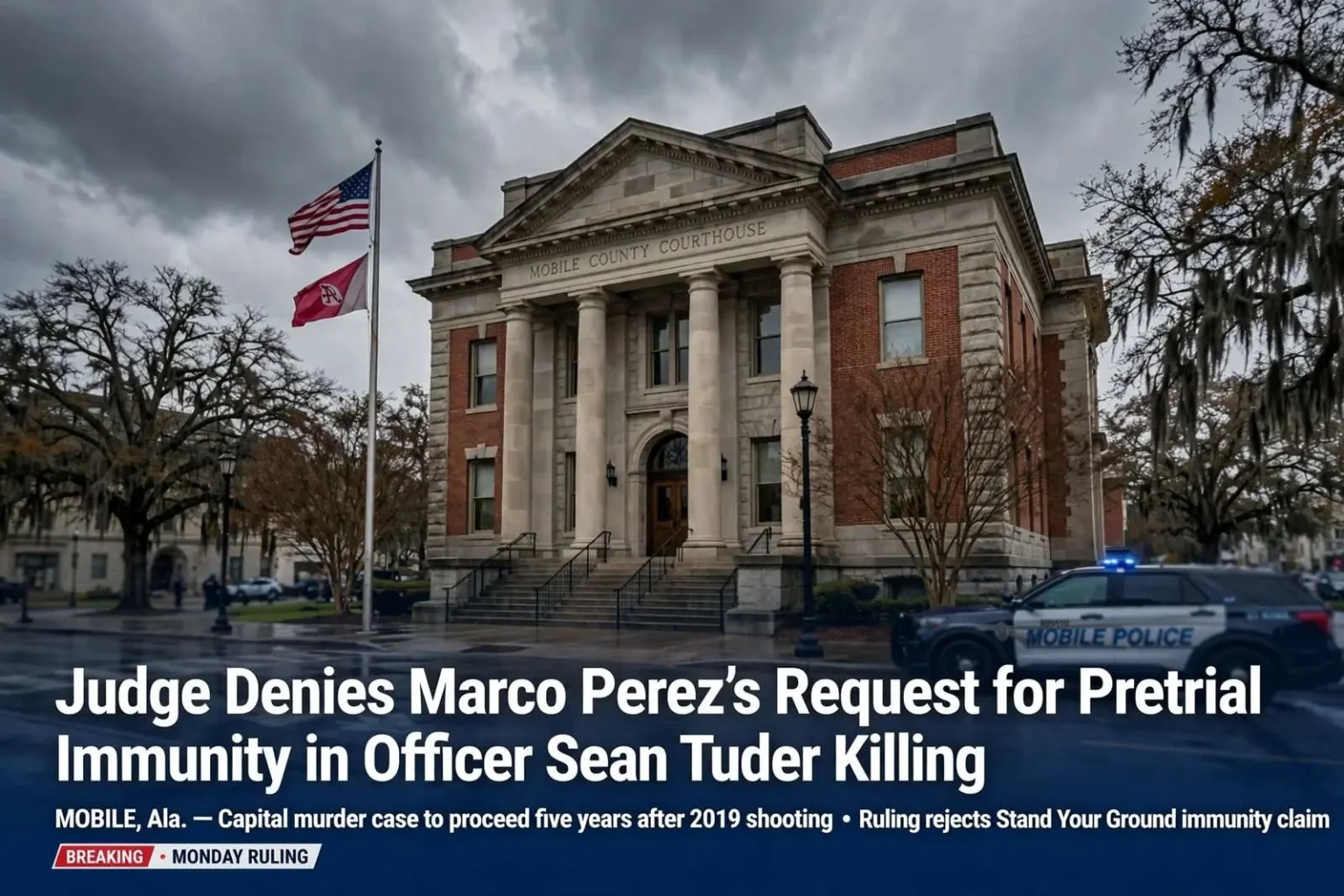
MOBILE, Ala. — A Mobile Circuit judge has denied accused cop killer Marco Perez’s request for pretrial immunity and dismissal of his capital murder indictment, keeping the case on track toward trial more than five years after Mobile Police Officer Sean Tuder was shot and killed in January 2019.
The ruling, set out in an order issued Monday, rejects the central legal argument the defense has pressed since early in the case: that the shooting was an act of self-defense protected by Alabama’s Stand Your Ground law. With pretrial immunity off the table, the capital murder charge stands, and the litigation now returns to the trial court’s ordinary track rather than ending before a jury is ever seated.
The defense position
According to court documents filed in February, Perez’s attorneys argued that Tuder never identified himself as a police officer during the encounter and that Perez believed he was being attacked. On that reading of the evidence, Perez claimed he was acting lawfully under Alabama’s Stand Your Ground statute, which eliminates the duty to retreat for a person who uses deadly force in self-defense anywhere he or she is lawfully present, and which can shield a defendant from both prosecution and civil liability.
Pretrial immunity is a powerful remedy in Alabama. When a judge grants it, the case ends before trial and the defendant cannot be prosecuted again for the same conduct. Because the stakes are so high, the person requesting immunity carries the burden of proving entitlement by a preponderance of the evidence — a lower standard than proof beyond a reasonable doubt, but one that still requires convincing the judge it is more likely than not that the use of force was justified. Defendants who succeed at this stage walk out of court with no trial at all; defendants who fail face the full weight of the charges they were facing when they filed the motion.
The prosecution’s answer
Prosecutors countered that the law does not apply to Perez at all, for reasons that have nothing to do with the final moments of the encounter. Perez was a convicted felon barred from owning a gun, and the weapon used was stolen. In the state’s view, a defendant who was armed in violation of the law cannot claim the statute’s protection, no matter how the confrontation began, because the law’s safeguards are reserved for people who are themselves acting within the bounds of the legal system.
That argument reflects the way Stand Your Ground defenses have been litigated across Alabama since the statute took effect. Judges weighing pretrial immunity motions routinely examine the defendant’s own status and conduct — whether the person was engaged in unlawful activity, whether the weapon was lawfully possessed, whether the defendant had a right to be where the shooting occurred — before reaching the question of who was the aggressor. A self-defense claim built on an unlawful foundation is one of the most common reasons immunity requests fail at this stage, and Monday’s order adds Mobile County to the list of jurisdictions where the argument has been rejected before trial.
The ruling also matters beyond this one courtroom. Mobile County prosecutors have treated the killing of a law enforcement officer as among the most serious cases on the docket, and a pretrial grant of immunity would have been an extraordinary outcome in the death of an on-duty officer. By keeping the case alive, the order preserves the option for a jury to hear the full story of what happened in January 2019.
What the judge found
In the order issued Monday, the judge wrote that Perez did not meet his burden of proving entitlement to pretrial immunity by a preponderance of the evidence. The court further found that Perez was not legally presumed justified in using deadly force, and that he had a common-law duty to retreat in the circumstances presented.
Each of those findings undercuts a distinct piece of the defense theory. The failure to carry the preponderance burden means the judge was not convinced, even on the more forgiving civil standard, that the shooting was justified. The rejection of the legal presumption matters because Stand Your Ground includes a built-in assumption of reasonable fear in certain situations — an assumption that can shift the weight of a hearing onto the prosecution. And the duty-to-retreat finding goes to the heart of the defense’s account: if a reasonable avenue of escape existed and was not taken, the use of deadly force becomes far harder to justify under long-standing Alabama common law principles that predate and operate alongside the modern statute.
The request for a pretrial declaration of immunity was denied, and with it the implied request to dismiss the capital murder indictment. Because the two motions rose and fell together, the dismissal question required no separate analysis — without immunity, there is no legal basis to wipe away the indictment a grand jury returned.
Why the charge is capital
Under Alabama law, the intentional killing of a police officer is one of the aggravating factors that can elevate a homicide to capital murder, a category that carries the harshest penalties in the state’s criminal code. A capital conviction exposes a defendant to either the death penalty or life imprisonment without the possibility of parole, and capital cases proceed under special procedural rules — heightened jury qualifications, stricter appellate review, and a separate sentencing phase if a jury returns a guilty verdict.
Prosecutors in Mobile County have previously signaled the seriousness with which they view the case, and the survival of the capital designation means the defense will continue to litigate in the shadow of those potential penalties. Capital prosecutions in Alabama routinely take years between indictment and trial, with extensive motion practice over evidence, jury selection, and mental health evaluations. Monday’s ruling removes one of the few motions that could have ended the case outright, but it is unlikely to be the last significant pretrial fight before a jury is selected.
The Stand Your Ground landscape
Alabama adopted its Stand Your Ground law in 2006, joining a wave of states that expanded self-defense protections beyond the traditional “castle doctrine,” which had applied only inside a person’s home. The statute extends the no-retreat principle to any place a person is lawfully present and adds the pretrial immunity mechanism that has generated a steady stream of hearings in courts across the state.
Those hearings have produced sharply different outcomes depending on the facts: judges have granted immunity in road-rage confrontations and home invasions, and denied it in cases involving armed felons, initial aggressors, and disputed accounts of who posed a threat. The mechanism places enormous pressure on trial judges, who must essentially preview the trial evidence in a single hearing. Perez’s failed motion now becomes part of that growing body of case law that defense lawyers and prosecutors on the Gulf Coast will study when similar motions are filed.
Youthful offender status already behind him
Perez, who was 19 at the time of the killing, was also denied youthful offender status in 2019, a separate setback that shaped how the case has proceeded ever since. Under Alabama law, youthful offender designation is available to people who were under 21 when an alleged offense occurred, and judges weigh factors including the nature of the crime, the defendant’s record, and the interests of justice. A grant would have moved the case into a confidential proceeding with limits on the punishment a court could impose.
The denial meant Perez would be prosecuted as an adult in open court, exposed to the full range of adult penalties if convicted. Combined with Monday’s immunity ruling, the defense has now lost the two legal avenues most likely to spare him the most severe consequences. What remains is a conventional — if extraordinarily serious — capital case, with all of the motions, hearings, and delays that designation entails.
An officer’s death felt across Mobile
Tuder’s killing in January 2019 sent a shock through the Mobile Police Department and the wider Gulf Coast law enforcement community. Line-of-duty deaths are rare in south Alabama, and the death of an officer so young prompted an outpouring of public support, from processions of patrol cars to memorial displays outside police precincts. Officers from departments across the region traveled to honor him, and his name joined the roster of Alabama officers remembered at the state’s law enforcement memorial in Montgomery.
The case has moved slowly through the courts in the years since, as capital cases typically do, and each hearing has drawn attention from officers and residents who followed the investigation from the beginning. Monday’s order keeps the prosecution moving, but the pace of capital litigation means a final resolution likely remains far off, with appeals potentially extending the case for years after any verdict.
What comes next
With immunity denied, the case returns to pretrial scheduling. The defense can continue to raise evidentiary challenges, question the state’s forensic findings, and argue over jury instructions, but the core dispute over whether the shooting was legally justified will now be resolved the way most criminal cases are: at trial, before a jury of Mobile County residents.
Prosecutors will be required to prove every element of the capital charge beyond a reasonable doubt, and the defense will get its full opportunity to present the self-defense account to jurors rather than to a judge in a pretrial hearing. Legal observers note that losing an immunity motion does not foreclose an acquittal — the preponderance standard at the immunity stage is only the first gate, and juries occasionally reach different conclusions after hearing complete testimony and cross-examination.
For now, the ruling stands as a firm answer to the question posed in February’s filings: the court found that Perez did not prove he was entitled to walk away before trial. The capital murder indictment remains in place, the Stand Your Ground defense failed at its first hurdle, and the case of Officer Sean Tuder’s killing moves forward in the courts where it began.