A Mobile judge has determined that prosecutors have gathered enough evidence to move forward with a murder case tied to a fatal stabbing on Gaston Street, clearing the way for the case to be presented to a Mobile County grand jury. The ruling came after a preliminary hearing, the routine but consequential checkpoint that filters felony cases early in Alabama’s criminal justice process.
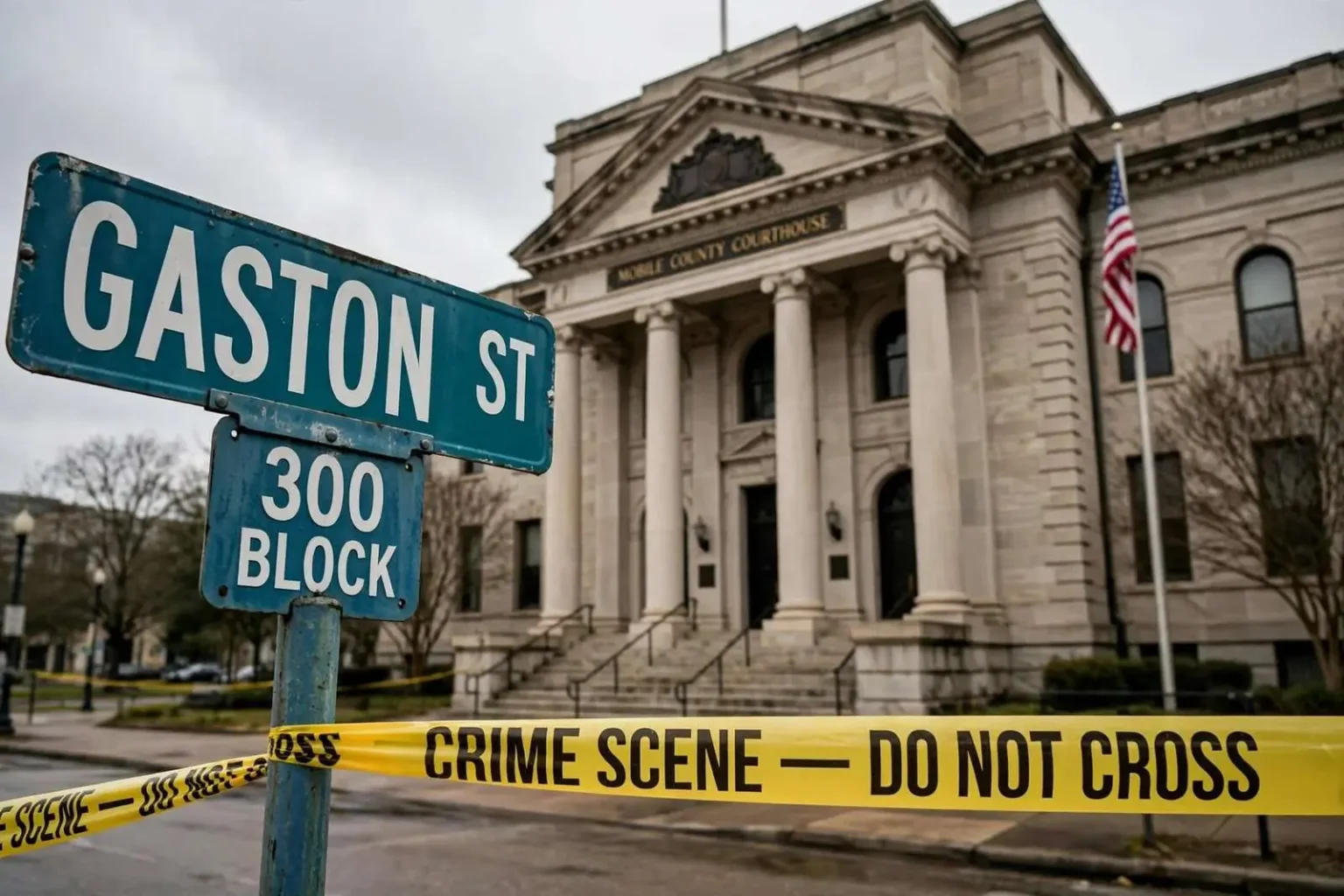
The stabbing took place in June in the 300 block of Gaston Street. The victim, Reginald Allen, later died from his injuries, turning what began as a report of an assault into a homicide investigation. James Marshall has been identified as the suspect in the case, and the proceedings that followed have moved through the earliest stages of the court system since.
With the judge’s ruling that probable cause exists, the decision on whether Marshall will face formal murder charges now rests with a grand jury. The panel will review the evidence gathered by investigators and prosecutors to decide whether an indictment is warranted, the step that formally charges a defendant with a felony in Alabama and moves the case toward circuit court.
How a Preliminary Hearing Works
A preliminary hearing like the one held in this case is a routine early step in Alabama’s criminal justice process for serious felony charges. Prosecutors are required to show a judge there is probable cause to believe a crime occurred and that the accused is connected to it before the case can advance. Witnesses, often including the investigators who worked the case, testify under oath, and defense attorneys have the chance to question them and test the state’s showing.
That threshold is lower than the standard needed for a conviction at trial. Probable cause asks whether a reasonable person would believe the defendant probably committed the offense, not whether guilt has been proven beyond a reasonable doubt. The ruling is not a determination of guilt but simply a signal that the case has enough weight to proceed, which is why defendants are frequently bound over to the grand jury even in cases that later end differently.
For the defense, the hearing offers the first real look at the evidence, since discovery in criminal cases is limited at this stage. Testimony given at a preliminary hearing can be used to challenge witness accounts later, and defense lawyers sometimes use the session to pin down stories while memories are fresh. For prosecutors, the hearing is a rehearsal of sorts, revealing which witnesses hold up and which parts of the case need more work before the grand jury presentation.
It will now be up to the Mobile County grand jury to decide whether to indict Marshall in connection with Allen’s death. Grand jury proceedings are closed to the public, and it is not yet clear when the panel will take up the case. The secrecy is by design: witnesses can speak freely, defendants cannot mount a defense in the room and the deliberations remain protected so that the panel’s judgment is not shaped by publicity.
The Grand Jury’s Role
In Alabama, a grand jury is drawn from the same pool of residents who serve on trial juries, but its work is entirely different. There is no judge presiding over the proceedings, no defense attorney present and no cross-examination. A prosecutor presents the evidence, calls witnesses and answers the panel’s questions, then leaves the jurors to decide among themselves whether probable cause exists to indict.
The grand jury’s options extend beyond a simple yes or no. The panel can indict on the charge presented, return a lesser charge if the evidence supports one, or decline to indict at all, a decision known as a no-bill. The panel also has the authority to investigate matters beyond the specific case brought before it, though in a routine homicide referral its work is usually confined to the evidence prosecutors present.
Because the proceedings are secret, neither the outcome nor the timing is announced until the indictment is returned or the term of the grand jury ends without action. In Mobile County, grand juries convene on a regular schedule and hear batches of felony cases, so a case bound over from district court typically waits for the next available panel. Once an indictment is returned, the case transfers to Mobile County Circuit Court, where arraignment, motions and eventually trial follow on the felony docket.
The gap between a preliminary hearing and a grand jury presentation is where most investigative work in a homicide case continues. Detectives finalize lab reports, gather medical examiner findings and reconcile witness statements, and prosecutors assemble the file into the presentation the grand jury will hear. Waiting periods of weeks or months are common, and families of victims often describe the interval as the hardest stretch of a case’s early stages.
The Case So Far
Authorities have not released additional details about what led to the confrontation on Gaston Street or Marshall’s relationship, if any, to Allen. The 300 block of Gaston Street sits in a residential section of the city, and the June stabbing drew the response of Mobile police homicide investigators, whose work has remained largely out of public view since the initial reports.
The reserve surrounding the case’s details is typical of prosecutions heading toward a grand jury. Investigators hold back witness accounts, motive theories and forensic findings to protect the integrity of the panel’s presentation, and prosecutors generally decline to discuss evidence outside the courtroom. The public record at this stage consists mainly of the charge under consideration, the identity of the accused and the procedural rulings that move the case forward.
For Allen’s family, the probable cause ruling is a milestone but not a resolution. Homicide cases in Alabama commonly take a year or more from arrest to trial once they reach circuit court, moving through arraignment, motion practice, competency and bond hearings, and the scheduling pressures of a crowded docket. Each stage offers the defense another opportunity to test the state’s evidence, and many cases end in plea agreements long before jurors are seated.
If the grand jury returns an indictment for murder, Marshall would face the charge in circuit court, where the potential penalties are the most serious Alabama law allows short of capital punishment in qualifying cases. Murder in Alabama carries a sentence of twenty years to life, with harsher ranges available when a firearm or prior felonies are involved, though the specific sentencing exposure in this case would depend on the charge as indicted and the circumstances prosecutors present.
The Gaston Street case follows the path every Alabama homicide takes in miniature: a death, an arrest, a preliminary hearing in district court, a bound-over file, a secret grand jury session and, if the panel agrees, a public trial in circuit court. Each step narrows the questions the justice system answers, from whether a crime occurred, to whether this defendant probably committed it, to whether guilt can be proven beyond a reasonable doubt.
For now, the file sits between stages, and the next public development will come when the grand jury acts. Grand jury proceedings are closed, and results are announced only when an indictment is filed or a term ends without one, leaving the courthouse docket and the clerk’s records as the only reliable indicators of where the case stands day to day.
This account reflects the case’s status as of the judge’s ruling. The story will be updated as the case moves through the Mobile County court system.
Alabama’s Two-Tier Felony Process
Alabama is one of the states that retains both a preliminary hearing and grand jury review for most felony cases, a double screening that dates to the state’s earliest courts. The district court stage exists to weed out cases with no evidentiary foundation before they consume grand jury time, while the grand jury exists as a citizen check on prosecution itself. A case must clear both gates before a defendant ever stands trial, and most felony prosecutions in Mobile County do exactly that.
Bond issues typically surface at this same stage of a murder case. District judges in Mobile County set or revisit bond after preliminary hearings, and in murder cases the amounts tend to be substantial, reflecting the gravity of the charge and the potential sentence. Defense attorneys can challenge the amount or seek a reduction, and those arguments play out in written motions and short hearings while the case waits for the grand jury.
The medical examiner’s findings form the backbone of most Alabama homicide prosecutions once a victim dies of his injuries. In a case like Allen’s, where a stabbing victim survived long enough to receive treatment before dying, investigators document the cause and manner of death through autopsy, and that report becomes central evidence at the grand jury stage. The interval between a fatal assault and the victim’s death also requires prosecutors to establish the chain of events connecting the attack to the fatal outcome.
June stabbings in residential neighborhoods like the 300 block of Gaston Street tend to produce dozens of potential witnesses, from neighbors who heard the disturbance to passersby who saw parts of the confrontation. Sorting those accounts is the unglamorous work that precedes a preliminary hearing, and the inconsistencies that surface, on timelines, descriptions and sequences of events, often shape which witnesses prosecutors ultimately present and in what order.
The grand jury itself operates on a term system in Mobile County, with a new panel convened periodically to hear the accumulated felony cases bound over from district court. Prosecutors schedule presentations based on the readiness of each file, and a case like this one competes with every other homicide referral for the panel’s time. The result is a schedule no one can predict precisely from the outside, which is why coverage of cases at this stage so often ends with the same phrase: it is not yet clear when the panel will take up the case.
When the grand jury does act, the file will move into the open again. An indictment returns the case name to the circuit court docket, where filings become public, hearings appear on the schedule and the next phase, arraignment and eventual trial preparation, proceeds in the ordinary course.