University of South Alabama Mobile
Juilliard-Trained Trumpet Virtuoso Joey Pero to Perform at USA’s Laidlaw Center
Juilliard-trained trumpet virtuoso Joey Pero performs at USA's Laidlaw Performing Arts Center Sept. 29, plus campus clinics for area music students.
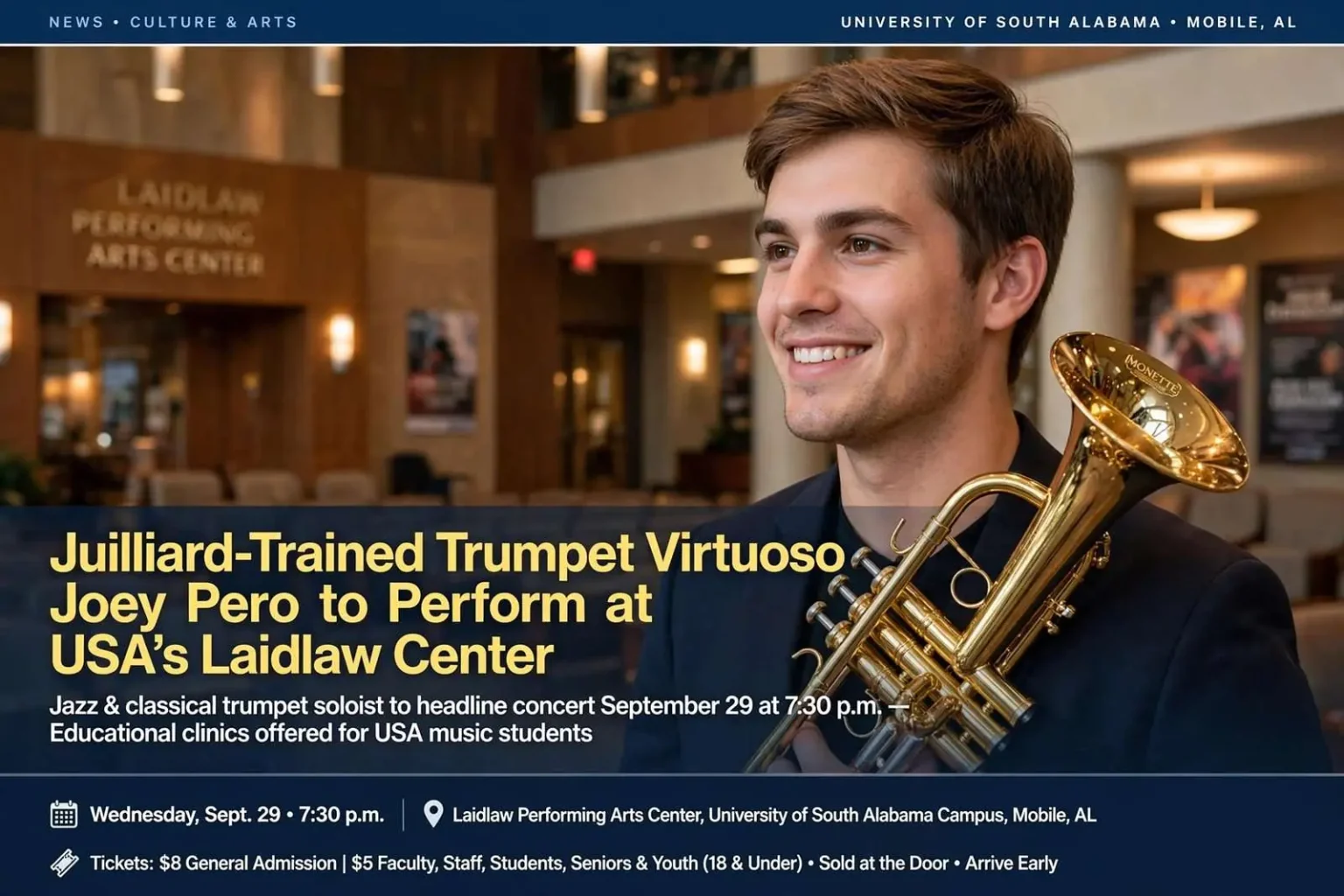
Trumpet player Joey Pero, a 28-year-old Juilliard School alumnus who has toured and studied alongside some of jazz’s most recognized names, will give a concert at the University of South Alabama’s Laidlaw Performing Arts Center on Wednesday, September 29, at 7:30 p.m. The engagement brings to Mobile a player whose resume reads like a tour through the upper reaches of American brass playing — conservatory training in New York and Boston, mentorship from the most famous trumpeter of his era, and a stint on the road with one of jazz history’s great big-band leaders, all before an age when many musicians are still finding their voice.
Pero, a New England Conservatory graduate as well, built his early career under the mentorship of trumpet great Wynton Marsalis, who gave him a 24-carat-gold Monette trumpet, along with Boston Symphony Orchestra trumpeter Charles Schlueter and American Brass Quintet member Ray Mase. The trio of mentors spans the full breadth of the modern trumpet world. Marsalis, the artistic director of Jazz at Lincoln Center and the only artist to win Grammy Awards in both jazz and classical categories in the same year, represents the pinnacle of the jazz tradition. Schlueter spent decades in the principal trumpet chair of one of America’s premier orchestras, embodying the orchestral discipline of the instrument. Mase, a longtime faculty figure and chamber musician, anchors the brass quintet tradition. Training under all three gave Pero credentials in both worlds — the improviser’s ear and the classical player’s technique — and the gold-plated Monette instrument that passed from Marsalis to the young trumpeter became a signature part of his story.
From big bands to a genre-blending sound
In 2005 he toured with big-band leader Maynard Ferguson, one of the most influential jazz trumpeters of the 20th century. Ferguson, famous for his stratospheric upper register and for decades of touring bands that served as a finishing school for gifted young players, gave Pero a professional apprenticeship that conservatories cannot replicate: night after night of big-band charts, road travel and the demands of playing at full volume for audiences across the country. Ferguson’s bands launched generations of leading trumpet players, and Pero’s place in that lineage marked him early as a player to watch.
Pero’s debut recording, “Resonance,” and its accompanying live show have drawn attention from critics and fellow musicians for blending jazz with other genres. Reviewers, including a write-up on AllAboutJazz.com, have pointed to his technical range and energetic stage presence as hallmarks of his performances. Rather than presenting himself strictly as a straight-ahead jazz player or a classical soloist, Pero has built a program that moves between idioms — the virtuosity of the conservatory, the swing and improvisation of jazz, and the pop and rock influences that shaped a player of his generation. That range is precisely what the Laidlaw audience can expect when the lights go down.
Marsalis, singer Freddy Cole and jazz vocalist Phoebe Snow have each praised Pero’s work, with Snow saying he is developing “an entirely new style of music and musicianship” that appeals to listeners of all ages. The praise from three such different corners of the music world — the jazz establishment’s most prominent trumpeter, the late Freddy Cole carrying the vocal legacy of the Cole family, and Phoebe Snow, whose soulful voice topped the pop charts in the 1970s — speaks to the breadth of Pero’s appeal. Snow’s description of a new style in the making captures the ambition behind “Resonance”: not a greatest-hits recital, but an attempt to push the trumpet into territory the instrument rarely visits.
The venue: Laidlaw Performing Arts Center
The Laidlaw Performing Arts Center has become the centerpiece of the University of South Alabama’s musical life since opening on the Mobile campus. Built for the university’s music department, the facility pairs a concert hall with rehearsal spaces, studios and classrooms, and it hosts a steady calendar of student recitals, faculty showcases, guest artist concerts and ensemble performances throughout the academic year. Its acoustics were designed with unamplified performance in mind, which makes it a natural room for a brass soloist — the trumpet’s dynamic range, from a whisper-soft mute to a full-voiced fanfare, plays to the back row without electronic assistance.
For University of South Alabama students, concerts like this one put a working professional’s career on display a short walk from the practice rooms. The music department has long used the guest-artist series to connect its students with performers whose paths run through New York, Boston and the international touring circuit, giving south Alabama audiences a calibre of programming more typical of a major city.
Education on and off the stage
Beyond the Wednesday night concert, Pero will lead educational clinics for USA music students during his visit to campus. Those sessions matter as much as the concert itself in the economy of a guest-artist residency. Trumpet students get the chance to play for a musician trained at Juilliard and the New England Conservatory, ask about the road that runs from conservatory to career, and hear firsthand what the demands of touring with a big band or sustaining a solo career actually look like. Clinic formats of this kind typically pair performance and conversation, with the visiting artist coaching soloists or sections and answering questions about technique, repertoire and the business of music.
Those interested in clinic times and locations can contact Dr. Peter Wood at the University of South Alabama at 251-460-7821. Wood, a member of the university’s music faculty, coordinates the guest artist appearances that bring players of Pero’s profile to campus, and the clinics are generally open to music students and, in some cases, to area band directors and advanced high school players — a pathway through which the university’s residency feeds the broader Mobile-area music community.
The visit also fits a pattern for the Laidlaw center’s September calendar, which tends to open the academic year with a mix of departmental ensembles and visiting soloists. A trumpet concert in that slot draws not only the university community but the region’s brass players — school band directors, church musicians, military-band players from the Gulf Coast’s installations and the amateur players who turn out whenever a horn of this caliber comes to town.
The road behind him
Pero’s path to the concert stage began, as it does for most brass players, in school bands, but it accelerated quickly once his talent placed him in front of the right teachers. Admission to the Juilliard School in New York — among the most selective music programs in the world — put him inside a conservatory whose brass alumni fill the principal chairs of major orchestras and the leading jazz ensembles, and his subsequent graduate work at the New England Conservatory in Boston kept him at the center of American music education. Along the way he collected the kind of mentors most young trumpeters only read about, and each left a distinct imprint: the classical precision of Schlueter’s Boston Symphony lineage, the chamber-music craft of Mase’s quintet work, and the improvisational daring that defines everything Marsalis touches.
By the time he recorded “Resonance,” Pero had absorbed all three traditions and begun bending them toward something personal. Critics reviewing the album and its live presentation have described a performer equally comfortable burning through a bebop line, shaping a lyrical ballad, or driving a groove that owes as much to rock and funk as to jazz. For Mobile audiences, that unpredictability is the draw — this is not a recital built around a single repertoire, but a showcase for a player who has spent his career refusing to be filed under one category.
Ticket information
Tickets for the Laidlaw Performing Arts Center concert will be sold at the door only. General admission is $8, while USA faculty, staff and students, along with youths under 18 and senior citizens, can attend for $5. The pricing follows the university’s standard guest-artist model, which keeps the door price low enough to fill the hall with students and families while supporting the department’s visiting-artist fund.
Because tickets are not sold in advance, concertgoers are advised to arrive early; popular guest-artist nights at Laidlaw can fill seats quickly, and the hall’s general-admission seating rewards an early arrival. The 7:30 p.m. Wednesday start time makes the concert an easy after-work outing for downtown Mobile and west Mobile audiences alike, with the campus venue accessible from the university’s main entrances along USA Drive South.
For a $8 ticket, the evening offers a rare package: a Juilliard-trained trumpeter carrying a gold Monette horn handed down from Wynton Marsalis, a debut album that critics have flagged for its genre-crossing ambition, and the stage presence that carried him through tours with Maynard Ferguson — all in one of Mobile’s finest concert rooms. For students, the daytime clinics extend the visit from a single evening into a working residency. Either way, September 29 marks one of the more distinctive stops on the Laidlaw calendar this season.