Killen man arrested after multi-vehicle hit-and-run on U.S. 98 in Okaloosa County
Florida Highway Patrol says a 33-year-old Killen, Alabama man fled the scene after a multi-vehicle hit-and-run on U.S.
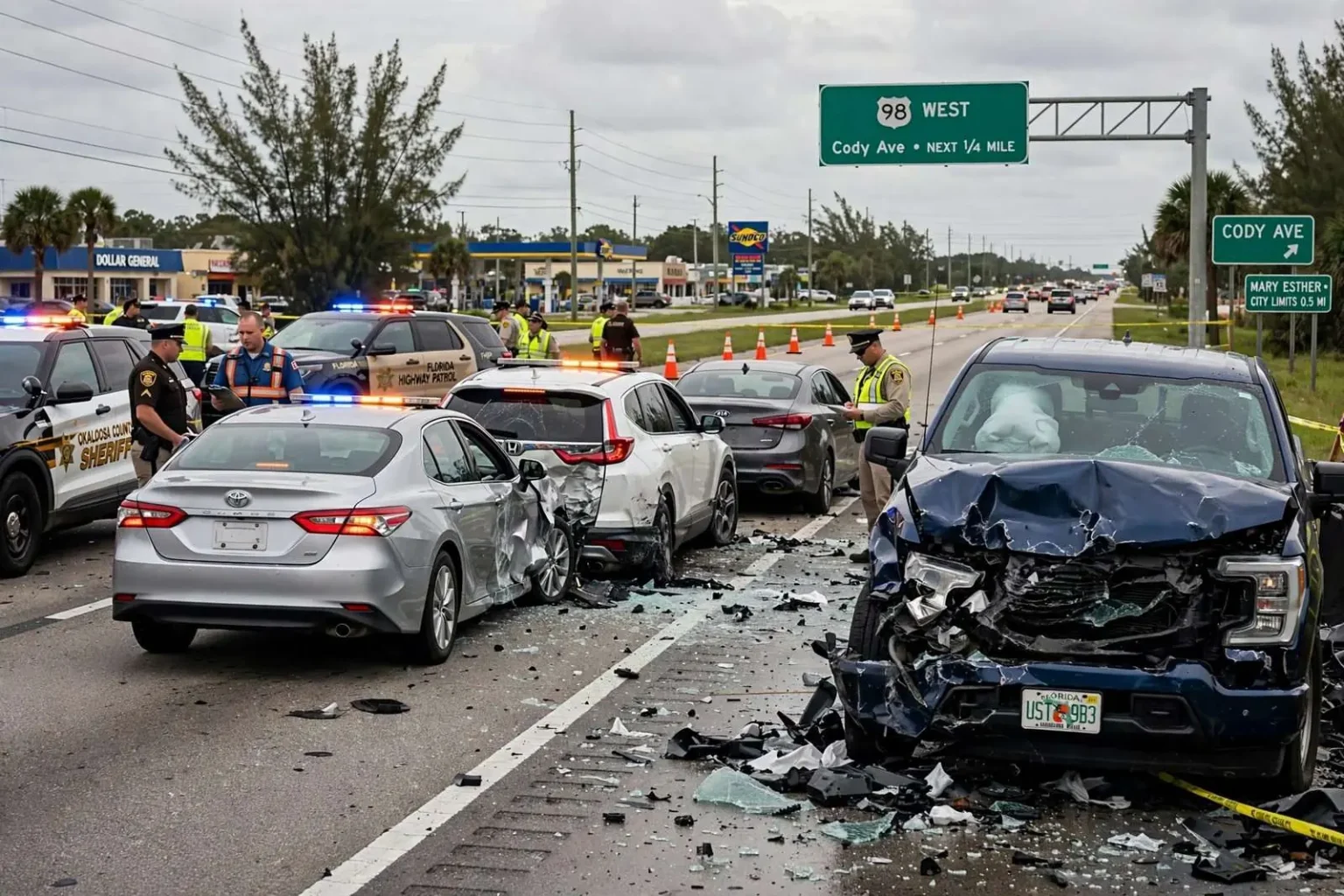
A 33-year-old Killen, Alabama, man is facing charges after a multi-vehicle crash on U.S. 98 in Okaloosa County, Florida, that investigators say he fled on foot before deputies caught up with him. According to the Florida Highway Patrol, Bryan Smith was driving a pickup truck westbound on U.S. 98 near Cody Avenue on a Wednesday afternoon when the vehicle drifted back and forth between the left and right lanes and struck three other vehicles.
Troopers said the trouble for Smith did not begin on the Okaloosa County stretch of the highway. Before the U.S. 98 collision, investigators said, Smith had also been linked to an earlier hit-and-run within the Mary Esther city limits, a small community just west of the crash scene along the same coastal corridor. By the time the wreck near Cody Avenue brought traffic to a halt, authorities were looking for a driver who had already left one scene without stopping.
Deputies with the Okaloosa County Sheriff’s Office took Smith into custody as he allegedly attempted to take another vehicle in order to leave the area. Authorities said his behavior in the moments after the crashes led them to believe he was under the influence of alcohol or drugs at the time, though the specific substances and the results of any testing were not immediately detailed in the initial reports.
A dangerous stretch of highway along the Emerald Coast
The crash occurred on U.S. Highway 98, the main east-west artery that hugs the Gulf Coast through the Florida Panhandle. In Okaloosa County, the highway threads through some of the region’s busiest commercial corridors, connecting Mary Esther, Fort Walton Beach, and the communities that line the road toward Destin. Near Cody Avenue, west of the heart of Fort Walton Beach, the roadway carries a steady mix of local commuters, tourists headed to the beaches, and commercial traffic, and drivers routinely contend with numerous curb cuts, intersections, and turning movements packed closely together.
Traffic engineers have long identified stretches of U.S. 98 in Okaloosa County as areas of concern because of the volume of driveways and side streets that feed into the highway. When a vehicle wanders between lanes on a road like that, the chances of striking another car are high, which is precisely what investigators said happened in this case. The three vehicles Smith’s truck struck were all traveling on the same highway, and the westbound lanes near Cody Avenue were disrupted while troopers documented the scene and worked the investigation.
The involvement of both the Florida Highway Patrol and the Okaloosa County Sheriff’s Office reflects how these cases typically unfold. The patrol handles crash reconstruction and traffic charges on state highways like U.S. 98, while the sheriff’s office has jurisdiction over unincorporated parts of the county and assisted in taking the driver into custody. When a suspect flees a scene, crosses a municipal boundary, and is then caught by a different agency, coordination between the agencies becomes a central part of building the case.
From Killen to the coast
Smith’s hometown of Killen sits in Lauderdale County in northwestern Alabama, a small town in the Shoals area near Florence and the Tennessee River. The distance from Killen to the Okaloosa County coast is roughly 250 miles, a drive that many North Alabamians make regularly for Gulf Coast vacations, particularly in the late summer weeks when beach season is still in full swing. Northwest Alabama residents are a familiar sight along the U.S. 98 corridor and the routes that feed it, and the region’s ties to the Emerald Coast run deep, with entire communities along the Panhandle counting Alabama visitors among their most frequent guests.
That connection is also what makes cases like this one resonate back home. A driver from the Shoals area facing charges hundreds of miles away will generally have to answer to them in Florida’s court system, where the alleged offenses occurred, rather than in an Alabama courtroom. Out-of-state defendants in Florida traffic and DUI cases typically face the same arrest, booking, and bond process as residents, with the practical burdens of returning for court appearances added on top.
What the charges can involve
Under Florida law, leaving the scene of a crash involving injury is a serious offense, and penalties escalate sharply when the crash involves damage to another vehicle, injury to another person, or evidence of impairment. A driver involved in a crash is legally required to remain at the scene, provide information, and render aid when it is needed. Fleeing on foot or attempting to commandeer another vehicle to escape, as deputies alleged in this case, tends to compound the legal exposure rather than reduce it.
Investigators’ indication that Smith appeared to be under the influence points to the likelihood of driving-under-the-influence charges as well. In Florida, as in Alabama, a first DUI conviction can bring fines, license revocation, probation, and possible jail time, and those penalties increase when a DUI involves a crash with injuries or a pattern of dangerous driving. The allegation that Smith was linked to an earlier hit-and-run in Mary Esther before the U.S. 98 wreck could also shape how prosecutors approach the case, since a series of related incidents involving the same driver is typically charged and negotiated differently than a single isolated crash.
Troopers and deputies did not release the full list of charges in the hours after the arrest, and details such as bond amounts and court dates were expected to be filed with the Okaloosa County court system as the case moved forward. The conditions of the three drivers whose vehicles were struck, and the extent of any injuries, were also not fully detailed in the initial account of the wreck.
Hit-and-run cases on the Panhandle’s coastal highways
The stretch of U.S. 98 between the Okaloosa County line and Destin has seen more than its share of serious crashes over the years, and hit-and-run collisions have been a recurring problem for agencies along the corridor. The road’s combination of heavy seasonal traffic, dense commercial development, and high speeds makes it unforgiving for drivers who lose control, and it gives a fleeing driver many opportunities to turn off and disappear into side streets and parking lots. In this case, investigators said, the driver’s attempt to leave appears to have been cut short by deputies who reached him as he tried to take another vehicle.
Law enforcement agencies in Florida have emphasized in recent years that witnesses who report erratic drivers quickly can make the difference in cases like this one. When motorists call in a vehicle that is drifting between lanes, dispatchers can push the description to patrol units in the area, and those earlier reports often become the foundation for DUI evidence even after the driver leaves the original crash scene. The account that Smith’s truck had been drifting between the left and right lanes before the collision is the kind of observation that typically comes from both witnesses at the scene and the troopers who reconstruct the crash from physical evidence such as lane positions, points of impact, and the final resting places of the vehicles.
Mary Esther, the small city where the earlier hit-and-run was reported, covers only a couple of square miles along U.S. 98 between Hurlburt Field and Fort Walton Beach, and its police department handles a disproportionately high volume of traffic calls for a community of its size because of the highway’s steady flow. A hit-and-run reported inside the city limits followed by a multi-vehicle crash a short distance away on the same highway is the kind of sequence that allows investigators to quickly piece together a driver’s path, and it appears that is what happened here, with troopers and deputies linking the two incidents to the same man from Killen.
The toll of impaired and fleeing drivers
State and federal crash data have consistently shown that driver impairment and hit-and-run behavior overlap to a striking degree. Studies of national crash records have found that a large share of hit-and-run drivers in fatal and injury crashes show signs of alcohol or drug involvement, a pattern that holds true in Florida and Alabama alike. A driver who is impaired has an obvious incentive to flee, because remaining at the scene means facing the DUI investigation that would otherwise follow, even though fleeing almost always makes the legal situation worse.
That dynamic was on display, in the view of investigators, in the Okaloosa County case. Authorities said Smith’s behavior after the crashes led them to believe he was under the influence, and his alleged attempt to take another vehicle to get away suggested to them a driver more focused on escape than on the people affected by the wreck. For the occupants of the three vehicles that were struck, a crash that begins with another driver drifting between lanes leaves little room to react, which is one reason multi-vehicle collisions on congested highways so often produce chains of damage and injury that extend well beyond the initial impact.
Emergency response to crashes on this part of U.S. 98 is generally fast because of the density of fire stations and medical units along the corridor, with agencies from Fort Walton Beach, Mary Esther, and Okaloosa County all positioned close to the highway. The 911 calls that follow a multi-vehicle wreck typically bring law enforcement, fire, and ambulance crews at once, and the roadway is usually cleared and reopened within a few hours once troopers complete their documentation.
What happens next in the case
Smith was expected to be processed through the Okaloosa County jail system following his arrest, with formal charges laid out in documents filed by the Florida Highway Patrol and the State Attorney’s Office for the First Judicial Circuit, which covers Okaloosa, Santa Rosa, Escambia, and Walton counties. Prosecutors in that circuit routinely handle cases that combine DUI allegations with hit-and-run charges, and the decisions about how to charge the case will depend on the troopers’ crash reconstruction, any impairment evidence that was gathered, and the outcome of the investigation into the earlier Mary Esther incident.
For the residents of Killen and the wider Shoals community, the case is a reminder of how quickly a trip to the coast can turn into a legal and personal crisis. Northwest Alabama news outlets have covered a steady stream of cases in which local residents face serious charges along the Gulf Coast highway corridors, and defense attorneys in both states routinely note that out-of-county and out-of-state defendants often underestimate the complexity of facing charges far from home, where every court appearance requires travel and where local counsel is essential.
The Florida Highway Patrol’s investigation remained active, and troopers asked anyone who witnessed the drifting truck before the collision or the events in Mary Esther to come forward, since witness accounts from the earlier period of a driver’s route often become important evidence in both the hit-and-run and DUI portions of a case. As is standard practice, the specific charges Smith ultimately faces will be set out in court filings, and any determination of guilt will rest with the courts rather than with the initial accounts given at the scene.