
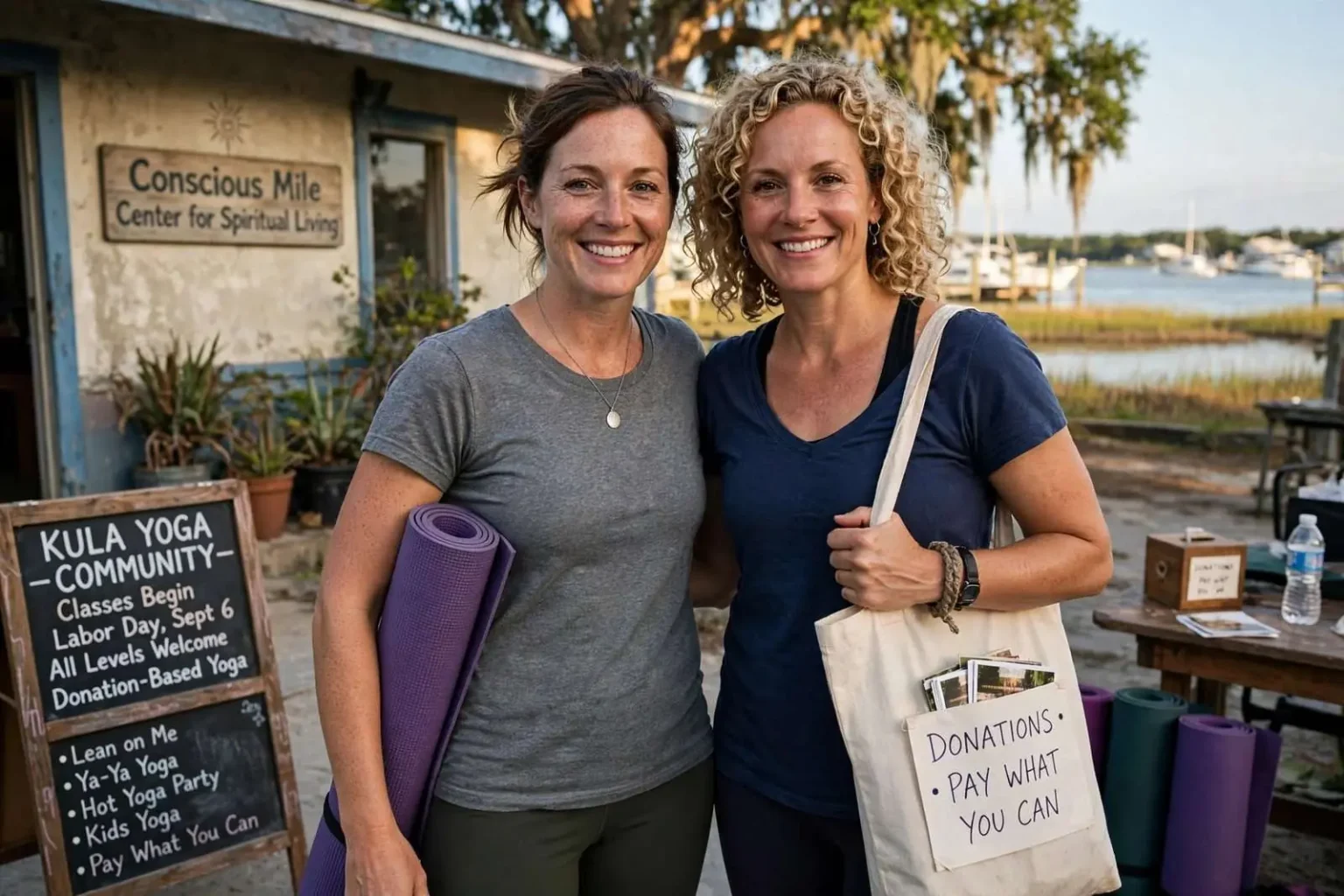
Riding the wave of interest generated by the movie Eat, Pray, Love, a new yoga venture launched across Mobile Bay in late summer 2010: Kula Yoga Community, with its first class schedule beginning Labor Day, September 6.
The timing was no accident. Elizabeth Gilbert’s memoir had spent years on bestseller lists, and the film adaptation that summer put yoga, meditation, and self-discovery in front of millions of moviegoers who had never set foot on a mat. Yoga studios across the country reported surges of newcomers that season, and on the Gulf Coast the trend found room to grow. Into that moment stepped two local teachers with a model designed to remove the biggest barrier between curious beginners and their first class: the price of admission.
Pay What You Can
Co-founders and teachers Amanda Brenner and Dana Goudie modeled their approach on Power Yoga teacher Bryan Kest’s popular California studios: tuition was entirely donation-based. Typical area classes cost ten to fifteen dollars, Goudie noted, and cost was one of the obstacles keeping people off the mat — so Kula removed it.
The donation-based model flips the usual economics of a fitness studio. Instead of a fixed drop-in fee or a monthly contract, students pay what they can afford, from nothing on a tight week to whatever a comfortable class feels worth. Kest’s Santa Monica studios, among the most influential in the American yoga world, built their reputation on exactly that principle, arguing that yoga should never be a luxury good. Importing the model to the Gulf Coast put Kula in the position of testing whether a community accustomed to per-class fees would support a studio on trust alone.
The economics are more forgiving than they first appear. Studios running on donations often see committed regulars give more than the going rate, offsetting students who pay little or nothing. The model also draws a wider crowd: teenagers, retirees on fixed incomes, parents stretching a household budget, and skeptics who would never pay fifteen dollars to try something they might not like. Every one of those newcomers is a potential convert, and a studio that removes the price barrier is betting that volume and loyalty will carry it.
The name comes from the Sanskrit word for community, and the mission followed suit: creating and supporting a community of yoga students linked by the desire for healthy bodies, mental clarity and spiritual well-being, embracing many styles of yoga as equally transformative.
Unconventional Classes, Two Locations
The schedule leaned fun and approachable, with offerings like Lean on Me, Ya-Ya Yoga and Hot Yoga Party — plus classes for kids. Brenner promised there was a class for everyone.
The playful class names were a deliberate signal. Yoga’s rapid growth in the United States had produced a culture that could feel intimidating to outsiders — studios full of flexible regulars, Sanskrit terminology, and $100 mats. By branding sessions with names like Hot Yoga Party, Kula advertised itself as a place where a first-timer could arrive without experience, special clothing, or any particular belief system and simply take part. Classes for children extended that welcome to whole families, an uncommon offering in an era when most studios served adults exclusively.
The two-location setup spread that welcome across Mobile Bay. Classes were held at Conscious Mile Center for Spiritual Living in Mobile and Eastern Shore Dance Academy in Daphne, giving the donation-based model a foothold on both sides of the bay.
Using borrowed space rather than building out a dedicated studio keeps overhead low enough for donations to sustain the operation. The Mobile venue tied the young venture to an existing spiritual community, a natural fit for practice that blends physical exercise with contemplation. The Daphne location, hosted at a dance academy on the Eastern Shore, put a class schedule within reach of Baldwin County residents who otherwise faced the bridge — and the psychological boundary — of crossing the bay for fitness. For years, Eastern Shore residents had driven into Mobile for many cultural offerings; a yoga presence in Daphne acknowledged how much that was changing as Baldwin County grew.
Yoga’s Moment on the Gulf Coast
Kula’s launch came as yoga’s American boom reached communities far from the coastal capitals where it first took hold. What had been a niche practice in the 1990s had become a mainstream fitness and wellness pursuit by the late 2000s, with studios in mid-sized cities across the South and yoga classes appearing in gyms, churches, and community centers. Mobile and the Eastern Shore were part of that spread, with local teachers building followings through gyms and word of mouth before dedicated spaces multiplied.
The Eat, Pray, Love effect gave the trend a cultural push. The story of a woman rebuilding her life through yoga and travel resonated far beyond regular moviegoers, and studio owners nationwide noticed the difference: more men in class, more complete beginners, more people asking not about flexibility but about stress relief and balance. A donation-based studio was positioned to catch precisely that wave of curious newcomers, since the model asks nothing of a first visit except showing up.
The community framing also matched where yoga culture was heading. Practitioners increasingly spoke of studios as their “kula” — their tribe — and of the practice as a social anchor as much as a workout. In a region where churches, leagues, and school communities do much of the connecting, a yoga venture built explicitly around community rather than fitness image offered something the national chains and gym classes could not.
What the Classes Looked Like
The variety in the schedule served both the curious and the committed. A class like Ya-Ya Yoga suggested a women’s social session, the kind of offering that turns a fitness class into a standing appointment among friends. Hot Yoga Party promised the sweat and intensity that made heated practice a national phenomenon, wrapped in a tone that emphasized fun over discipline. Lean on Me hinted at partner or support-focused practice. Kid-friendly classes, meanwhile, addressed a growing awareness among parents that children carry stress too, and that movement-based mindfulness helps with focus and behavior as much as with fitness.
Brenner’s promise that there was a class for everyone was the practical corollary of the donation model. A studio that welcomes anyone regardless of income cannot afford to turn away anyone by difficulty level either; a beginner scared off by a power-flow session has no reason to return. The mix of gentle, social, hot, and kids’ classes gave newcomers an entry point matched to their comfort, and gave experienced practitioners reasons to keep showing up.
Starting the schedule on Labor Day weekend added a symbolic touch. The holiday marks the traditional end of summer, after schools have resumed and vacation routines give way to fall schedules — exactly when people look for new commitments. Launching then meant catching residents as they reorganized their weeks, and it let Kula ride the residual attention from the summer’s yoga moment straight into the fall.
A Test of Generosity Across the Bay
The venture’s fate rested on a question bigger than any one studio: would Mobile and Daphne support a business built entirely on goodwill? Communities that have sustained donation-based yoga tend to share certain traits — dense social networks, an existing wellness culture, and teachers who stay long enough for trust to compound. The founders’ decision to open two locations at once was an ambitious version of that bet, spreading risk but also spreading the community they hoped to build.
Whatever the ledger showed, the model’s local effect was immediate. Residents who had priced themselves out of studio yoga had a door with no cover charge, and the notion that yoga could be a civic offering rather than a consumer product took root in midtown Mobile and on the Eastern Shore in the same season. In a region where fitness often comes bundled with membership contracts and initiation fees, a studio that trusted its students to pay what they could was itself a statement — one the Sanskrit name said plainly. A kula is not a customer list. It is a community, and Kula Yoga Community opened its doors on Labor Day weekend to see how many people across Mobile Bay were ready to join one.
The Teachers Behind the Mat
Community yoga studios rise or fall on their teachers, and the co-founders’ shared classroom experience shaped what students encountered from the first week. Both Brenner and Goudie taught the schedule themselves rather than staffing it with hired instructors, which meant the founding philosophy was delivered directly in every session. Students asking about poses, philosophy, or the donation basket got the same answer from the same people who had designed the model, a closeness that dedicated chains cannot replicate.
The borrowing of Kest’s Power Yoga approach also connected Mobile to a recognizable national lineage. Kest had popularized the idea that asana practice could be athletic and accessible at once, and his studios’ pay-what-you-can policy became a template copied by independent teachers around the country. For Gulf Coast students, that meant the classes on Carlen Street’s spiritual center and the Daphne dance academy floor carried the DNA of one of American yoga’s most influential scenes, translated for a community discovering the practice in real time.
For residents on both sides of the bay, the launch offered a low-stakes way into a practice they had heard about for years, taught by neighbors, at a price each person set for themselves. That combination — familiar faces, welcoming schedule, no set fee — defined Kula’s pitch as its first Labor Day schedule began.


