Late Mobile Writer Eugene Walter’s Spirited Cookbook ‘The Happy Table’ Reaches Shelves
The posthumous cookbook "The Happy Table" gathers 300+ Southern spirit-inspired recipes, essays and writings from Mobile native Eugene Walter.
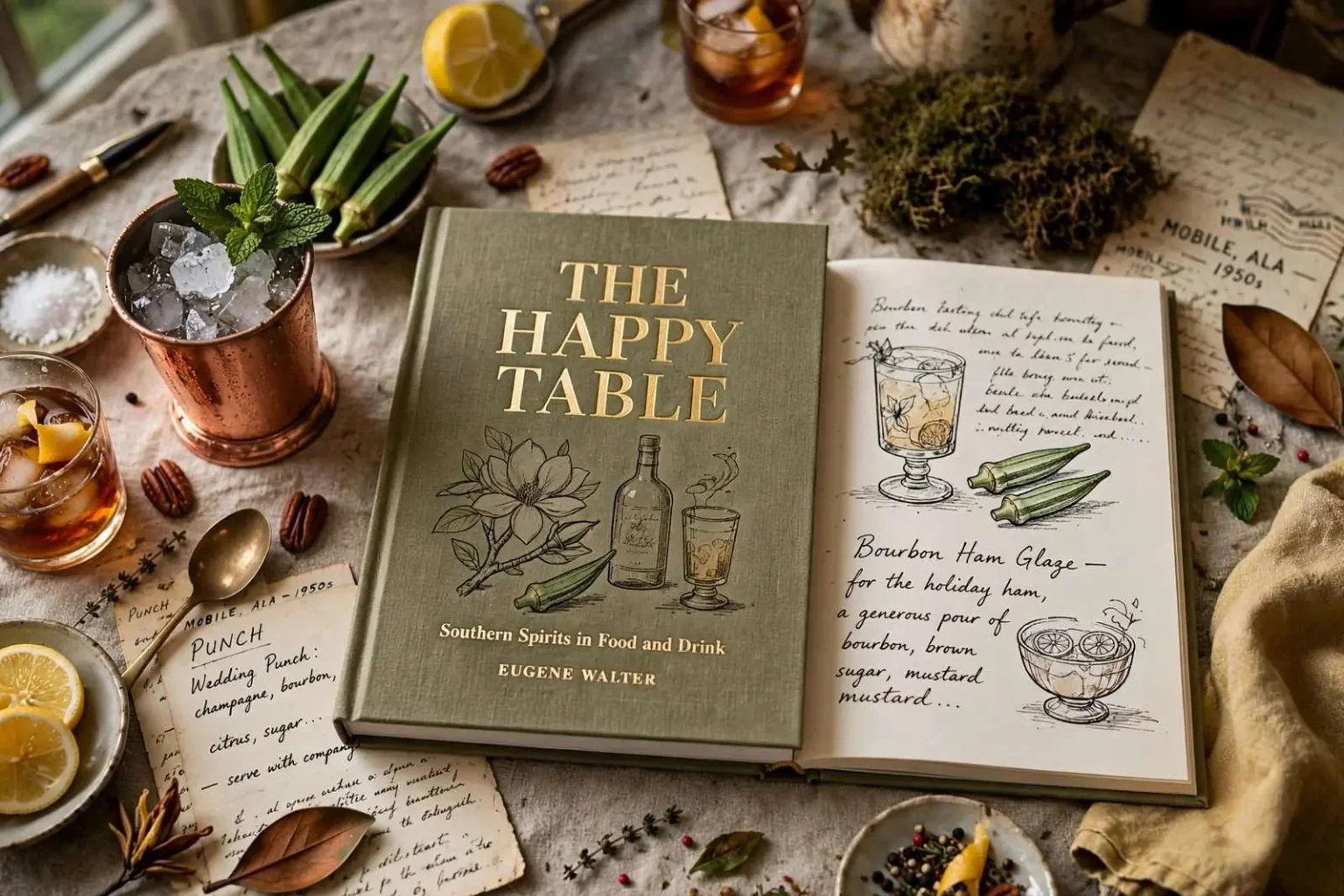
Mobile-born writer Eugene Walter (1921-1998) is back in print this season with “The Happy Table of Eugene Walter: Southern Spirits in Food and Drink,” a posthumous cookbook assembled from the author’s collection of recipes, drawings, menus and anecdotes. More than a decade after his death, one of Mobile’s most colorful literary exports is being reintroduced to readers through the kitchen — the room where, his admirers have always insisted, his writing was most at home.
The book arrives as a two-course revival of Walter’s reputation. A generation of Southern food writers has claimed him as a forebear, and his out-of-print works have traded hands among collectors who knew what casual readers did not: that the Mobile native who drifted through Paris, Rome and New York had written some of the most entertaining prose ever put to paper about Southern food and drink. “The Happy Table” gathers that voice in its most natural setting, organized around the role that bourbon, champagne and good company play at a Southern table.
The improbable life of Eugene Walter
A pioneering Southern food writer, Walter earned lasting fame with “American Cooking: Southern Style,” his volume in the Time-Life Foods of the World series, and with “The Untidy Pilgrim,” his 1954 novel set in the Mobile of an earlier day. The Time-Life volume introduced millions of American households to Southern cooking as a serious culinary tradition at a moment when the food itself was often dismissed as homely fare, and it remains a touchstone for food writers working in the region today.
Walter’s life resisted any tidy category. He was also an actor who appeared in films directed by Federico Fellini, a translator, screenwriter, poet and one of the founding editors of The Paris Review. The arc runs from Mobile — where he absorbed the foodways, folk speech and storytelling that colored everything he wrote — to Paris in the 1950s, where he helped found the storied literary magazine, to Rome, where he lived for years, acted in movies and made himself useful to a circle of artists and filmmakers that included Fellini. He eventually came home to Mobile, where he spent his final years being interviewed, cooking for friends and holding court as the city’s most beloved eccentric.
What’s in The Happy Table
The Happy Table gathers more than 300 recipes built around the role of spirits in the food and drink of the South, from bourbon and mint juleps to champagne and punch, alongside short essays, side notes and the humor that made Walter a beloved figure among food writers. The organizing idea is characteristically Walter: rather than segregating drinks into a bartending appendix, the book treats spirits as an ingredient and an institution of Southern hospitality — the julep at the Derby table, the punch bowl at the wedding, the bourbon in the ham glaze.
The manuscript material behind the book — recipes, drawings, menus and anecdotes — comes from Walter’s own collection, and the assembled volume reads less like a modern cookbook than like a conversation with a gifted, digressive host. Readers move from a recipe to a reminiscence to a sketch to a piece of advice, in the pattern of Walter’s table talk, which friends described as one of the great experiences of knowing him.
The editors who brought it together
The volume was assembled and edited by Donald Goodman, Walter’s literary executor, and Thomas Head, the former executive food and wine editor of Washingtonian magazine. Goodman, who controls the Walter estate, has spent years keeping the author’s work in print and in circulation, while Head’s editorial background in food writing gave the project the practical kitchen sense a posthumous cookbook requires — testing, ordering and organizing the work of a writer who treated recipe measurements as loose suggestions.
An Okra Pick for fall
The book has been named a Fall 2011 “Okra Pick” by the Southern Independent Booksellers Alliance, a selection highlighting notable Southern titles. The Okra Picks program spotlights books with Southern connections that independent bookstores across the region hand-sell to their customers, and the designation has become a meaningful launch for Southern authors and subjects — a sign that the region’s booksellers expect a title to move off their tables on word of mouth alone.
For a posthumous work, the bookseller endorsement carries particular weight. Independent stores are the natural habitat of a book like “The Happy Table,” which depends on readers discovering it by browsing, on staff recommendations delivered with a story attached, and on the personal connection between a regional author and the communities that remember him. Walter — a founding editor of The Paris Review who ended his days telling stories in Mobile — is exactly the kind of author the Okra Picks program exists to celebrate.
Early reception
Advance praise for the cookbook has come from across the food world, with Library Journal recommending the collection and Zagat.com listing it among top must-read fall books for food lovers. Library Journal’s recommendation matters to the library market that puts books into circulation nationwide, while the Zagat listing aimed the book at the general food-loving audience that follows the brand’s restaurant coverage.
Chef Frank Stitt of Birmingham’s Highlands Bar and Grill and authors Pat Conroy and Nathalie Dupree have also praised the volume for the portrait it captures of the South’s culinary traditions. The three endorsements represent the strongest possible triangle of Southern food and letters: Stitt, whose Birmingham restaurant helped elevate Southern cooking to national fine-dining respectability; Conroy, the beloved novelist of the Carolina coast; and Dupree, the doyenne of Southern cooking teachers whose own books taught a generation of home cooks. Each recognized in Walter’s work the same thing his readers always have — a South rendered with affection, humor and complete absence of pretense.
Mobile’s literary legacy
Walter belongs to a Mobile literary tradition that runs from the antebellum humorists through “To Kill a Mockingbird” author Harper Lee, a fellow Alabaman whose own path also passed through New York publishing. What distinguishes Walter within that tradition is the table at its center: his Mobile is a city of gumbo, wine punch and story-swapping, where the region’s complicated history expresses itself in what gets served and how. “The Untidy Pilgrim,” his 1954 novel, introduced that world to readers, and food writing let him stay there for the rest of his career.
The city has never stopped claiming him. Walter’s grave in Mobile’s historic church cemetery draws visitors who leave tokens; local writers still invoke him as the standard for wit and hospitality; and his recordings of interviews and readings remain in circulation among Gulf Coast residents who remember hearing him in person. “The Happy Table” gives that local memory a fresh reason to surface — a book to cook from, not just to read about.
A book for the holidays ahead
A fall release built around spirits and Southern hospitality lands with obvious timing. The recipes in “The Happy Table” were made for the season’s entertaining — the punches and cocktails, the hams and game, the sweets that follow — and the book’s digressive charm suits the holidays’ long evenings better than any orderly modern cookbook could. For readers who knew Walter, it is a return; for readers meeting him for the first time, it is an introduction to one of the South’s great table companions, a Mobile writer whose happy table is now open to everyone.
The Time-Life book that changed things
Walter’s “American Cooking: Southern Style” arrived in 1978 as part of the Time-Life Foods of the World series, the ambitious set that sent writers and photographers across the globe to document the world’s cuisines for American readers. The Southern volume, with Walter’s prose carrying recipes researched and tested by the series’ kitchens, treated regional cooking with the same seriousness the series gave to France and China — and it put Walter’s voice in living rooms nationwide, wrapped around dishes from burgoo to beaten biscuits.
Food writers since have traced the modern celebration of Southern cooking back, in part, to that volume. When a generation of chefs began presenting Southern food on white tablecloths in the 1990s, the intellectual scaffolding — the history, the regional distinctions, the dignity of the tradition — had been laid in books like Walter’s. His insistence that the South’s cooking deserved the same attention as any cuisine’s helped make the later revival possible, and the current book’s editors sit squarely in that lineage.
From Mobile to Paris to Rome and home
The facts of Walter’s biography read like a tall tale, which is precisely how he told them. Born in Mobile in 1921, he grew up in the city’s old neighborhoods, absorbing the dialect, the food and the graveyards that would furnish his writing. Service in World War II took him abroad; New York in the late 1940s and early 1950s put him in the room when The Paris Review was founded; Paris and then Rome kept him in Europe for nearly three decades, acting in Fellini films like “8½” and “Juliet of the Spirits,” translating, writing and hosting the dinners that made his apartments legendary.
His return to Mobile in his later years completed the circle. He cooked for friends, recorded oral histories, received visitors and gave interviews that preserved his performance style — the elaborate courtesy, the digressions, the punch lines delivered deadpan — for readers who never met him. He died in Mobile in 1998, and the posthumous publications that have followed, of which “The Happy Table” is among the most substantial, have kept his voice in print for an audience that grows rather than shrinks.
Why a cookbook suits him
Among all the genres Walter touched — poetry, fiction, memoir, translation, screenwriting — food writing was where his sensibility found its perfect form. A recipe, as he wrote it, is a story with an edible ending; a menu is a piece of social observation; a drink is an occasion for hospitality, which was for him the highest Southern art. The 300-plus recipes in “The Happy Table,” surrounded by drawings, menus and anecdotes, read as the complete expression of a writer who believed that a region reveals itself at the table more honestly than anywhere else.
That belief, applied to the Gulf Coast’s traditions — the bounty of Mobile Bay, the European inheritance of the old port city, the ceremonial drinking culture of the Deep South — is what distinguishes the book from other Southern cookbooks on the fall shelf. It is not a survey or a compendium but a portrait, drawn by the one writer positioned to capture both the kitchen and the parlor, and the praise from Stitt, Conroy and Dupree recognizes the portrait rather than the recipes alone.