
Late-Night Shooting Steps From the Police Precinct Renews Safety Debate Over LoDa’s Nightlife
A witnessed shooting steps from Mobile's police precinct renews concerns over LoDa nightlife safety, with 83 police calls to one club since 2009.
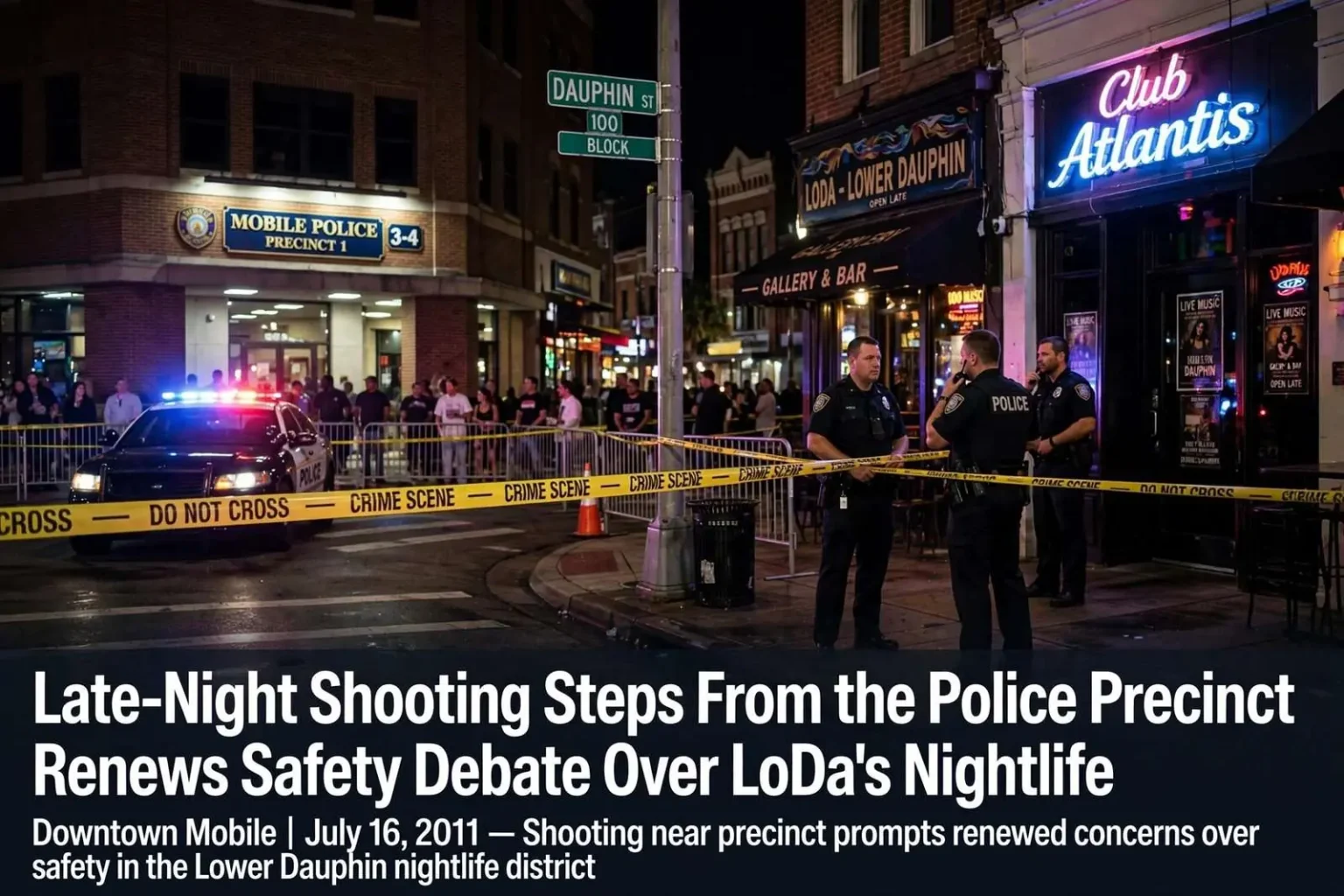
A downtown Mobile resident who watched a shooting unfold late Saturday, July 16, 2011 — one block from the police precinct, at one of the city’s most visible intersections — says gunfire sent people screaming and running through the Lower Dauphin entertainment district. Police arrived quickly and drew their weapons, according to the witness’s account, but made no arrests at the scene. The episode has become a flashpoint in the ongoing debate over how Mobile manages its most concentrated nightlife corridor after dark.
The account, published as a guest column by a downtown resident and business owner, described hours of growing street congestion before the shots rang out around midnight, then a scene the writer found more disturbing than the violence itself: bar patrons wandering through the crime-scene tape with little reaction while detectives worked. That detail — the normalization of gunfire as part of a night out — is what transformed the column from a complaint into an argument. A witness can describe a shooting; a resident who says the shooting no longer surprises anyone is describing something worse.
The witness-columnist, a self-described ambassador for downtown Mobile, wrote that after the July 16 shooting he could no longer in good conscience invite friends to LoDa after dark — and called on city leaders to act before the district’s nightlife economy and reputation suffered lasting damage. Coming from someone whose livelihood and identity are tied to downtown, the admission was aimed squarely at the tension the district lives with: the same after-midnight crowds that fill restaurants and clubs also generate the disorder that threatens them.
A pattern the numbers back up
The column’s editors paired the eyewitness report with a documented history of violence in and around LoDa’s late-night clubs. The record they assembled stretches back years and clusters around the same venues, the same hours and the same weekend pattern.
July 5, 2011: A teenager was grazed in the face by a gunshot after hundreds of teens left a dance party at The Temple Downtown, within sight of the police precinct’s back door; a 17-year-old was later arrested on a second-degree assault charge. The location detail is the point — the precinct’s back door was within sight of the gunfire, a fact that made the July 16 shooting a week later land with double weight. If violence can erupt within view of headquarters, residents asked, what does that say about the rest of the district?
Feb. 10, 2010: DeAngelo Williams, 20, was shot to death near Club Atlantis in the Lower Dauphin district. The homicide put a name and a death at the center of the corridor’s troubles, marking the point where the pattern stopped being a nuisance complaint and became a fatality.
Nov. 10, 2009: A man was shot three times inside Club Atlantis on Dauphin Street — the second shooting at that club in roughly a year, according to Mobile police. The concentration of incidents at a single venue gave city officials a specific target for enforcement rather than a diffuse problem to lament.
The numbers behind the pattern were starker still. Since January 2009, police had been called to Atlantis 83 times, half for fights; in May 2008 someone fired a gun inside the club, wounding a patron at the bar. Eighty-three calls in roughly two and a half years works out to about one police response every eleven days at a single establishment, and the fights that made up half the calls describe a venue generating disorder continuously rather than experiencing an isolated bad night. The May 2008 shooting inside the club — gunfire at the bar itself — completed a picture that residents and police found increasingly difficult to explain away.
The incidents have clustered after midnight on weekends around specific venues, but business owners say they color perceptions of the entire downtown. That spillover is the economic engine of the complaint. LoDa’s restaurants, galleries and shops depend on the district’s reputation as a safe, lively place to spend an evening, and each violent incident attaches itself in the public mind not to the venue where it happened but to Lower Dauphin as a whole. Owners who close at dinner time inherit the consequences of venues that stay open past midnight, because the headlines carry the district’s name, not the club’s.
The geography of the problem
Lower Dauphin — LoDa in the shorthand the district gave itself — is a compact stretch of Dauphin Street in downtown Mobile where restaurants, bars, music venues and the city’s arts community concentrate within a few blocks. The district built its identity on the mix: galleries and theater companies anchoring the daytime and evening economy, bars and clubs carrying it past midnight. The concentration that makes the district work also concentrates its problems. Thousands of people funnel into a few blocks on weekend nights, and the crowds peak in the hours when alcohol consumption is deepest and most venue staffs are thinnest.
The proximity of police headquarters to the corridor cuts both ways in the public argument. Officials point out that response times in LoDa are among the fastest in the city — officers can be on scene in moments, as they were in the July 16 shooting, where police arrived quickly and drew their weapons. Residents counter that fast response is not the same as deterrence, and that a district requiring a standing police presence to remain orderly is not actually safe. Both things are true, which is why the debate keeps recurring: the problem is not whether police can get there, it is whether the district can function without them standing on every corner.
The no-arrest outcome of the July 16 shooting illustrates another dimension of the problem that residents frequently raise. Shots fired into a dense midnight crowd leave witnesses scattered, videos scarce and suspects gone before the tape goes up. Police arriving quickly can secure the scene, but securing a scene is not solving a case, and each unsolved shooting in the district deepens the sense among both residents and participants that the after-midnight hours carry no consequences. Deterrence depends on cases closing, not just on squad cars arriving.
What the column asked for
The guest column’s force came from its origin: not an outside critic but a downtown stakeholder describing the moment his own advocacy ran out. Someone who spends his evenings persuading friends to come downtown concluded he could no longer honestly do it — and asked city leaders to treat that as the alarm it was. The request embedded in such columns is always the same bundle: sustained police presence in the late-night hours, accountability for venues that generate repeated calls, and a plan for managing the crowds that the district itself works to attract.
Cities that have stabilized their entertainment districts have generally combined those elements: data-driven enforcement aimed at problem venues rather than the district at large, coordinated closing practices, and investment that keeps the pre-midnight economy — dinner, galleries, music — strong enough that the district’s identity does not rest entirely on its last two hours. The alternative, letting the pattern accumulate, risks the cycle every downtown fears: residents stop coming, businesses suffer, and the district becomes known only for what happens in it after dark.
The venue-specific record gave Mobile officials a place to start. A club generating 83 police calls in two and a half years, including a shooting inside the bar, presents a enforcement question that does not require restructuring the entire district to answer — license reviews, occupancy enforcement and response requirements all exist as tools. The July 16 shooting, one block from the precinct and two months after the graze wound at The Temple Downtown, made the argument for using them harder to defer.
What the 2011 shooting did not do was settle the debate. The pattern the column documented — clustered after midnight, concentrated at specific venues, tolerated by crowds too numb to flinch — had been building for years, and the column’s publication marked a moment when downtown’s own ambassadors said the price of the district’s nightlife economy had climbed too high. Whether city leadership responded with the urgency the writer demanded would determine whether LoDa’s late-night hours remained an asset or became the thing the district is known for.
The crowd behavior the column described — patrons drifting through crime-scene tape while detectives worked — deserves its own examination, because it speaks to how nightlife crowds process violence in a district that has seen it repeatedly. Regulars who have witnessed or heard about multiple shootings over a few years develop a fatalism that shows up exactly this way: curiosity instead of panic, no urgency to leave, no awareness that walking through police tape contaminates a scene. Officers managing such crowds face a task that has nothing to do with the shooting itself — keeping dozens of mildly interested bystanders from trampling evidence — and it is a task no city wants its officers performing three blocks from its entertainment core every few months.
The timing of the July 16 shooting, one week and eleven days after the Temple incident, also compressed the public conversation into a concentrated window. Two weekends of gunfire in the same small district, one within sight of the precinct, made it difficult to treat either as an anomaly. Coverage of the column circulated among downtown’s stakeholders — the merchants, venue operators, residents and city officials who share the same few blocks — and the guest-column format itself signaled something: when a district’s own promoters start publishing warnings, the ordinary defenses no longer hold.
The July 5 incident at The Temple Downtown carried its own warning label that residents noted. A dance party that drew hundreds of teens, followed by a gunshot that grazed a teenager in the face as the crowd emptied, raised the recurring question of events that outgrow their venues and spill unmanaged onto downtown streets. Large youth-oriented events downtown operate at the intersection of two pressures — a business community hungry for any crowd that fills the district, and a residential community that bears the disorder when the crowd disperses without a plan.
For the LoDa businesses that close before midnight, the pattern documented in the column represented a cost they paid without contributing to it. A district’s brand is collective; there is no separate reputation for the establishments that close at ten and the ones that pour until two. That shared-brand dynamic is why columns like this one get written by business owners rather than neighborhood gadflies — the writer’s livelihood depends on the district’s name meaning something good, and each after-midnight headline spends that name down.


