Laurel & Hardy Fans Gather in Mobile as Sons of the Desert Chapter Meets Aug. 27
Mobile's Sons of the Desert chapter screens rare Stan and Ollie cameos plus classic shorts Aug. 27 at 2:30 p.m. at the Playhouse in the Park.
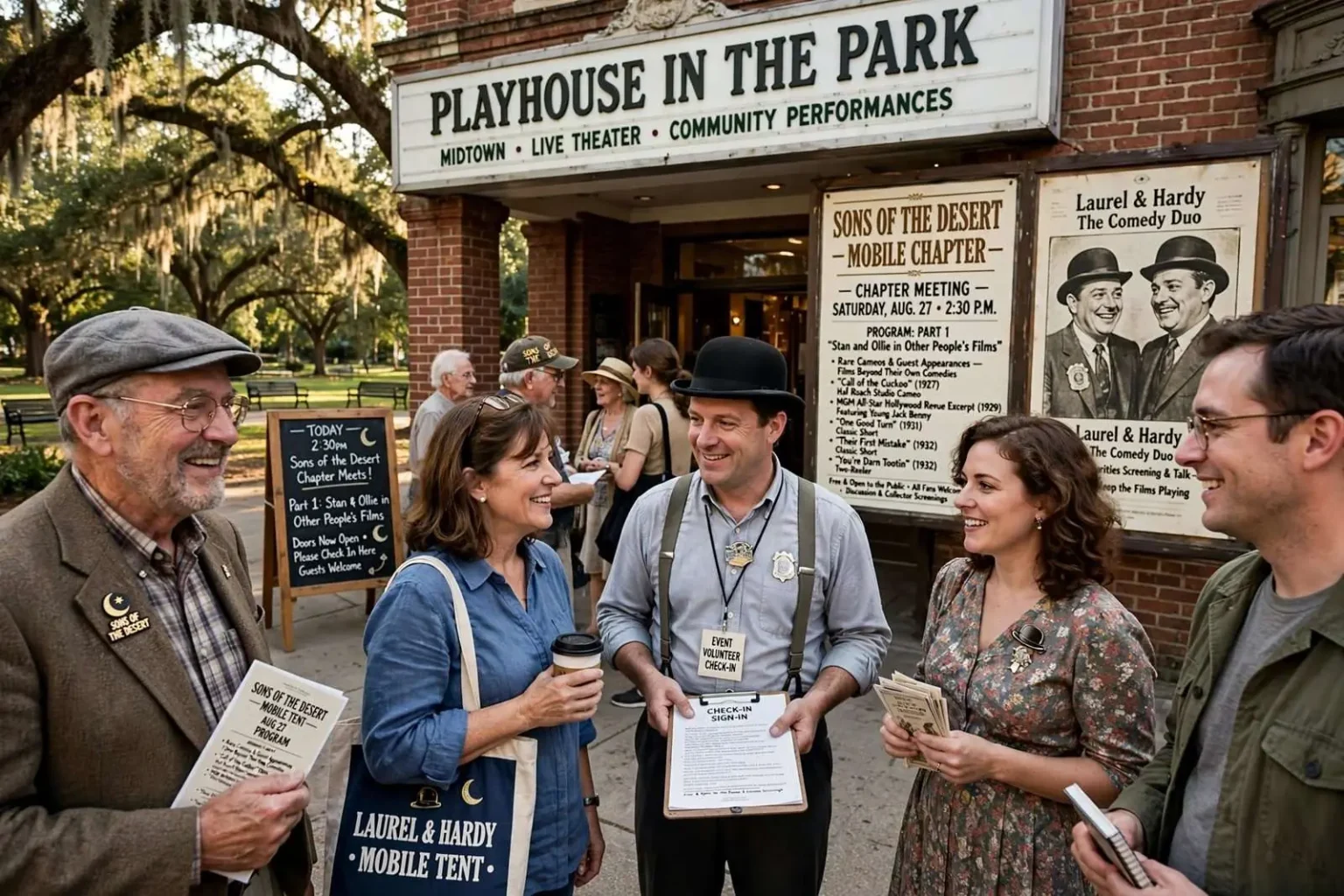
MOBILE, Ala. — The Mobile chapter of the Sons of the Desert — the international Laurel & Hardy appreciation society — hosts its August gathering Saturday, Aug. 27, at 2:30 p.m. at the Playhouse in the Park, and the program offers a deep cut for fans of the famous duo. Rather than the familiar starring shorts, this month’s meeting digs into the rarities: the films where Stan Laurel and Oliver Hardy appeared outside their own comedies, often in cameos and supporting bits that even devoted fans have never seen on a big screen.
The screening is part one of a four-part series titled “Stan and Ollie in Other People’s Films,” spotlighting cameo and supporting appearances the pair made outside their own starring shorts. Across their careers, the two comic giants popped up in other filmmakers’ projects — sometimes as themselves, sometimes in costume, sometimes in fragments of footage repurposed from earlier work — and those appearances have become prized viewing for collectors and historians of the studio era.
Highlights include “Call of the Cuckoo” (1927) from Hal Roach Studios and a scene from MGM’s All-Star Hollywood Revue of 1929 featuring a very young Jack Benny. Alongside the rarities, the program includes a pair of classic Laurel & Hardy shorts: “One Good Turn” (1931) and “Their First Mistake” (1932), plus the two-reeler “You’re Darn Tootin'” — a program that balances the deep cuts with the sort of expert comedy that made the duo the most beloved film team of the first half of the twentieth century.
The Films on the Program
“Call of the Cuckoo” occupies a special place in the team’s filmography. The 1927 Hal Roach Studios short was built around a house-swap gag that gathered a gallery of Roach’s comedy roster in cameo bits — and it caught Stan and Ollie at the precise moment their teaming was being assembled at the Culver City studio. Seeing them in it is a glimpse of the duo in formation, before “You’re Darn Tootin'” and the shorts that followed fixed their screen personas in place.
The MGM excerpt from All-Star Hollywood Revue of 1929 drops the duo into a lavish revue picture alongside a cast of the era’s biggest names, including a very young Jack Benny, still years away from the radio and television stardom that would make him an American institution. The cameo captures the strange economics of early sound pictures, when studios packed revue films with every act on the lot and comedy teams appeared as one number among many.
“One Good Turn” (1931) and “Their First Mistake” (1932) represent the duo at full power. The first puts Stan and Ollie among the unemployed, raising the question of whether a good deed — helping an elderly woman — can survive the run of bad luck that follows; the second builds its comedy around Ollie’s attempt to help a beleaguered friend, with results only the boys could engineer. “You’re Darn Tootin’,” the two-reeler set among musical would-bes, adds the street-accordion chaos that remains one of their signature set pieces.
The Sons of the Desert
The Sons of the Desert takes its name from the 1933 Laurel & Hardy feature of the same title, and its tent chapters around the world keep the duo’s comedy in regular theatrical circulation. The organization was founded in the 1960s and structured, with typical affection, around the film’s fraternal lodge plot: members belong to “tents,” the parent body is the ” international,” and the group’s devotion to keeping the films projected for audiences rather than watched alone has never wavered.
The name comes from one of the team’s best-loved features. In “Sons of the Desert” (1933), Stan and Ollie belong to a fraternal lodge whose members swear an oath to attend the organization’s convention in Chicago — an oath Ollie honors despite his wife’s objections, with consequences that build through one of the pair’s most celebrated features. The film’s lodge ritual, with its exotic hats and solemn nonsense, became the real society’s founding mythology: tents, oaths and all.
Chapters operate on a simple model. A tent gathers members periodically, projects the films properly — on a screen, with an audience, the way they were made to be seen — and pairs the program with whatever rarities, restoration notes or historical trivia the local leadership can assemble. Attendance requires no membership fee beyond enthusiasm; the international organization’s only real requirement is that the films be shared.
Mobile’s tent carries that mission along the Gulf Coast. Its gatherings give area fans something streaming cannot replicate: a room full of people laughing together at comedy nearly a century old. Silent and early sound comedies play differently with an audience — the timing lands harder, the gags build collectively — and the Sons of the Desert exists precisely to keep that experience alive.
The Playhouse in the Park Setting
The Playhouse in the Park gives the gathering a fitting home. The venue in Mobile’s MIDTOWN area near the park of the same name has long served as a home for live theater and community performance, and its stage-and-seats setup suits the revival-house feel of a Sons of the Desert program — an audience, a screen, and comedy meant to be watched together.
The 2:30 p.m. afternoon time makes the event accessible to the chapter’s whole constituency, from retirees who grew up with television broadcasts of the duo’s films to younger viewers discovering them for the first time. Classic comedy has proved endlessly transmissible; Laurel and Hardy’s dance-of-the-titles routine, the tit-for-tat car destruction and the famous two-step of Stan’s crying fits play as freshly for children today as they did for their great-grandparents.
Mobile’s chapter welcomes anyone curious about classic screen comedy to attend. No knowledge of the duo’s filmography is required, and the chapter’s screenings double as an informal education: part one of “Stan and Ollie in Other People’s Films” will teach newcomers more about the team’s history — their Hal Roach roots, their studio-era cameos, the shape of their career — than most books manage.
Why the Cameos Matter
The “Other People’s Films” series serves a purpose beyond novelty. Laurel and Hardy’s non-starring appearances trace the machinery of the studio system: loan-outs between studios, charity and revue pictures, and the practice of padding all-star productions with the lot’s contract players. Each cameo is a small document of how the team was managed, marketed and sometimes merely borrowed during the height of their fame.
For historians, the cameos also mark turning points. The 1927 “Call of the Cuckoo” catches the team on the eve of their breakthrough; the 1929 MGM revue catches them just as sound transformed the industry they had mastered as silent comedians. Watching the fragments in sequence, as the Mobile tent’s four-part series will do, reconstructs a career from its margins inward — the rare program that rewards both the first-time viewer and the expert.
Part one’s blend makes the case better than an argument could. Two genuine rarities to widen the picture, three certified classics to remind the room why the pair earned it: that is the Sons of the Desert formula, and on Aug. 27 at the Playhouse in the Park, Mobile’s tent will run it again. The oath, as any member will attest, is simple — keep the films playing, and keep the laughter shared.
Laurel and Hardy on the Gulf Coast
South Alabama has its own long memory of the duo’s work. Laurel and Hardy shorts ran for decades on regional television, packaged for after-school and weekend broadcasts that introduced each new generation of Gulf Coast children to the bowler hats and the piano-moving disasters. For many viewers now in retirement, the Mobile tent’s screenings are a return to something first seen on a black-and-white set decades ago — only this time with an audience to laugh with.
The chapter’s gatherings also plug into a broader network of film appreciation along the coast. Mobile’s downtown Saenger Theatre and other venues have periodically revived classic Hollywood fare, and the city’s audiences have repeatedly shown up for screen comedy of every era. The Sons of the Desert’s model — a regular schedule, a knowledgeable host, films projected properly — fills the gap between the occasional revival and the empty ritual of watching alone at home.
The appeal, members say, is partly generational inheritance. Parents bring children; children grow up and bring theirs. A comedy team that stopped making films more than eighty years ago keeps finding new audiences precisely because the humor is physical, visual and kind — slapstick built on escalating catastrophe rather than on anyone’s expense, and resolved, always, with the boys’ unshakable loyalty to each other.
The Craft Behind the Comedy
Part of the enduring interest in Laurel and Hardy is craft. Stan Laurel, the team’s creative engine, spent painstaking hours constructing each film’s gags and pacing — he famously worked scripts and cuts long after the cameras stopped, refining every routine. Oliver Hardy supplied the other half of the equation: the exasperated dignity, the slow burn, the camera-glance that turns an audience into his co-conspirator.
Their two-reelers are studied today as models of structure. A typical short builds from a simple domestic premise through a ladder of cause-and-effect disasters, each complication growing logically out of the last, until the finale collapses the whole structure in a single extended routine. Watching “One Good Turn” or “You’re Darn Tootin'” with attention to that architecture reveals why the films still work: nothing in them is random, however chaotic it appears.
The cameos, by contrast, show the duo compressed into other people’s structures — a bit in a revue, a walk-on in a gag picture. The contrast is instructive, and it is presumably part of what the tent’s series intends: after watching Stan and Ollie confined to someone else’s frame, the classics on the same program play with renewed force. The team was never better than when they ran the whole show.
Details for Attendees
The August gathering opens at 2:30 p.m. Saturday at the Playhouse in the Park. The program runs about two hours, including the two rarities, the MGM excerpt and the three classic shorts, with the informal conversation before and after the screening that is half the pleasure of any tent meeting. Newcomers are welcome to simply arrive and take a seat.
The chapter’s leadership invites area fans of classic comedy of any stripe — silent film buffs, golden-age Hollywood devotees, or families looking for an afternoon of screen entertainment that asks nothing of anyone. Part two of “Stan and Ollie in Other People’s Films” follows at a later gathering, continuing the tour through the team’s non-starring appearances. For one August Saturday, though, the bill is set: two deep cuts, three classics, and a room full of people discovering — or rediscovering — why two men in bowler hats still command an audience a century on.