Le Krewe de Bienville Turns 50 With a Funky Meters Headline Ball
Le Krewe de Bienville celebrated its 50th-anniversary Mardi Gras ball in 2011 with live music from New Orleans funk legends The Funky Meters.
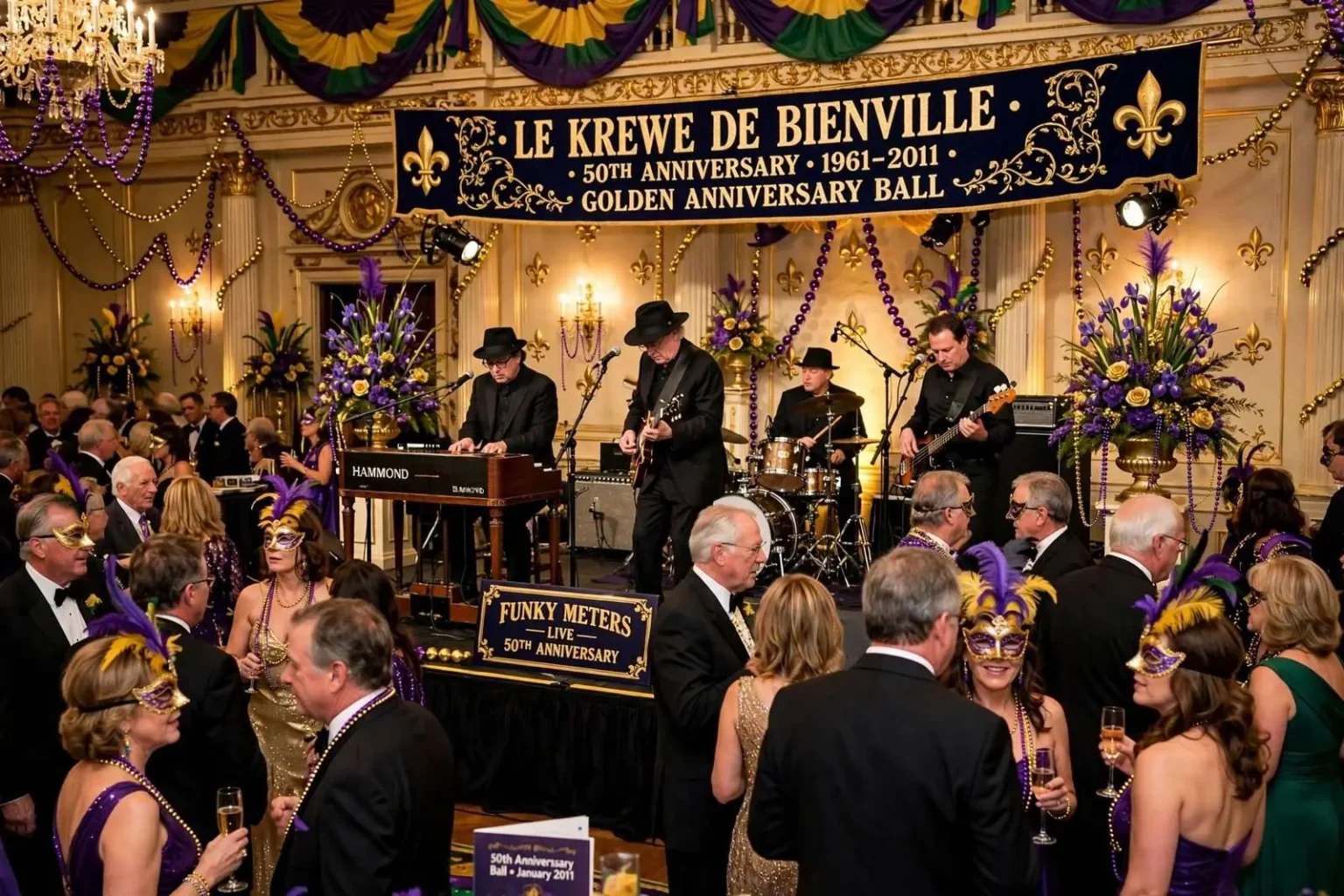
Mobile’s Carnival season reached a golden milestone in 2011, as Le Krewe de Bienville marked its 50th anniversary with a Mardi Gras ball built around one of the most celebrated acts in Gulf Coast music history. The krewe booked The Funky Meters, the New Orleans funk legends whose grooves helped define the sound of the Crescent City, to headline the anniversary celebration — a fitting pairing of five decades of Carnival tradition with five decades of Gulf Coast rhythm and blues. The ball promised a full night in the classic Carnival mold: food, drink and live music for members and guests gathered to honor a half-century of one of Mobile’s signature krewes.
Mobile’s claim as the birthplace of Mardi Gras in America gave the anniversary added weight. The city’s first Carnival observance dates to 1703, when French colonists at the original settlement of Twenty-Seven Mile Bluff marked the season more than a decade before New Orleans existed. When the celebration moved with the town to its present site on Mobile Bay, it grew into a network of mystic societies — private Carnival organizations that stage parades, present royalty, and host the formal balls that remain the backbone of the local season. That network of parades and balls now fills weeks of the city’s calendar each winter and draws visitors from across the Southeast.
Le Krewe de Bienville takes its name from Jean-Baptiste Le Moyne, sieur de Bienville, the French colonial governor who founded Mobile and later founded New Orleans, and whose name is attached to streets, parks and landmarks across both cities. Organized in 1961, the krewe spent five decades building its own place in that landscape, growing from a young society into one of the most recognizable names on the Mobile Carnival calendar. Reaching a 50th season put the krewe in rare company, and the organization planned its anniversary ball as a statement event rather than an ordinary stop in the season’s schedule.
A New Orleans Soundtrack for a Mobile Institution
The choice of headline entertainment gave the anniversary its musical signature. The Funky Meters rose out of New Orleans in the late 1960s, built around keyboardist Art Neville and a rhythm section whose instrumental singles became foundational documents of funk. Tracks like “Cissy Strut” and “Look-Ka Py Py” turned the band into fixtures of the New Orleans sound, and their blend of second-line groove, swampy guitar and tight, syncopated keyboards has influenced generations of players far beyond the Gulf Coast. Members of the band went on to front the Neville Brothers, further tying the group to the musical identity of the region.
For a golden-anniversary booking, the band’s pedigree matched the occasion. Fifty years of Mobile Carnival tradition met a band with fifty years of its own history, and the pairing gave the ball a soundtrack rooted in the same Gulf Coast culture that shaped the krewe itself. New Orleans funk and Mobile Mardi Gras have traveled together for generations, sharing a birthplace in French colonial settlement and a common calendar, and the anniversary ball leaned into that kinship rather than reaching outside the region for its entertainment.
The Anatomy of a Mobile Carnival Ball
Carnival balls occupy a distinct place in Mobile’s season, separate from the street parades that most visitors know. A ball is a formal, ticketed or invitation event staged by a krewe for its members and their guests, traditionally built around a tableau — a themed presentation of the krewe’s royalty, costume design and music. Balls run on their own etiquette: attendees dress in formal wear or masquerade costume, arrive for a full evening’s program, and dance and dine while the krewe’s royalty holds court. For many Mobilians, the balls are the heart of the season, carrying on traditions that stretch back to the earliest mystic societies of the nineteenth century.
Le Krewe de Bienville’s anniversary ball followed that model closely. Attendance was strictly limited to ages 21 and up, keeping the event an adults-only night in keeping with the formal ball tradition. A dress code applied as well: guests were required to appear in formal wear or in a full masquerade costume, and the krewe published detailed attire rules and examples on its website for anyone unsure what qualified. That kind of guidance is a practical courtesy in Carnival circles, where first-time guests often arrive unsure whether a tuxedo, a gown or a sequined costume best fits the evening, and the krewe’s published standards kept the room in the spirit of the occasion.
The evening’s program delivered the full complement of ball traditions. Food and drink were part of the package, and the Funky Meters provided live music for dancing rather than a brief concert set. In the classic Carnival mold, a ball of this kind runs for hours — a seated dinner service, the presentation of the krewe’s royalty, and an extended night of music that carries guests toward the early morning. The anniversary format gave the krewe’s members and their guests a milestone celebration that felt less like a party and more like aseasonal institution marking a rare occasion.
Getting Tickets in a Mobile Tradition
Access to the ball ran through three channels. Tickets were available online for anyone who preferred to purchase in advance from home, and they were also sold in person at two long-standing Mobile businesses: Serda’s Coffee, the downtown coffeehouse that has served the business district for years, and Randall’s Formalwear, a Mobile shop that specializes in exactly the tuxedos and formal attire the ball’s dress code calls for. The pairing made practical sense for revelers — a stop at Randall’s could outfit a guest for the evening and send them home with tickets in the same trip.
Physical ticket outlets remain a fixture of the Mobile Carnival economy. Downtown businesses near the parade routes and the civic center have long served as pick-up points for ball tickets, mask supplies and costume accessories, and the weeks leading up to Fat Tuesday bring a steady stream of customers fitting tuxedos, altering gowns and buying shoes. For the krewe, the in-person outlets put tickets where prospective guests were already shopping for the season, while the online option served the growing number of attendees who bought everything from parking passes to costume pieces digitally.
What the Golden Anniversary Meant for the Season
The 2011 Carnival season gave Mobile plenty of reasons to celebrate, and the krewe’s milestone sat near the top of the list. Carnival in Mobile is more than a festival — it is a cultural and economic engine that fills hotels and restaurants downtown, supports the local businesses that sell costumes and tickets, and connects generations of families who belong to the same societies their grandparents joined. A 50th anniversary ball added a marquee night to that calendar, drawing members home and giving newer revelers a reason to seek out one of the season’s most established organizations.
The anniversary also underscored how Mobile’s Carnival institutions endure. Fifty years spans enormous change in the city — from the early 1960s, when the krewe was founded, through decades of growth along the Gulf Coast, to a modern season that unfolds across downtown’s biCentennial-era streets and waterfront. Societies that reach such milestones have done so by passing membership through families, adapting their balls and parades to new generations, and maintaining the formal traditions that distinguish Mobile’s celebration from more free-form street festivals elsewhere on the Gulf.
For the guests who filled the ballroom, the night delivered what the anniversary promised: a full evening of tradition and elegance, with the funk of New Orleans carrying the dance floor. The Funky Meters’ catalog gave the krewe a soundtrack with deep roots in the same Gulf Coast soil that produced Mobile’s Carnival itself, and the booking turned a golden anniversary into one of the memorable musical nights of the season. Five decades after its founding, Le Krewe de Bienville celebrated the way Mobile’s oldest institutions always have — with royalty, formal dress, and music that kept the room moving until the evening’s end.
Ticket demand followed the pattern of other milestone celebrations in the city. Carnival balls in Mobile typically move their tickets in the weeks between Twelfth Night and the first parades, when the season’s momentum builds and guests finalize their plans, and an anniversary ball with a headline act of the Funky Meters’ standing gave buyers an added reason to commit early. The spread of purchase points — online, downtown coffeehouse, formalwear shop — reflected the krewe’s effort to make the milestone night reachable for longtime members and first-time guests alike, whether they were assembling a tuxedo or planning a full masquerade costume.
As the krewe closed out its 50th season, the ball stood as a marker of where Mobile’s Carnival has been and where it continues to go. The city’s mystic societies have carried the season through three centuries, and organizations like Le Krewe de Bienville represent the mid-century wave that modernized the calendar while holding onto its traditions. With a funk-and-anniversary night behind it, the krewe headed into its next fifty years with the kind of milestone celebration that Mobile’s Carnival season does best.