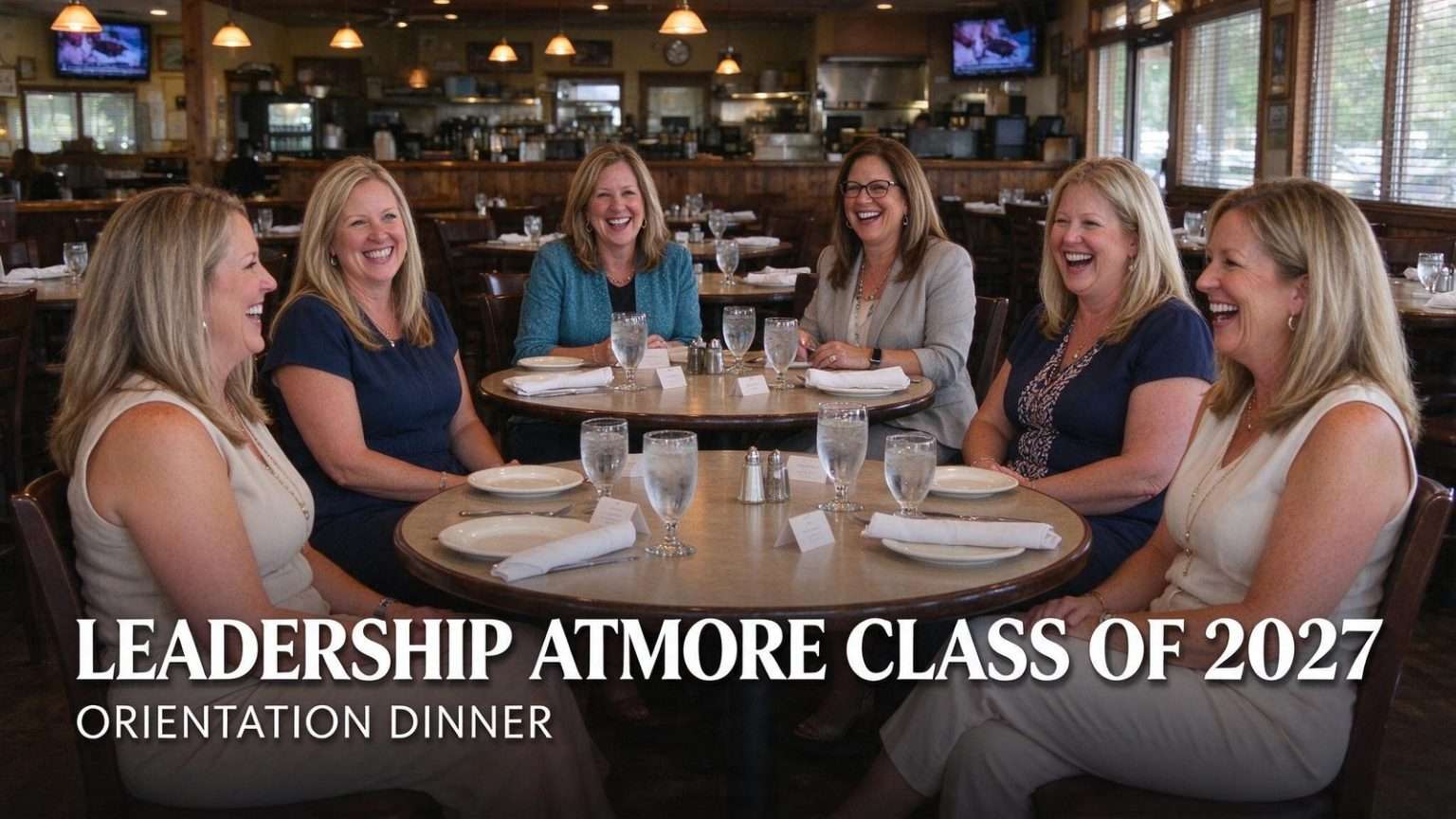
ATMORE — The newest group of residents to enter this city’s long-running civic leadership program sat down together for the first time Thursday night.
The Leadership Atmore Class of 2027 held its orientation at David’s Catfish House, walking through the shape of the program, the schedule of meetings ahead, and the fundraisers and projects the class will take on during its term.
The program is run by the Atmore Area Chamber of Commerce and has been operating for more than three decades.
Who Is in the Class
Members of the Class of 2027 are Leslie Svendsen, Sue Stabler, Latoya Staples, Susan Rhodes, Monique Brown, Michelle Adair, Mollie McMullen and Brittany Kelley.
Small class sizes are typical of programs like this one, and they are a design choice rather than a limitation. A cohort small enough to fit around a few tables can be given access that a larger group cannot — a working conversation with a mayor, a walk through a plant floor, a seat in a courtroom — and the participants end the year actually knowing one another rather than simply having shared a mailing list.
What Happened at Orientation
Thursday’s session was organizational. The class reviewed how the program works, when it will meet over the course of the year, and the fundraisers and projects that will occupy it.
The fundraising and project components are the parts that most often outlive a given class. Community leadership programs generally require their participants to plan and complete something tangible together, funded at least partly by money the class raises itself. The finished product might be a park improvement, a piece of playground equipment, a mural, a piece of equipment donated to a school or first responders, or a service event.
The educational value of the exercise is in the friction. A class project forces a group of people from different employers, backgrounds and parts of town to agree on a goal, raise money for it, navigate whatever permits or permissions are required, and finish on a deadline — which is a compressed rehearsal of what serving on a board, a commission or a council actually feels like.
A Program Founded in 1993
Leadership Atmore was founded in 1993 and was modeled after other leadership programs operating throughout the state.
Alabama has a dense network of such programs. Most are run by local chambers of commerce, and many trace their lineage to the community leadership movement that spread across the United States in the 1970s and 1980s, when chambers and civic foundations began treating leadership as something a community could deliberately cultivate rather than wait for.
The structure has proved durable because it addresses a problem that recurs in every small city: a relatively small number of people end up serving on nearly every board, and when they age out or move away, there is no obvious bench behind them. A leadership class is, in effect, a bench-building exercise.
What the Program Is Designed to Do
The program’s stated purpose is to identify and develop leadership potential in the community. Each class brings together individual local leaders and is intended to reflect the diversity of the community it serves.
That diversity — in both backgrounds and experiences — is treated as a feature of the curriculum rather than a demographic target. The reasoning is that the leadership experience is enhanced when participants encounter perspectives they would not meet in their own workplace, and that the class ends the year having built a network of informed citizens who share a common bond.
The practical version of that idea is straightforward. A banker, a teacher, a nurse, a small-business owner and a municipal employee who spend a year in the same room learn how the parts of their town connect to one another. When a problem arises later, each of them knows who to call.
How Chamber Leadership Programs Work
The typical community leadership program runs across most of a year, with sessions spaced out so participants can keep working full time. Individual sessions are usually built around a theme — local government, public safety, education, health care, industry and economic development, agriculture, history and the arts — and are hosted by the institutions being studied.
What distinguishes the format from a lecture series is access. Participants are generally taken inside the places they are learning about: a water treatment plant, a courthouse, a hospital, a manufacturing floor, a school district central office. The intent is to replace assumptions with firsthand observation, and in most classes at least one participant emerges surprised by how a system they had complained about for years actually operates.
Graduates commonly go on to serve on nonprofit boards, run for local office, chair committees or take volunteer leadership roles in their churches, schools and civic organizations. Over the course of three decades, the accumulated effect on a small city can be substantial.
Why Atmore Runs One
Atmore sits in Escambia County in south Alabama, near the Florida state line and roughly midway along the corridor between Mobile and Pensacola. Like many communities of its size, it depends heavily on a comparatively small group of residents to staff its civic institutions.
The Atmore Area Chamber of Commerce, which operates the program, occupies the position most chambers do in a city this size — part business advocate, part convener, part clearinghouse for community projects that do not belong to any single government agency. A leadership class is one of the more efficient tools available to an organization in that role, because it produces informed volunteers rather than simply informing existing ones.
What Comes Next
Having set its calendar at orientation, the Class of 2027 now moves into the working portion of the program: the scheduled sessions, the fundraising, and the project the class will select and carry out together.
Its members will join more than three decades of Leadership Atmore alumni.