Leading others is simple for Major General Janet L. Cobb, USS Alabama’s executive director
Maj. Gen. Janet L. Cobb (Ret.) leads the USS Alabama Battleship Memorial Park, the first woman to serve as its executive director.
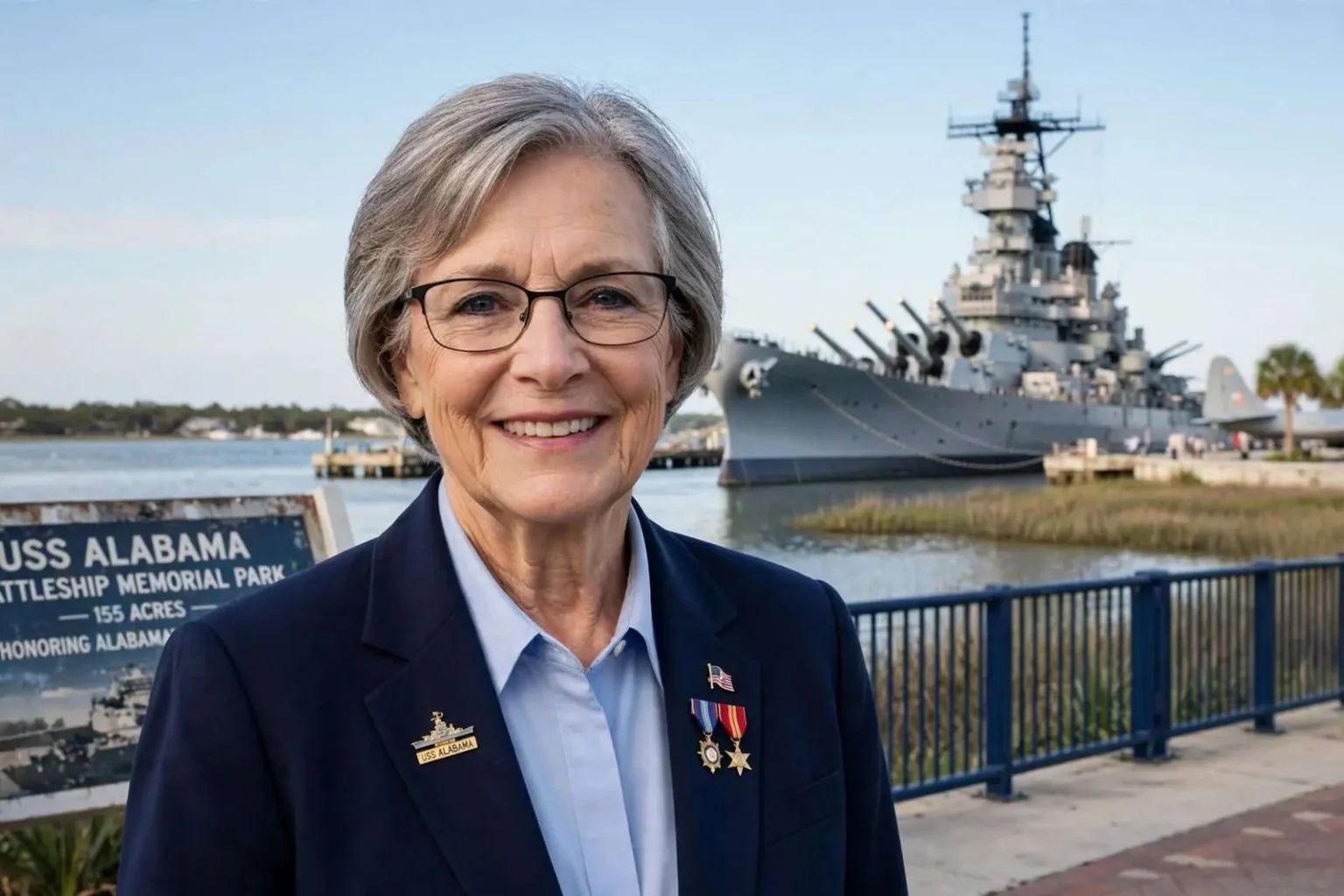
Maj. Gen. Janet L. Cobb (Ret.) has come a long way from working in the potato sheds of Baldwin County at age 14. After graduating from Foley High School, she joined the U.S. Army Reserve, and 42 years later retired as the commanding general of the 81st Regional Support Command. Today she is at the helm of the USS Alabama Battleship Memorial Park, the 155-acre waterfront attraction on Mobile Bay that honors the state’s veterans.
In 2015, she became the first woman to serve as executive director of the park, which encompasses its 155-acre property along the Mobile waterfront. The park draws visitors from across the country to walk the decks of the battleship USS Alabama, tour the submarine USS Drum, and view one of the largest collections of military aircraft and equipment in the region. “It is the coolest job in the world. We are charged with honoring the men and women who have served in the military in all branches who are from the state of Alabama and to educate the public on those sacrifices,” Cobb said.
The position made her responsible for a site that functions as both a museum and a memorial. The battleship itself earned nine battle stars in World War II and survived both an Atlantic and a Pacific deployment, and it has rested at its berth on the bay since 1965, when Alabamians rallied to bring the ship home before it was to be scrapped. The park’s mission, as Cobb describes it, is to keep that history alive for generations who have no living memory of the wars the exhibits represent.
From Foley potato sheds to the Pentagon
Cobb’s military career took her around the world, from loading ships in Saudi Arabia to working in the Pentagon. Enlisting in the Army Reserve as a young woman out of Foley High School, she rose through the ranks over four decades to command the 81st Regional Support Command, an Army Reserve organization whose reach spans multiple states across the southeastern United States. Her assignments included logistics work at the center of overseas operations — the loading of ships in Saudi Arabia during deployments in the Middle East — and staff duty at the Pentagon, the seat of the Department of Defense.
Her decorations include the Legion of Merit and the Bronze Star, two of the nation’s most respected military honors, awarded for exceptionally meritorious service and for heroic or meritorious achievement in combat respectively. Cobb, characteristically, credits the people who worked for her for whatever success she achieved, a modesty her employees recognize in daily life at the park as well.
Those who work with her describe her as fair and modest. Pam Jeffcoat, the park’s longest-serving employee, calls her “the best.” The endorsement from a veteran staff member carries weight in an organization where the director’s decisions shape everything from restoration projects to daily visitor operations across the sprawling bayfront property.
Leading a living memorial
The USS Alabama Battleship Memorial Park occupies a distinctive place in Alabama life. Created to honor the state’s veterans of all branches, the park has grown from the single battleship at its core into a campus that includes the submarine USS Drum — a World War II combat veteran itself — aircraft from multiple eras of American military aviation, tanks, artillery and memorials to Alabamians who served. School groups file through the gangway year-round, veterans’ organizations hold ceremonies on the grounds, and the ship’s decks serve as a classroom where history is something visitors can touch.
Running such a site is no small enterprise. The park depends on admission revenue, private support and state partnership to fund the constant work of preserving massive steel artifacts against the corrosive forces of a saltwater environment. Battleship preservation is an ongoing battle against rust and time, and every restoration project — from hull maintenance to aircraft restoration — competes for limited dollars. Cobb’s leadership background in logistics and large-organization management, honed over 42 years in uniform, translated directly to the job of keeping a 45,000-ton warship and its surrounding campus open, safe and educational for the public.
Her appointment in 2015 also carried symbolic weight. In an institution built on the stories of generations of Alabama service members, the first woman to lead the park had herself broken ground in a military career that began when few women rose to general officer rank. Cobb’s path — from a teenage job in Baldwin County’s potato sheds to commanding general of a major Army Reserve command — reflected the changing opportunities open to women in the armed forces over the four decades she served.
Service, survival and what comes next
A breast cancer survivor for more than a decade, Cobb draws strength from her faith and a positive outlook. Colleagues say the resilience that carried her through treatment is the same steadiness she brings to the park’s challenges, whether a hurricane season bearing down on the bayfront property or the daily demands of an attraction that hosts hundreds of thousands of visitors a year.
Now 63, she expects to serve as executive director for a few more years before retiring to a quieter life of kayaking, reading and visiting friends. The plans say something about the person: the outdoor pursuits of someone who grew up working outdoors in Baldwin County, and the low-key pleasures of someone who never traded her modest roots for the pomp of her rank.
Until then, her days remain devoted to the job she calls the coolest in the world — standing watch over the memorial that honors Alabamians who served, and making sure every visitor who climbs the battleship’s ladders leaves understanding a little more about the sacrifices the ship and its crew represented. For a general who spent her career leading soldiers, the mission has come full circle: honoring the men and women of her home state who wore the uniform, and educating the public on what their service cost.
The ship that started it all
The story of the park begins with the battleship itself. The USS Alabama was commissioned in 1942 and served in both the Atlantic and Pacific theaters during World War II, earning nine battle stars for her service. She escorted Atlantic convoys, shelled Japanese positions in the Pacific’s final campaigns, and survived the war without losing a crew member to enemy action — a record her sailors wore with pride. When the Navy decided after the war to scrap its aging battleships, Alabama schoolchildren donated their lunch money and spare coins in a statewide campaign that raised the funds to bring the ship to Mobile Bay, where she was moored in 1965 as the centerpiece of what became the memorial park.
That grassroots origin still defines the park’s character. It was built by the people of Alabama for the people of Alabama, and the executive director’s job is ultimately the stewardship of that trust. Visitors walk the same compartments where sailors ate, slept and fought, tour the engine rooms and gun turrets, and climb to the bridge for a view of the bay. The USS Drum, moored alongside, offers its own underground-in-reverse experience — a World War II submarine credited with sinking substantial enemy tonnage, preserved intact with its torpedoes, bunks and periscope stations.
The aircraft pavilion and grounds add the air and land dimensions of military service, with vintage warplanes, helicopters, tanks and artillery from World War II through the modern era. Memorials across the grounds honor Alabama prisoners of war, the state’s Medal of Honor recipients and the branches of the armed services, making the park a site of active remembrance as well as tourism. Veterans return for reunions aboard the ship that carried them to war, and their gatherings are among the most meaningful events the staff hosts each year.
Baldwin County roots and a military path
Cobb’s personal story is woven into the same south Alabama landscape the park serves. Working in the potato sheds of Baldwin County at 14 taught her early lessons about hard labor and organization that she has said served her throughout her career. Foley, the south Baldwin community where she attended high school, sits in the heart of a farming region that has since transformed into one of the fastest-growing areas of the state — a transformation Cobb has witnessed from the potato shed floor to the executive suite.
Her enlistment in the U.S. Army Reserve set in motion a career that spanned the Cold War’s end, the Gulf Wars and the transformation of the Reserve component into an operational force deployed repeatedly overseas. Her assignment loading ships in Saudi Arabia placed her at the logistical center of American power projection in the Middle East, where the materiel that sustained combat operations moved through ports under her oversight. Her Pentagon service gave her the department-wide perspective that few field officers gain, and her eventual command of the 81st Regional Support Command made her responsible for the training and readiness of Army Reserve units across a multi-state region.
Retiring as a two-star general after 42 years of service, she carried into civilian leadership the same habits that marked her military reputation: preparation, fairness and insistence on standards. Employees at the park see those qualities in meetings and maintenance decisions alike, and the park’s longest-serving employee’s simple assessment — that Cobb is “the best” — reflects a workforce that has rallied around her leadership style.