
Lightning Blasts Bark Clean Off a Tree in Turnerville — and a Reader Caught It on Video
A lightning strike in Turnerville, Alabama stripped the bark off a 30-inch tree — and a resident captured the aftermath on video.
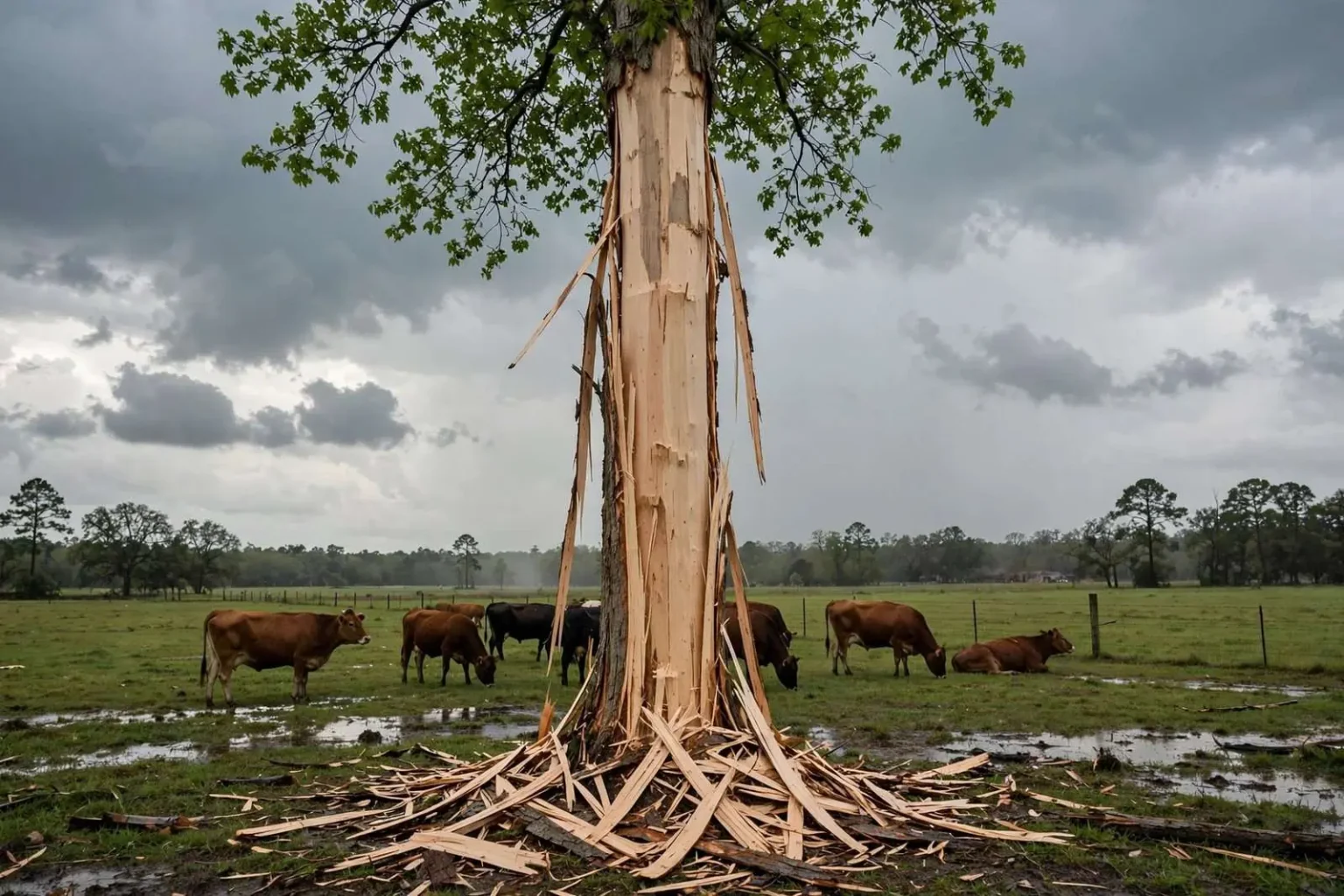
Strong storms swept across the Gulf Coast Friday evening, leaving the usual trail of downed limbs and scattered power outages, but one piece of damage in Turnerville in western Mobile County stood out from the rest. A lightning bolt struck a tall tree directly and stripped it bare, blasting the bark off the trunk down its entire length while leaving much of the tree otherwise standing. The unusual result was captured on video and shared by Turnerville resident Michael Bru, whose footage shows the stripped trunk towering over a pasture while cows graze unconcerned around its base.
Bru estimated the tree was about 30 inches in diameter before the strike. In the video, the bark has been torn away in long streaks, exposing the pale wood beneath from the upper reaches of the trunk down toward the ground. Such total bark removal is rare even in a region where lightning strikes trees constantly during the long summer storm season, which runs from roughly June through September across south Alabama. More commonly, a strike leaves a narrow scar running down one side of the trunk, kills the top of the tree, or blows the tree apart entirely. A trunk stripped clean of bark, while the tree remains upright, is a striking illustration of how much energy a single bolt carries.
Lightning is one of the most powerful natural forces that regularly visits the Gulf Coast. A typical bolt can carry tens of thousands of amperes, flashed down the conductive channel of a wet tree trunk in a fraction of a second. When that current passes through a tree, the moisture in the bark and the sapwood beneath it flashes to steam almost instantly, and the resulting pressure can split wood, peel bark away in ribbons, and throw fragments many feet from the base. Trees in open pastures, along fence rows, and at the edges of fields are frequent strike points because they stand taller than everything around them, exactly the profile that attracts a downward-moving leader from a storm cloud.
Why Turnerville and west Mobile County see this kind of damage
Turnerville sits in the rural stretch of western Mobile County, in an area of pastures, timberland, and scattered homes between the communities of Wilmer, Semmes, and the Mississippi state line. The landscape is classic Gulf Coast thunderstorm country. Afternoon sea-breeze collisions, daytime heating, and the proximity of Mobile Bay and the Gulf of Mexico combine to produce some of the highest lightning densities in the United States. Storms that build over the timberlands inland can march across the county through the evening hours, dropping heavy rain, frequent cloud-to-ground strikes, and occasional damaging wind gusts.
Friday evening’s storms fit that pattern, with heavy rain and lightning reported across the western part of the county. Most strikes do no more than the region expects, but the damage in Turnerville provided a vivid reminder of what a direct hit can do. Farmers and landowners in the area are familiar with lightning-killed pines, which turn rusty red within weeks of a strike and become standing hazards that must eventually be felled. Hardwoods struck by lightning may survive a glancing blow, but a strike powerful enough to remove bark down the full length of the trunk usually kills the tree outright by destroying the thin layer of living tissue that carries water and nutrients between the roots and the crown.
What a strike like this means for the tree and the landowner
In the days after a strike, the full extent of the damage often takes time to show. Bark removal leaves the wood exposed to insects and decay fungi, and the destruction of the cambium layer interrupts the flow of water to the branches. A tree stripped as thoroughly as the Turnerville specimen will likely decline over the following months, even if it greens out briefly in the early going. Landowners who lose shade trees near homes, barns, or livestock areas are usually advised to have the remains evaluated, since a dead or dying trunk can come down without warning in the next strong wind.
The video Bru shared resonated widely in part because of its calm centerpiece: the cows around the base of the tree appear entirely unbothered, grazing in the shadow of a trunk that had just absorbed one of the most violent natural events in nature. Livestock are frequently endangered by strikes in open pastures, because an animal standing near a tree when it is hit can be injured by ground current or by falling debris, and cattle sheltering under isolated trees during storms is a persistent hazard that farmers in south Alabama know well. In this case, the animals’ distance from the tree at the moment of the strike presumably kept them out of harm’s way.
The physics behind a stripped trunk
The reason bark flies off in a case like this comes down to speed and moisture. A lightning bolt completes its path to ground in roughly a few hundred microseconds, but in that instant the current heats the sap and moisture in the tree to temperatures far above the boiling point of water. The steam explosion takes the path of least resistance, which is often the boundary between the bark and the wood, peeling the bark away in sheets or ribbons. When the strike is strong enough and the trunk is wet from rain, the effect can run the entire height of the tree, which is what makes the Turnerville damage so unusual to see in person and on video.
Forecasters and emergency managers in Mobile County regularly remind residents that summer storms can build and strike with little warning, and that no outdoor spot is safe during active lightning. The National Weather Service’s long-standing guidance applies as much to a pasture in Turnerville as to a ballfield in the city: when thunder roars, go indoors, and wait at least 30 minutes after the last thunder before returning outside. The same strikes that peel a tree are dangerous to people and animals in the open, and the Gulf Coast’s frequent afternoon storms make that advice a daily summertime necessity rather than a rare caution.
Documenting storm damage in the smartphone era
The video also reflects how storm damage gets recorded and shared now. Twenty years ago, a stripped tree in a rural pasture would have been seen by the landowner, maybe a few neighbors, and an insurance adjuster. Today a short clip can circulate through the community the same evening, letting neighbors compare notes on the storm that passed over and giving local news outlets a vivid illustration of what the weather did. Bru’s clip did exactly that, turning a single tree in a Turnerville pasture into the most talked-about piece of storm damage from Friday’s round of storms.
For the rest of the storm season, which still has weeks to run before the pattern finally eases in the fall, expect more of the same across south Alabama: afternoon buildups, evening downpours, and lightning that finds the tallest object in the field. Most strikes will leave nothing more than a scorch mark or a dead pine to be cleared later. But occasionally, as residents of Turnerville saw Friday evening, a single bolt delivers a display of raw energy that no photograph quite captures, and the evidence stands in the pasture for everyone driving by to see.
Anyone who spots storm damage like this is encouraged to keep a safe distance from struck trees, whose weakened limbs and trunks can drop without warning in the days and weeks after a strike, and to report downed power lines or burning trees to the utility and local emergency services rather than approaching them. The safest view of the Gulf Coast’s summer lightning show is always from indoors, well away from anything tall enough to draw a strike of its own.
Lightning season on the Gulf Coast by the numbers of daily life
Residents of south Alabama live with more cloud-to-ground lightning than nearly anywhere else in the country, and the practical consequences show up every summer. Utility crews respond to transformer strikes and momentary outages on an almost daily basis from June through August. Insurance claims for lightning damage to homes, outbuildings, and equipment spike in the peak months. Schools and youth sports leagues build lightning-delay policies into every outdoor practice and game, and golf courses, marinas, and construction sites across Mobile and Baldwin counties all follow the same drill when storms build on the horizon.
Homeowners in rural areas like Turnerville also learn to protect what they can. Surge protectors and whole-house surge devices guard electronics from the voltage spikes that nearby strikes induce in wiring. Tall shade trees near houses are pruned and inspected, because a split limb over a roofline is a liability every hurricane and thunderstorm season. Some landowners install lightning rods on barns and stables to give strikes a safe path to ground, protecting both the structures and the animals inside them.
The tree in the Turnerville pasture will remain as a local landmark of sorts for a while, stripped and pale against the sky where it stood green and full before Friday evening. Whether it survives or must eventually come down, the video of its bark-blasted trunk has already done what the best storm documentation always does: it put a rare and dramatic piece of weather science in front of thousands of neighbors who now have a better appreciation for just how much power passes through the Gulf Coast sky on a typical summer evening.