
Live Oak Trace: 56-Unit Affordable Housing Community for Seniors Planned in West Mobile
The City of Mobile announced Live Oak Trace, a 56-unit affordable housing development for seniors planned near Overlook and Mind Ring roads in west Mobile.
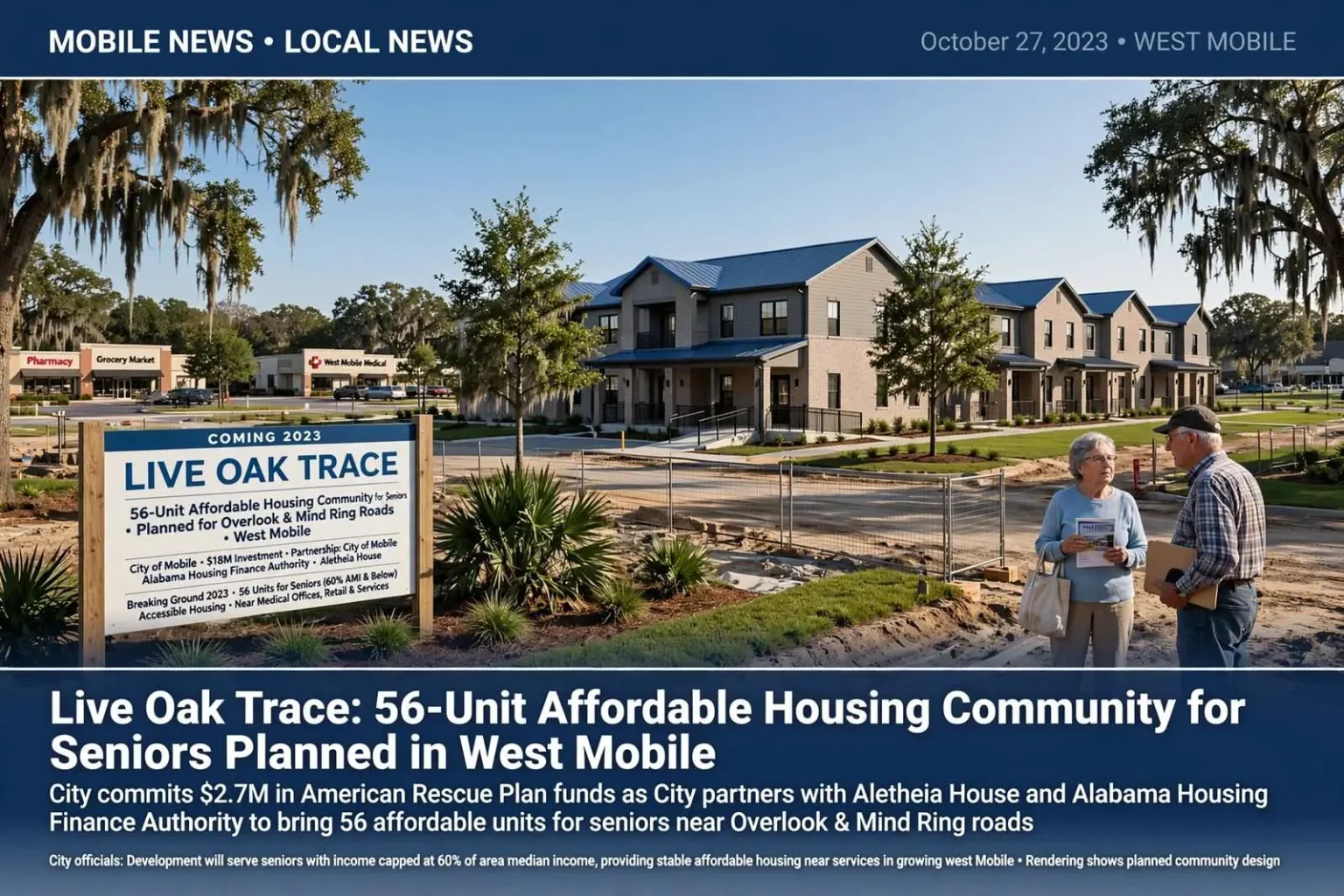
Mobile is moving forward with a new affordable housing community aimed at senior residents in the western part of the city. City officials announced plans for Live Oak Trace, a 56-unit development planned near the intersection of Overlook and Mind Ring roads in west Mobile, an area of neighborhoods, medical offices and retail corridors that has grown steadily outward from the city’s core for decades. The project pairs the city’s own money with federal tax credit financing and the experience of a Birmingham-based housing nonprofit, and it puts senior housing — one of the region’s most persistent unmet needs — at the center of Mobile’s housing agenda.
The City of Mobile and the Alabama Housing Finance Authority are partnering on the project alongside Aletheia House, a federally recognized community housing development organization based in Birmingham. The city is committing $2.7 million from its American Rescue Plan allocations toward the project, which carries an estimated total cost of $18 million. The rest of the financing will come through private investors receiving low-income housing tax credits along with development funding from the Alabama Housing Finance Authority, according to the announcement — a financing stack that has become the standard template for affordable development across the country.
Because of the federal and state tax incentives involved, annual income for residents will be capped at roughly 60 percent of the area median income — approximately $31,380 for a family of two in Mobile, the city said. The development will be required to keep rents affordable for low-to-moderate-income seniors, and the city noted the site will sit within minutes of shopping, physicians, pharmacies, banks and other everyday services, an orientation toward seniors living on fixed incomes for whom proximity to daily errands is not a convenience but a necessity.
How the Financing Fits Together
The structure behind Live Oak Trace is worth unpacking, because it explains both why the project is possible and why such projects are scarce. The low-income housing tax credit, created by Congress in 1986, is the nation’s principal funding tool for affordable rental construction. Developers like Aletheia House receive an allocation of credits from the state allocating agency — in Alabama, the Alabama Housing Finance Authority — and sell those credits to private investors, typically banks and corporations seeking to reduce tax liability. The investors’ cash reduces the amount the project must borrow, allowing rents to be set below market levels without a subsidy that would never cover the gap.
The credits alone rarely close a deal, which is where the city’s $2.7 million comes in. Funding from the American Rescue Plan Act — the federal pandemic-relief package that sent money to cities and counties in 2021 and 2022 — can be spent on a range of eligible uses, and housing has been among the most common. A local contribution of city funds serves as the soft cost or gap financing that makes a credit allocation competitive: state agencies score applications in part on local support, and a committed municipal contribution signals both need and readiness. The Alabama Housing Finance Authority’s development funding rounds out the stack and carries the compliance requirements the project will operate under for years.
That compliance is the other side of the tax credit bargain. Projects financed with credits must keep units affordable to income-qualified households for a mandatory period — typically 30 years or more — with rents set by formula and tenants’ incomes verified annually. Live Oak Trace’s senior focus means the income caps will be administered against a population largely living on Social Security and fixed pensions, making the difference between market rent and affordable rent the difference, for many residents, between stability and displacement.
The Senior Housing Gap
The need the project addresses is measurable. Across the Gulf Coast, the population of adults over 65 has grown faster than the general population for years, while the supply of rental housing priced for fixed incomes has not kept pace. Seniors on Social Security alone often cannot qualify for market-rate apartments under standard income screening rules, which typically require income of roughly three times the rent. The result is a well-documented squeeze: long waiting lists for subsidized senior communities, seniors paying disproportionate shares of income for housing, and older adults doubling up with family or drifting into unsuitable housing stock.
“The City of Mobile has made unprecedented investments in affordable housing in recent years, but we know there is still a great need in the community, particularly among seniors living on a fixed income,” Mayor Sandy Stimpson said in a statement. “We are excited to take this first step with Aletheia House and bring 56 new affordable housing units online for senior Mobilians. This is the beginning of a long partnership that will only enhance our efforts to expand affordable housing in the City of Mobile.”
Aletheia House’s Move to Mobile
Aletheia House plans to open an office in Mobile as part of the nonprofit resource center the city is opening in 2023, a step that extends the Birmingham organization’s footprint to the Gulf Coast. Chris Retan, the organization’s executive director, said he hopes the development leads to more projects in the city. “We are hopeful this will be the first of many affordable housing projects in the City of Mobile,” Retan said. With funding in place, Aletheia House is projected to break ground on the development sometime in 2023, according to the announcement.
The organization’s arrival carries weight beyond a single project. Community housing development organizations — CHDOs, in the language of federal housing law — are nonprofits certified to receive set-aside HOME Investment Partnerships funds and to sponsor affordable development in their communities. Aletheia House built its record in Birmingham, where its housing work has been entwined with services for populations that market housing rarely reaches, and its expansion into Mobile brings that operator experience to a city working to build its own affordable housing capacity. A permanent Mobile office, housed in the city’s nonprofit resource center, positions the organization to respond to future funding rounds — including the state’s annual tax credit allocations — with projects of its own.
For the city, the partnership model is as significant as the units. Rather than issuing a request for proposals to national developers, Mobile partnered directly with a nonprofit and steered federal relief money into the gap — an approach that keeps the asset in mission-driven hands and, in Retan’s framing, opens a long-term relationship rather than a one-off construction deal. City officials have described the resource center as a way to consolidate nonprofit services in one place, and Live Oak Trace gives that effort a concrete housing product to point to.
What Live Oak Trace Means for West Mobile
The Overlook and Mind Ring roads site places the community in the path of west Mobile’s growth, where subdivisions, medical campuses and shopping centers have pushed the city’s developed footprint steadily westward. For senior residents, the location matters as much as the rent: living within minutes of groceries, pharmacies and physician offices determines whether an older adult without regular transportation can remain independent. The project’s site selection reflects that calculus, and it ties into the broader planning principle that affordable housing works best when it is close to services rather than isolated at the periphery.
The 56 units will add to the senior housing inventory in a part of the city where much of the existing stock is single-family homes built out over the last several decades — housing that suits aging owners but offers little to aging renters. A purpose-built community with accessible units, common space and on-site management addresses a segment that scattered-market rentals cannot, and its income restrictions put it within reach of households at the 60 percent area median income line and below.
The timeline ahead — groundbreaking in 2023, followed by a construction period that typically runs 12 to 18 months for a community of this size — means units would come online while the city’s broader affordable housing initiatives are still unfolding. Stimpson’s characterization of the project as a “first step” frames it as the opening entry in a pipeline rather than a standalone gesture, and Retan’s stated hope for many more projects suggests the partnership intends to test that framing.
The Larger Housing Picture
Live Oak Trace arrives amid a period when Mobile has put significant money into housing — the “unprecedented investments” Stimpson referenced — driven by pandemic-era federal funding and a growing local consensus that housing instability was among the city’s most consequential problems. Cities across the country face the same arithmetic: construction costs have risen sharply, market rents have climbed, and the supply of naturally affordable housing has eroded. Against that backdrop, tax credit developments like Live Oak Trace are among the few reliable mechanisms for adding income-restricted units, and each allocation the state awards is intensely competitive.
The project’s details will matter to its future residents long before the ribbon-cutting: unit sizes designed for one- and two-person senior households, accessibility features that anticipate aging in place, rents calculated against the area median income figures the city cited. But for now, the announcement’s significance is simpler. Mobile has committed real money, secured a tax credit partner, and recruited an experienced nonprofit operator — the three ingredients that 56 new affordable senior homes require. The groundbreaking will tell whether the rest of the process moves as smoothly as the financing came together.


