Live Reptiles Take Center Stage as Mobile’s SketchCrawl 4 Hits the Exploreum
Mobile's fourth SketchCrawl draws artists to the Gulf Coast Exploreum on July 31, where 30 live reptiles from 20 countries will serve as sketching models.
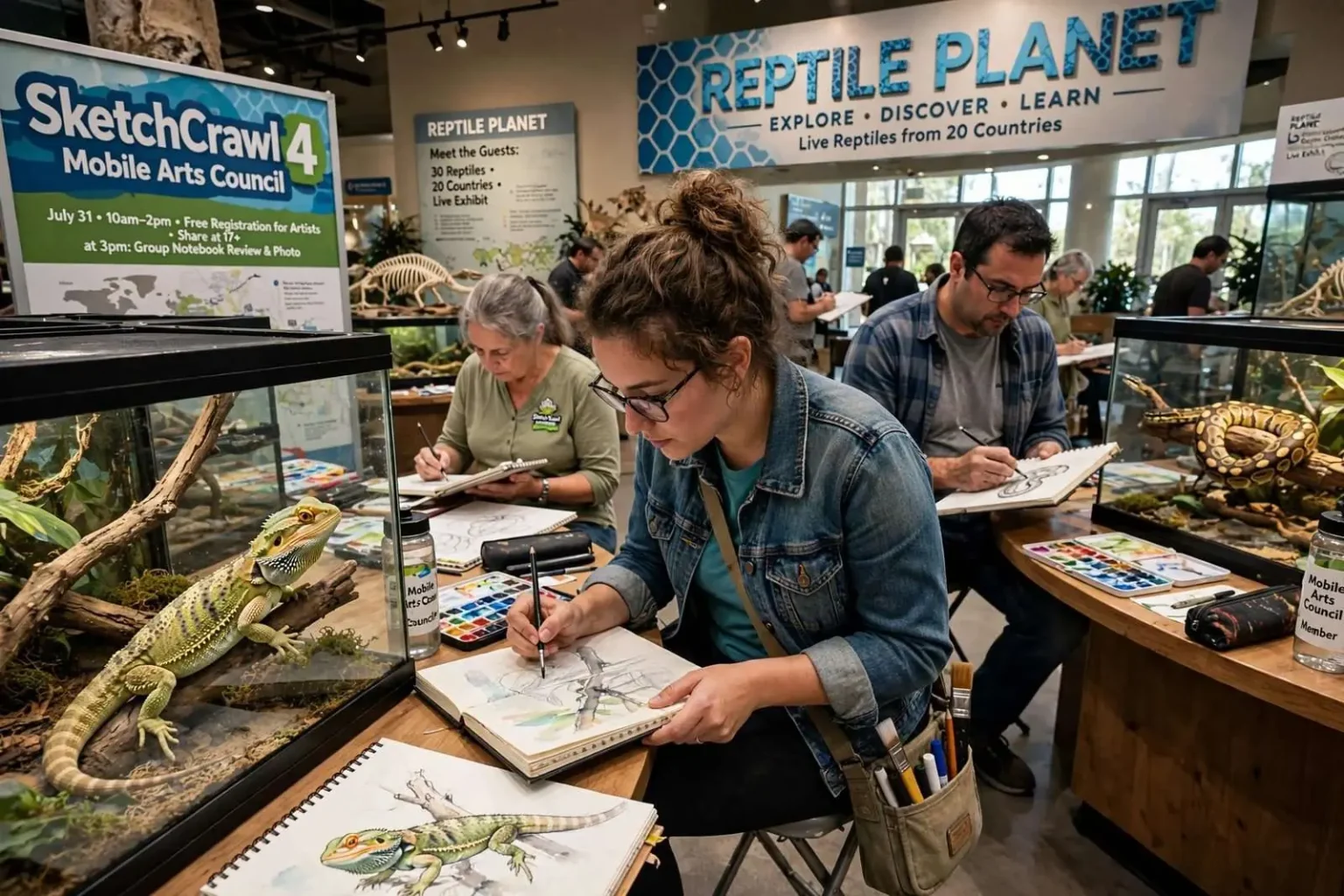
Thirty exotic reptiles representing 20 countries will serve as live models this Saturday, July 31, when Mobile’s SketchCrawl drawing marathon returns for its fourth installment at the Gulf Coast Exploreum Science Center on Government Street. The event, organized locally by the Mobile Arts Council, invites artists of any skill level, amateur or professional, to spend the day sketching whatever catches their eye — though this time the museum floor is doing everything it can to make sure the reptiles catch it first.
Participants 17 and older can register for free admission between 10 a.m. and 2 p.m., which includes access to the Exploreum’s “Reptile Planet” exhibit and its other permanent galleries. Family members who tag along will receive discounted admission, making the crawl one of the more affordable ways to spend a Saturday downtown while introducing the rest of the household to both art and science under one roof.
Sketchers regroup at 3 p.m. to compare notebooks, socialize and pose for a group photo — the traditional closing ritual that turns a day of solitary drawing into a shared event. Comparing pages is half the fun of a SketchCrawl: two artists who sat ten feet apart all day often come away with utterly different interpretations of the same snake, and the notebook comparison at day’s end is where participants see how many ways a single subject can be seen.
A Global Drawing Tradition With Local Roots
SketchCrawl was created several years ago by Enrico Casarosa, a storyboard artist for Pixar, and has since spread to cities worldwide; Saturday’s Exploreum gathering will be the 28th SketchCrawl held anywhere on the planet. The idea struck Casarosa as a way to give the solitary practice of urban sketching the structure and camaraderie of a group event, and the format proved portable enough that artists in dozens of cities have picked it up and run with it on the same day.
The format is loosely modeled on a pub crawl, except participants carry sketchbooks instead of drinks: artists meet at a set location in the morning, then fan out to draw for hours at a stretch, aiming for roughly a sketch an hour of buildings, people, street scenes or anything else nearby. Some work strictly in pencil; others bring watercolors or markers. There are no judges and no prizes — the only requirement is a willingness to fill some pages.
At day’s end, sketchers upload their work to an international SketchCrawl website that showcases drawings from cities including Paris, Bangkok, Rome and Sydney, alongside a dedicated site for Mobile’s own crawls. That global gallery gives even a first-time participant a worldwide audience, and Mobile’s sketchers have taken pride in seeing their city — its oaks, its storefronts, its historic districts — appear alongside drawings from the world’s great capitals.
Mobile’s version of the event began last October at the suggestion of local artist Val Webb and has since been coordinated by the Mobile Arts Council, with previous crawls held in downtown Mobile, at the Mobile Museum of Art and at the historic Oakleigh house museum. Each venue has pushed the group’s sketchers in a different direction: downtown offered street life and architecture, the museum offered old masters to copy, and Oakleigh offered antebellum detail in paint and ironwork.
The council’s role has been to keep the crawls regular and welcoming. By handling registration, promoting the events to its member artists and the general public, and choosing venues that offer both subject matter and comfort, the organization has turned a one-off idea from a local illustrator into a quarterly fixture of Mobile’s arts calendar in under a year.
Sketching Live Animals
Saturday’s Exploreum stop gives the group a science-center setting and a built-in menagerie of subjects, from snakes to lizards — thirty of them, drawn from twenty countries and displayed as part of the Reptile Planet exhibit. For sketchers accustomed to buildings and park benches, live animals present a different kind of challenge: they move, they hide, they stare back, and they do not hold a pose just because an artist needs ten more minutes.
Drawing live animals is one of the oldest disciplines in art education, and it rewards the same rapid-observation skills that SketchCrawl’s one-sketch-an-hour pace is designed to build. A coiled snake offers repeating patterns of scale that reward patience; a lizard mid-stride demands the artist capture gesture in seconds and fill in the anatomy from memory and understanding afterward. Many participants will find their favorite pages of the day are the ones that happened fastest.
The Reptile Planet exhibit gives artists models few sketchers ever get: exotic species from across the globe, displayed close enough to study skin texture, color and form in detail. Specimens that a wildlife artist would normally see only in photographs — or in a rainforest — will be a few feet from the sketchbook, moving at whatever pace a well-fed reptile moves, which for the artists’ purposes is often exactly slow enough.
The science-center setting solves the practical problems that plague outdoor sketching in a Gulf Coast July. There is air conditioning, seating, restrooms and no threat of an afternoon thunderstorm washing out the day. For a drawing marathon that asks participants to work for hours at a stretch, those amenities are not trivial — they are the difference between a devoted handful and a crowd.
Where Art and Science Share a Lobby
The pairing of a drawing event with a science center reflects a crossover the Exploreum has embraced: its galleries are, among other things, a rich collection of visual subjects, from the preserved specimens and interactive machines to the architecture of the building itself. Sketchers will find no shortage of material even if the reptiles are resting, and the museum’s staff are used to visitors who want to linger over a single display far longer than the average guest.
For the Exploreum, hosting the crawl aligns with its educational mission. Drawing is a form of close looking — an artist rendering a snake must understand how its jaw articulates, how its muscles bunch and release, how its pattern follows the geometry of its body. Observation drawing has been used in science education for centuries, and a museum that puts a sketchbook crowd in front of its exhibits gets visitors processing what they see at a depth passive viewing rarely reaches.
The Mobile Arts Council has likewise framed the crawl as more than a pleasant Saturday. Sketch groups build the habits that sustain working artists, and they give beginners a low-stakes way to start: nobody critiques the pages, nobody grades them, and the person beside you is usually too absorbed in their own notebook to glance at yours. Regular crawls have already drawn participants who had not drawn in years, alongside professionals who spend the day filling pages the way runners log miles.
Family participation rounds out the day. With registered sketchers admitted free and accompanying family members receiving discounted admission, the event invites parents to make an afternoon of it — one family member sketching while the rest tour the galleries, then everyone regrouping for the 3 p.m. notebook comparison. The arrangement turns a solitary artistic practice into a family outing, which is exactly the kind of audience both the council and the science center hope to cultivate.
How the Day Will Unfold
Sketchers will register and begin working within the 10 a.m. to 2 p.m. window, spreading through the Reptile Planet exhibit and the Exploreum’s permanent galleries at their own pace. The one-sketch-an-hour goal is a suggestion rather than a rule; some participants will produce a dozen loose studies, others will spend the entire session on a single detailed rendering of one cooperative python.
Supplies are up to each artist. The event draws a mix of media — graphite, ink, watercolor, marker — and veterans of previous Mobile crawls have displayed everything from quick gestural pages to finished watercolors. Newcomers wondering what to bring need little more than a sketchbook and a pencil; the discipline of the crawl is in the looking, not the gear.
The 3 p.m. regroup closes the day with the traditional notebook sharing and group photo, which the organizers upload alongside the day’s drawings to Mobile’s dedicated SketchCrawl site. From there, the pages join the international gallery alongside work from Paris, Bangkok, Rome and Sydney, continuing the pattern that has made each of Mobile’s four crawls part of a worldwide drawing day.
With its fourth installment, the Mobile SketchCrawl has come a long way in less than a year — from a suggestion by one local artist to a recurring event with a rotating set of venues and a growing following. Saturday’s science-center session offers its most unusual models yet, and the artists who fill their pages with reptiles this weekend will have sketchbooks that few crawls anywhere can match.
The crawls have also quietly documented a year of Mobile through artists’ eyes. The pages uploaded from each installment — downtown storefronts, museum galleries, Oakleigh’s historic grounds — form a growing, unsanctioned portrait of the city rendered one sketch at a time, and the Exploreum chapter will add its reptiles and museum floor to that record. Local arts organizers point to that accumulating archive as one of the quieter benefits of the format: a city that draws itself regularly ends up with a visual diary no single exhibition could assemble.