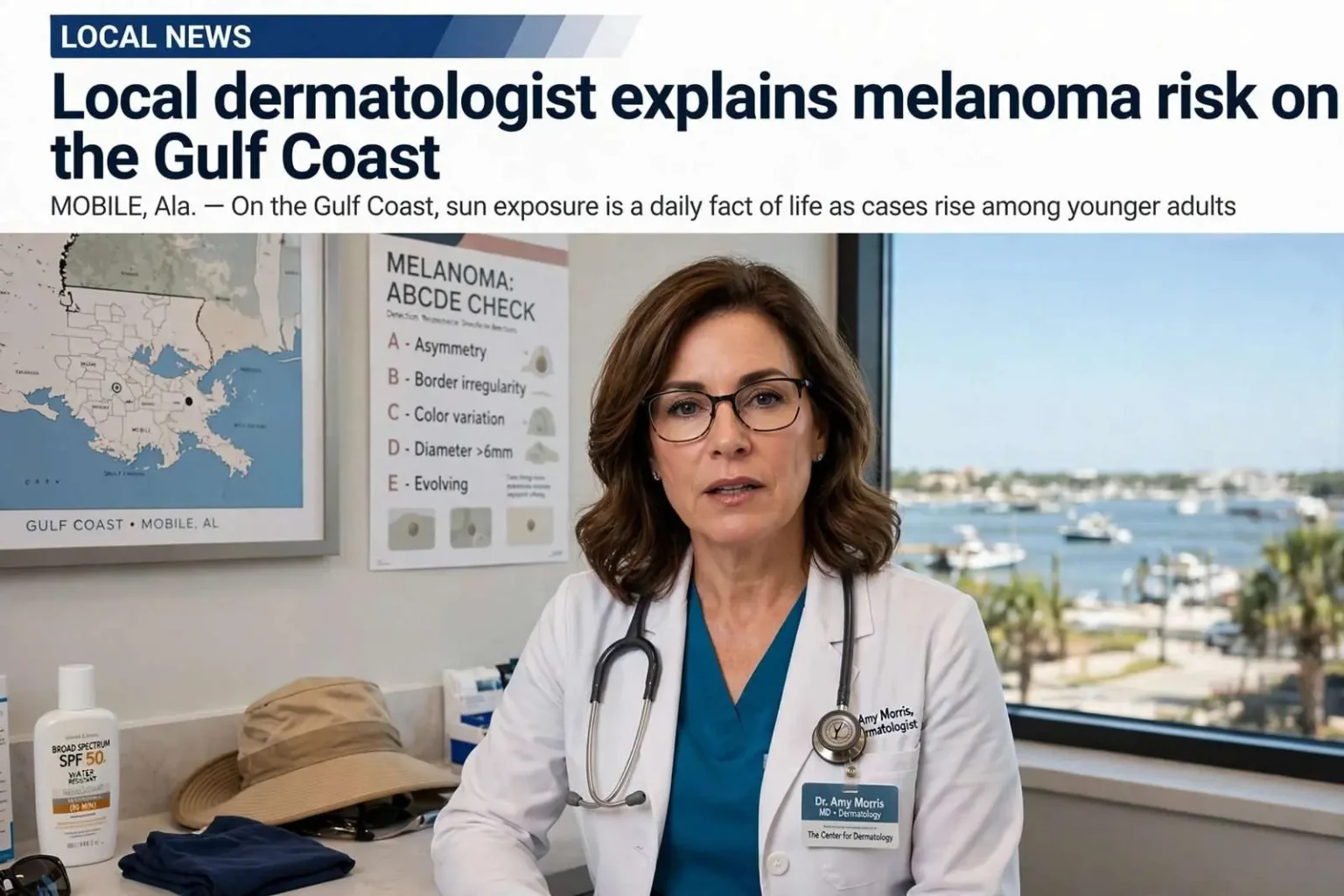
Local dermatologist explains melanoma risk on the Gulf Coast
A local dermatologist explains melanoma risk on the Gulf Coast, why there is no healthy tan, and how daily sun protection can lower skin cancer risk.
MOBILE, Ala. — Skin cancer is the most common cancer in the United States, and while melanoma makes up only about 1 percent of skin cancer cases, it causes a large share of skin cancer deaths. On the Gulf Coast, where sun exposure is a daily fact of life rather than a seasonal hazard, local dermatologists say protection needs to start early and never really stop.
“We probably see at least 50 skin cancers a week if not more, and I would not be surprised if we see new patients with melanoma at least once or twice a week,” said Dr. Amy Morris, a board-certified dermatologist with The Center for Dermatology. The volume she describes is not unusual for the region: along the northern Gulf, outdoor work, fishing, boating and beach culture add up to a lifetime of ultraviolet exposure that dermatologists see written on the skin of patients decades later.
Who is at risk
Some people face higher risk than others, and the traits that raise it are visible. “Fair skin and blue eyes [mean] we cannot protect our skin as well as those with pigment in their skin, and when you get a tan, any time your skin is darkening, that’s actually showing damage to your skin,” Morris said. The point runs against a stubborn cultural habit: the tan that Gulf Coast residents have long treated as healthy-looking is, in a dermatologist’s terms, the visible record of injury.
Melanoma is more than 20 times more common in white Americans than in African Americans, but darker-skinned people are not immune. “African Americans can get skin cancer, although rarer than those that are fair skinned. Bob Marley actually had melanoma and died of malignant melanoma at the age of 36,” Morris said. The reggae legend’s death from a disease that began, as his case did, under pigment is a standard warning in dermatology: no skin type gets a pass, and melanoma in darker skin is often caught later precisely because patients and clinicians do not expect it.
The risk profile extends beyond complexion to history. A person’s cumulative sun exposure, the number of severe sunburns and the family’s cancer history all shape the odds, which is why dermatologists ask about sunburns from childhood as carefully as they ask about the spots a patient can see today.
Geography does the rest. Mobile sits far enough south that ultraviolet radiation is intense twelve months a year, and the region’s outdoor economy, from construction sites to shrimp boats to youth sports fields, keeps its residents in the sun during the hours dermatologists most want them covered. A fair-skinned worker in south Alabama absorbs more annual sun than a beach vacationer in most of the country, and the skin clinics along the Gulf Coast exist in their present density largely because of it.
Rising among younger adults
The disease is increasingly showing up in younger people. Morris told reporter Cherish Lombard that melanoma is the most common cancer in adults ages 25 to 29, and that it is rising among women 15 to 29, likely tied to tanning bed use. The demographic is not the one most people picture when they hear the word cancer, and it is exactly the group indoor tanning has recruited for decades with the promise of a base tan before beach season.
“There’s no such thing as a ‘healthy tan,'” she said. The tanning industry’s claim that a controlled base tan protects against burning has been rejected by dermatologists, who note that any tan is a defense response to damage that has already occurred. For young women, the statistics on tanning beds have driven public health campaigns across the country, and Alabama dermatologists see the same pattern in their own waiting rooms.
The rise among younger patients changes the conversation doctors are having. A melanoma diagnosis at 27 carries consequences, from surgery to lifelong surveillance, that a 27-year-old rarely anticipates, and Morris’s message to that age group is that the habits of their twenties are written into their skin in their forties.
Protection that works on the Gulf Coast
Morris recommended sun-protective clothing such as rash guards, sunglasses and wide-brimmed hats for children, and making broad-spectrum sunscreen a daily habit. The emphasis on clothing reflects where sun protection science has moved: fabric is more reliable than a sunscreen application, which most people spread too thinly and reapply too rarely. A child in a rash guard at the beach gets a full day of protection that no lotion can match.
She noted that ordinary activities — driving, shopping, talking with neighbors outside — add up to cumulative exposure. “The skin is kind of like an elephant and it doesn’t forget any of the exposure,” she said. The left side of the face and the left arm of an American driver show what she means: decades of daily driving leave measurably more sun damage on the window side, a fact dermatologists can point to on patients’ skin.
The daily-habit framing is deliberate. Dermatologists long ago learned that sunscreen applied only for the beach misses most of the lifetime total, because the ordinary hours, the drive with the arm on the windowsill, the lunchtime errand, the conversation in a neighbor’s yard, are where the quiet accumulation happens. Broad-spectrum protection in the morning routine treats the sun the way the region should treat it: as a year-round fact, not a weekend event.
The stakes of that cumulative exposure are quantified. Having five sunburns in a lifetime more than doubles the risk of developing melanoma as an adult, according to Morris. On the Gulf Coast, where a childhood includes years of beach trips, fishing piers and ball fields, five sunburns is a low bar, and preventing them in children is the single clearest intervention dermatologists can point to.
What early detection looks like
Dermatologists pair prevention with surveillance, and the tools are simple enough to teach. The ABCDE checklist — watching moles for asymmetry, border irregularity, uneven color, diameter larger than a pencil eraser and any change or evolution — remains the standard advice for self-checks, and Morris’s volume of patients means the region’s clinics see the difference early detection makes every week. A melanoma found thin, before it grows downward, is highly treatable; one found late is the reason the disease’s death toll is so out of proportion to its case count.
Regular skin checks matter most for the region’s highest-risk residents: fair-skinned adults with a history of sunburns, patients with a family history of melanoma, and anyone with a mole that is changing. Dermatologists recommend an annual professional exam for those patients, and a monthly self-check for everyone, using a mirror and a camera phone to track spots that the eye might not notice changing week to week.
Clinics in the region also emphasize that skin cancer is not a single disease. Basal cell and squamous cell carcinomas, the two most common forms, are highly curable when caught but can disfigure when ignored, and both appear at the rates Morris described in her weekly patient volume. Melanoma gets the warnings because it kills, but the same sun that drives one drives all three, and the protection that prevents one prevents the others.
The daily-habit advice bears repeating in a climate like south Alabama’s, where ultraviolet levels are high enough for damage year-round. Sunscreen on the face and hands every morning, protective clothing for time outdoors, and shade in the middle of the day are the habits Morris’s specialty has spent decades teaching, and the region’s skin cancer numbers are the argument for treating them like seatbelts rather than beach-day extras.
The bottom line for the Gulf Coast
None of this means abandoning the outdoor life that defines the coast. Boating, fishing, beach days and backyard afternoons are the region’s currency, and dermatologists are not prescribing a life indoors. What they prescribe is the same discipline applied to any long-term risk: protection on children first, daily habits that require no judgment calls, and attention to the skin that catches problems while they are still easy to fix.
The numbers behind Morris’s waiting room tell the story a region needs to hear. Fifty skin cancers a week is not an abstraction; it is what daily sun, fair skin and decades of exposure produce in a Gulf Coast population. The disease’s answer is neither fear nor avoidance but arithmetic applied early: fewer burns, fewer tanning beds, more rash guards and more eyes on the moles that change, starting with the patients young enough to never need the lesson the hard way.
For parents, the guidance distills to a handful of habits worth starting this week: hats and rash guards for the kids, broad-spectrum sunscreen in the morning routine, and a standing annual exam if the family’s skin is fair or its history includes melanoma. The Gulf Coast is not going to cool down, and the sun is not going to soften. The protection, dermatologists say, has to come from the household, and it works best when it starts before the first sunburn rather than after the fifth.