
Locally Owned WHEX Community Radio Still Headed for 104.7 FM in Mobile
Mobile's nonprofit WHEX community radio station remains on track for a 104.7 FM launch by spring, with a new organizer leading the volunteer-driven effort.
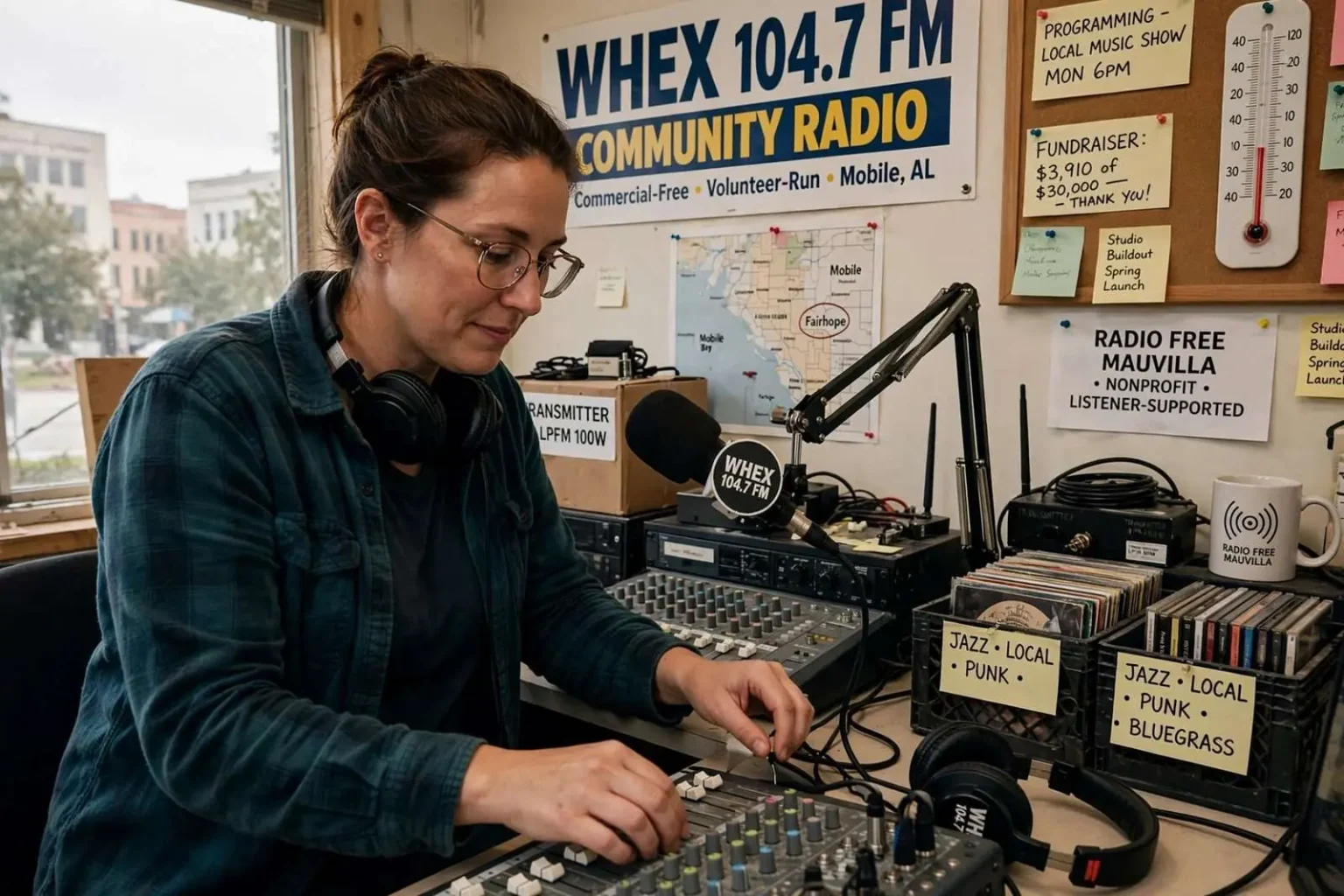
A homegrown, commercial-free radio station is still on its way to Mobile’s airwaves, according to the volunteers behind the project, though the launch date has slid about a year past their original target. Radio Free Mauvilla, the nonprofit group behind the planned low-power station WHEX, now expects to begin broadcasting at 104.7 FM by next spring. When the venture was unveiled a year ago, organizers had hoped to be on the air sometime in 2015.
The delay, volunteers say, reflects the unglamorous reality of building a radio station from nothing. An FM signal on paper is one thing; a studio, a transmitter, an antenna, a music library and a programming schedule are another, and every one of them costs money the group does not yet have. What has not changed is the destination: a volunteer-run, listener-supported frequency reserved for music and community voices that the commercial dial in Mobile does not carry.
New Leadership, Same Mission
Emily Hayes has taken over as the station’s organizer, replacing co-founder Trey Lane, who stepped aside to concentrate on other projects. Both previously spent years working together on the Mod Mobilian website, one of the city’s early independent online outlets, and the handoff keeps the project in familiar hands. The transition also signals that WHEX is intended to be an institution rather than a personal project, with leadership that can change while the mission holds.
Hayes said the group is wrapping up the behind-the-scenes groundwork before launch: choosing a studio space, building out the facility, assembling a music library and setting programming schedules. In the final stretch of an online fundraising push, the team is also preparing to reveal the key volunteers helping bring the station to life.
The declared mission is a nonprofit, listener-supported outlet that showcases music unavailable elsewhere on local radio while keeping the public connected to the work of area arts organizations and other nonprofits at no charge to those groups. Organizers describe WHEX as an effort to entertain, inspire and enrich listeners across the Mobile community through musical, cultural and educational programming.
In practical terms, that means airtime for genres that commercial radio in a market Mobile’s size tends to squeeze out: local and regional original music, jazz, punk, hip-hop, bluegrass and experimental work that has no obvious home on the corporate-formatted dial. It also means community bulletin-board service — announcements for gallery shows, benefit concerts, neighborhood meetings and nonprofit drives — delivered as a regular part of the broadcast day rather than an occasional public-service slot squeezed in after midnight.
Signal Range and Startup Costs
As a low-power station, WHEX will face natural limits on how far its signal carries, but Lane has said coverage should reach most of the mobile area, including the Eastern Shore — roughly from west Mobile out to Fairhope, based on current expectations. Low-power FM stations typically broadcast at 100 watts, a fraction of the power behind the market’s commercial signals, but a well-sited antenna covering the city proper and the bay can put the station in reach of a large share of the metro area’s listeners.
Funding remains the central challenge. The group’s GoFundMe campaign had collected $3,910 over five months toward a stated $30,000 goal to cover startup costs. Beyond underwriters from the local business community, organizers say pledge drives and memberships may also become part of the financing mix.
How Low-Power FM Works
WHEX belongs to a class of station created by the Federal Communications Commission at the start of the 2000s specifically to hand spectrum back to communities. Low-power FM licenses are reserved for nonprofits, schools, churches and local governments, they cannot be sold to the highest bidder, and they carry no commercial advertising requirement. The idea was to counterbalance two decades of media consolidation that had left most mid-sized markets, Mobile included, with a dial dominated by a handful of corporate owners playing syndicated formats.
The tradeoffs are built into the license. A low-power station generally transmits at 100 watts, reaching a radius measured in miles rather than the entire region, and it must yield to full-power stations whenever interference questions arise. Engineering is therefore as important as programming: finding an antenna site with the right height and proximity to the community of license can determine whether a station’s signal hugs its city or fragments across the metro area. Organizers’ projection that WHEX will stretch from west Mobile across the bay to Fairhope is an ambitious one for the class, and depends on how the transmitter site ultimately comes together.
What low-power stations lack in wattage they tend to make up in localness. Nationwide, the LPFM service has grown into a web of several hundred community stations, many run almost entirely by volunteer DJs who train on the equipment, host shows out of passion and answer directly to their listeners. Music programmers at LPFM stations are famous for taking chances — spinning local bands, deep album cuts and genres the commercial dial abandoned years ago — because no ratings service is dictating the playlist.
Why a Community Station Matters in Mobile
Mobile’s radio market mirrors the national pattern: strong signals, familiar formats, and little room for the city’s own musicians or for programming aimed at neighborhoods rather than demographics. A station like WHEX would give local artists their first reliable airplay close to home, would give the city’s many festivals, theaters and arts groups a free promotional channel, and would give listeners an alternative to a dial where the same songs rotate across several stations at once.
The station’s nonprofit partners stand to benefit in concrete ways. Because WHEX pledges to promote area arts organizations and nonprofits at no charge, the station would function as a civic megaphone — a place where a small theater company’s production, a food drive or a neighborhood association’s meeting can reach tens of thousands of listeners without a marketing budget. For groups that survive on volunteer energy and thin funding, that kind of free reach is a meaningful resource.
The volunteer model also creates a training ground. Community radio has historically been where young broadcasters, students and hobbyists learn the craft, and a Mobile station with open volunteer slots would give the city a pipeline of on-air and production experience that currently has no local home. Organizers’ plan to reveal the volunteers behind the launch suggests that pipeline is already forming.
The Money Question
The gap between what the group has raised and what it says it needs frames the project’s next chapter. Startup costs for a low-power station add up quickly even in volunteer form: a transmitter, antenna and cabling, studio equipment, licensing of the automation software many community stations run on, insurance, rent and the engineering studies required before the signal ever leaves the tower. The $30,000 goal Radio Free Mauvilla has set is modest by commercial standards — the price of a single market campaign for a commercial station — but for a fundraising effort powered by small donations, it is the mountain in front of the launch.
The fundraising approach mirrors the station’s philosophy. Rather than seeking a single corporate sponsor to bankroll the launch, the group is collecting small contributions online while planning pledge drives and memberships — the listener-support model that public and community radio has used for decades. If the pattern holds, the station’s budget will be owned by its audience from day one, which organizers argue is the surest guarantee that programming stays answerable to the community rather than to advertisers.
Underwriting will still play a role. Community stations commonly accept on-air acknowledgments from local businesses — brief, non-promotional announcements thanking an underwriter by name — which keeps revenue flowing without opening the door to full commercial breaks. Organizers’ mention of underwriters from the local business community suggests they intend to blend that traditional support with memberships and events rather than depend on any single source.
What Listeners Can Expect by Next Spring
If the spring target holds, the first months on the air will likely be scrappy. New community stations typically begin with a core block of volunteer-hosted shows, an automated music stream filling the overnight hours, and a schedule that expands as more volunteers complete training. The music library the group is assembling will be the backbone: shelves and drives of albums across genres that commercial radio in Mobile does not touch, curated by people who listen to music the way record store clerks do.
The programming schedules now being set will determine whether the station becomes a fixture or a whisper. Community stations that survive tend to establish anchor shows early — a morning program people build a habit around, a local music showcase, a weekly rundown of what is happening in the arts — and then let the edges of the schedule stay experimental. With the Mod Mobilian lineage behind it, Radio Free Mauvilla arrives with a built-in network of local musicians, writers and organizers who have been waiting for exactly this platform.
For now, the volunteers are asking for patience and, more to the point, for contributions. The date has moved once, and fundraising totals suggest it could move again. But the fundamentals of the project — an FCC license, a leadership team, a mission and a growing roster of volunteers — are all in place. Mobile’s airwaves, one of the last corners of the city’s media landscape without an independent local voice, are one transmitter, one studio buildout and one successful fundraising drive away from changing.
Listeners who want to follow the project’s progress can watch for the group’s announcement of its key volunteers, the unveiling of its studio location and the continuation of its online campaign — the milestones organizers say stand between the city and its first commercial-free frequency in years.


