
LoDa ArtWalk: Nine Gallery Openings Light Up Dauphin Street
Nine downtown Mobile galleries hosted openings, receptions and an artist talk for the March 2011 LoDa ArtWalk, from Cathedral Square to Space 301.
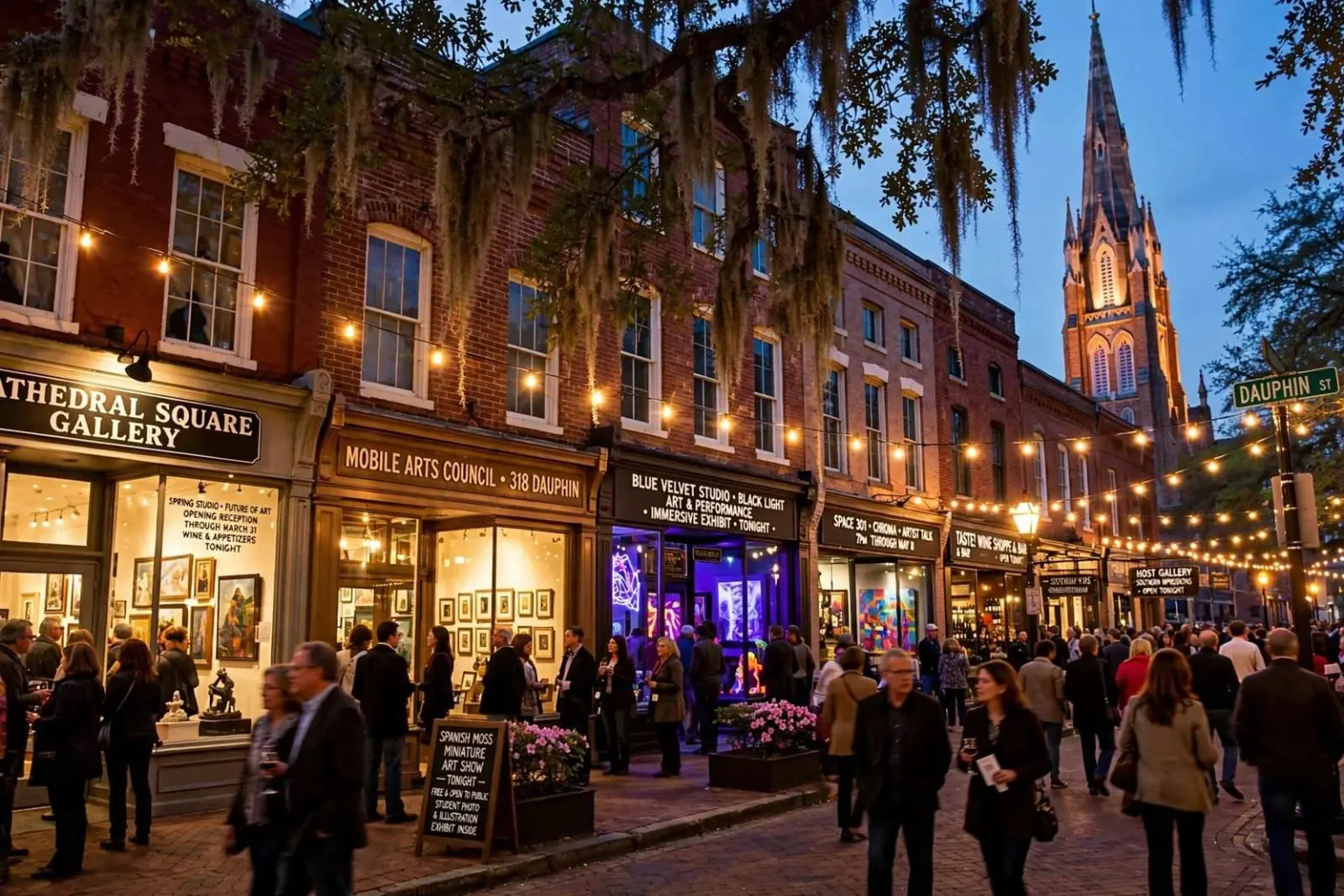
Downtown Mobile’s gallery district threw its doors open for the March 2011 LoDa ArtWalk, with nine venues along Dauphin and Royal streets hosting openings, receptions, and artist talks in a single evening. The monthly event — LoDa being the long-standing shorthand for the Lower Dauphin entertainment district — has become the anchor of downtown Mobile’s cultural calendar, an evening when the historic street transforms into a walkable gallery circuit drawing thousands of residents and visitors on foot.
The March edition showcased the range that has made the ArtWalk durable: painting, photography, sculpture, jewelry, illustration, and performance spread across commercial galleries, nonprofit spaces, and businesses that double as exhibition venues. Visitors could move from a formal gallery opening to a black-lit performance space to an animated film screening, all within a few blocks.
Along Dauphin Street
At Cathedral Square Gallery, Spring Studio’s “Future of Art” exhibition brought together figurative and sculptural work from featured artists Conroy Hudlow, Nancy Hanrath, and Joanne Brandt, with new artists Nikki McLaughlin and Conroy Hudlow also showing. The reception included music, wine tasting, and appetizers, and the show ran through March 31, giving visitors who missed the opening night nearly a month to catch the exhibition in the gallery adjacent to the Cathedral of the Immaculate Conception — one of downtown’s most picturesque settings.
The Mobile Arts Council at 318 Dauphin hosted three exhibitions at once for the Spanish Moss Miniature Art Show evening: the Alabama Miniature Art Society’s annual miniature project “Moments Not Lost,” photographs by Leigh Brown’s Photography III students from St. Paul’s Episcopal School, and illustrations for Eugene Walter’s Jennie the Watercress Girl created by Daniel Wildberger’s University of South Alabama students. The triple bill made the arts council the densest stop on the circuit, and its layered programming reflected the organization’s role as downtown Mobile’s community arts hub.
The miniature show highlighted a demanding artistic discipline. Miniature art requires working at a scale where precision matters more than gesture — small works, often executed with fine brushes or etching tools, judged for detail that rewards close viewing. The Alabama Miniature Art Society’s annual project brings together artists from around the state, and its appearance at the arts council connected Mobile audiences to a statewide community of practitioners.
The student exhibitions served a different purpose. Photographs by advanced students at St. Paul’s Episcopal School put high schoolers’ work on professional walls, while the University of South Alabama illustrations for Jennie the Watercress Girl — Eugene Walter’s celebrated story of a Mobile character who sold watercress downtown — tied the evening’s art directly to the city’s literary heritage. Walter, the Mobile-born writer, chef, and raconteur, remains one of the city’s most beloved cultural figures, and illustrations honoring his work resonated with the local audience.
Space 301 on Conti Street opened “Chroma,” featuring work by Susan Bremer, David Keens, Ben Shamback, and Tommy White, with an artist talk at 7 p.m.; the show continued through May 8. The Center for the Living Arts facility one block off Dauphin has been the district’s contemporary anchor, and an exhibition built around color — the literal meaning of chroma — gave the four artists a thematic frame for work spanning their different media and approaches.
Artist talks have become a distinguishing feature of the ArtWalk experience at Space 301 and similar venues. Hearing an artist discuss work in the same room as the work itself converts a casual gallery visit into something closer to a seminar, and the 7 p.m. slot placed the discussion at the heart of the evening’s foot traffic.
WellbornIdeas debuted “Life Outside the Cubicle,” abstract paintings by Robert C. Skye, with wine provided by Taste! Wine Shoppe and Bar. The title framed the show’s premise — work made beyond the office walls — and the venue itself embodied the ArtWalk’s hybrid character, where creative businesses host exhibitions alongside their regular operations.
The Host Gallery opened “Southern Impressions” from Stevi Gaston and Jacqueline Ellens. Host galleries along the Dauphin corridor have long mixed established regional artists with emerging names, and a two-person show built around Southern imagery fit the neighborhood’s sensibility, where regional identity is both subject matter and selling point.
Edward Jones Investments on Dauphin showed Mike Carmichael’s photography exhibition “Engaging Moments,” continuing the district’s tradition of financial services offices, salons, and storefronts doubling as satellite galleries. For artists, these alternative venues mean wall space and exposure beyond the formal gallery system; for the businesses, they mean foot traffic on a night when thousands stroll past their windows.
Blue Velvet Studio staged a black light exhibit of visual and performance art under fluorescent illumination — the most experimental presentation of the evening, transforming an ordinary storefront into a glowing immersive environment. Black light shows occupy a curious place in the art world, evoking both 1960s psychedelic culture and contemporary installation practice, and the studio’s staging gave ArtWalkers a sensory experience unlike anything else on the circuit that night.
Down Royal Street
Over on Royal Street, Kangal Gallery in the Sail Loft featured jeweler Cynthia Scott and photographer Michael Thomas during its open house. The Sail Loft building, part of the historic commercial fabric between Dauphin and Government streets, provided a venue one block south of the main corridor, and pairing jewelry with photography gave visitors both wearable craft and framed imagery in a single stop.
Jewelry exhibitions occupy a practical niche in the ArtWalk economy. Unlike large paintings, wearable pieces sell readily on the night of an opening, giving artists immediate income and galleries a commercial rhythm that sustains the district between bigger shows. Scott’s work drew collectors who follow the city’s jewelers, while Thomas’s photography broadened the gallery’s appeal for the evening.
The Crescent Theater rounded out the night with daily screenings of the animated film The Illusionist. The small cinema on Dauphin Street has been the district’s film home since it opened, beloved for independent and art-house programming unavailable at suburban multiplexes. The Illusionist, the hand-drawn French-British animation based on Jacques Tati’s unpublished script, had earned an Academy Award nomination that year, and its run gave ArtWalkers a natural evening capstone steps from the galleries.
Altogether, the March 2011 walk demonstrated the formula that keeps LoDa alive: nine venues, each offering something distinct, within walking distance of restaurants and bars that stay busy long after the gallery lights dim. For downtown Mobile — a district still rebuilding its nighttime economy from decades of suburban flight — the ArtWalk functions as both cultural event and commercial engine, proving month after month that the historic core can still draw a crowd.
For the artists showing in March 2011, the ArtWalk represented the most reliable audience in the region. A painter or photographer can wait months for a gallery opening in a larger city; in Mobile, the monthly walk guarantees every exhibiting artist a crowd of hundreds passing through their venue within a few hours, many of them arriving specifically to see new work. The format also lowers the barrier for first-time collectors — works at ArtWalk venues range from student pieces to established regional names, and the informal, wine-glass atmosphere makes buying feel like part of the evening rather than a transaction.
The student presence in the March edition deserves particular note. With Photography III students from St. Paul’s Episcopal School and USA students illustrating Eugene Walter’s work both on display at the Mobile Arts Council, the evening connected three generations of Mobile artists — working professionals, university students, and high schoolers still finding their medium. Arts councils in mid-sized cities across the country have found that exhibiting student work alongside professional shows builds the audience pipeline: young artists bring families and friends who might never otherwise enter a gallery, and some of them stay.
The geographic spread of the March venues — from Cathedral Square at the east end of Dauphin to the Sail Loft on Royal — also mapped the district’s growth. What began as a handful of galleries clustered on a few blocks had become a circuit that pulls walkers several blocks in every direction, past storefronts that benefit from the spillover whether or not they host art. City officials and downtown advocates have long credited the ArtWalk with anchoring residential and restaurant growth in the LoDa district, each successful walk adding evidence that the historic core can sustain a nighttime economy.
March’s timing helped as well. Early spring brings peak azalea season to Mobile, pleasant walking weather, and a steady stream of visitors in town for the city’s spring festivals — conditions that have historically made the spring ArtWalks among the best-attended of the year. With nine venues opening simultaneously, the district offered a full evening’s itinerary: exhibitions and receptions from Cathedral Square to Royal Street, an artist talk at Space 301 at 7 p.m., and The Illusionist at the Crescent for those who wanted to end the night in the dark with a story on screen.
By any measure, the March 2011 walk showed the LoDa ArtWalk doing what it was designed to do: turning Dauphin Street into an open house for the arts, giving Mobile’s artists an audience, its students a stage, and its downtown a heartbeat that returns on the first Friday of every month.


