Longtime Mobile Anchor Mel Showers Plans Major Announcement
Veteran Mobile anchorman Mel Showers, celebrating 50 years at the station he joined in 1970, announced plans for a major announcement on the 10 p.m.
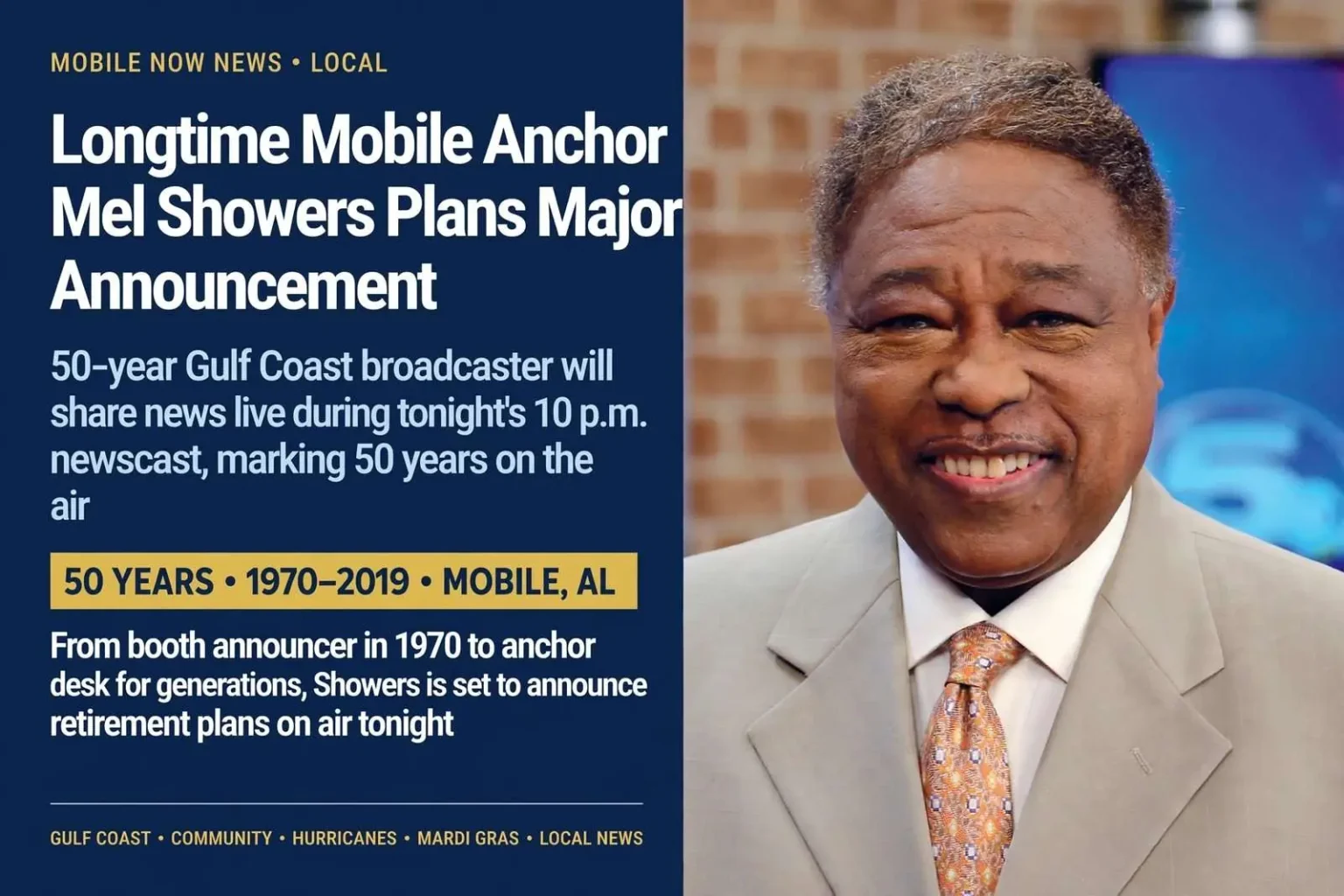
Longtime Mobile anchorman Mel Showers told viewers he planned to make a major announcement during the station’s 10 p.m. newscast that week, capping a remarkable half-century on the air. Showers reached 50 years with the Mobile television station in 2019. He was hired in 1970 and began as a booth announcer, delivering live hourly station identifications before moving in front of the camera as a news reporter in 1974. Over the decades that followed, Showers became one of the most familiar faces in Gulf Coast broadcast journalism, anchoring the news for generations of Mobile-area viewers.
The teaser alone was enough to set Mobile talking. Viewers who had welcomed Showers into their living rooms for decades understood that an announcement framed that way, from a man who had been at the station for fifty years, carried the weight of a milestone. Social media filled with speculation and affection, and by the time the 10 p.m. newscast arrived, the audience that had grown up with his voice was watching with a mixture of gratitude and dread, knowing that announcements of that magnitude from broadcasters of that tenure usually mean a farewell.
Showers’ story in Mobile television began long before he was an anchor. He joined the station in 1970 as a booth announcer, the voice behind the live hourly station identifications that punctuated the broadcast day in that era. The job was a classic proving ground of local television, demanding a steady voice and reliability at all hours, and it put the young announcer inside a newsroom at a moment when television news itself was growing into the dominant source of information for Gulf Coast households.
In 1974, Showers moved from the booth in front of the camera, joining the station’s news operation as a reporter. The move came as local news was expanding its reach and ambition, with stations across the country investing in their news departments and reporters becoming the faces their communities trusted. Showers spent his reporting years learning the Gulf Coast beat by beat — city hall, the courts, the neighborhoods, the storms — and building the institutional knowledge that would define his later work at the anchor desk.
Half a century on Gulf Coast television
By 2019, Showers had been part of Mobile television for fifty years, a tenure that made him one of the longest-serving broadcasters in the region’s history. Five decades span an astonishing stretch of change: the transition from film to videotape to digital, the arrival of color everywhere, satellite news gathering, the internet, social media and the fragmenting of the audience into a thousand streams. Through all of it, Showers remained a constant, a presence so embedded in the community that generations of families could say they had always watched him deliver the news.
Anchoring in a market like Mobile demands a particular kind of connection. The Gulf Coast is a region with its own rhythms — hurricane seasons that put entire communities on edge, Mardi Gras celebrations that fill downtown streets, high school football rivalries, a port and shipbuilding economy, and the everyday news of neighborhoods from Prichard to Theodore, Saraland to Tillmans Corner. An anchor who lasts is one who understands those rhythms and treats the audience as neighbors rather than numbers. Showers’ longevity testified that he had done exactly that.
The years Showers covered included the moments that defined the region’s recent history. Hurricanes have swept the Gulf Coast repeatedly during his tenure, and Mobile viewers learned during those emergencies to rely on the steady delivery of information that local anchors provide — the school closings, the evacuation routes, the storm tracks, the recovery updates. Broadcasters who anchor through such events become part of the community’s memory of them, and Showers’ voice accompanied the region through decades of trials and recoveries.
His half-century also made him a mentor and an institution inside the newsroom. Young reporters who passed through Mobile learned from a colleague who had seen every kind of story the Gulf Coast could produce. Longtime co-workers built careers alongside him. The station’s identity and the anchor’s identity became intertwined over fifty years, which is why the prospect of a major announcement resonated so broadly beyond the newsroom itself.
The announcement and what it meant
Retirement announcements from beloved local anchors carry a weight that national media departures rarely match. A local anchor is not a distant celebrity but a daily companion, present at the breakfast table and the evening wind-down, through celebrations and emergencies. When that presence ends, the community loses not just a broadcaster but a fixture of its shared routine. In Mobile, where Showers had anchored longer than many of his viewers had been alive, the departure marked the close of an era measured in generations.
His career also stands as a piece of Gulf Coast broadcasting history. The booth announcer hired in 1970 entered a profession in which Black journalists were still fighting for opportunity in newsrooms across the South, and his rise from hourly station identifications to the anchor desk traced the broader opening of the industry over the decades that followed. Showers became one of the most recognizable Black broadcasters on the Gulf Coast, and for young viewers growing up in Mobile he stood as proof of what a career in journalism could look like and who could have one.
Colleagues and viewers alike marked the milestone year by recalling the qualities that kept him on the air so long: a calm presence, a deep connection to the community, and a professionalism that held steady from routine weeknights to hurricane coverage. Those qualities are harder to measure than ratings, but they are the ones that explain why a half-century tenure is so rare in an industry defined by constant movement between markets. Anchors who stay for decades in one city do so because that city keeps choosing to watch.
Mobile and its broadcast history
Mobile’s television market reaches across south Alabama and into northwest Florida, serving communities from the Mississippi line to Pensacola. The city’s stations have been part of the region’s life since the early days of television, covering the port, the shipyards, the paper industry, the beaches and the storms that shape everything else. Broadcasters who spend their careers here become regional figures in a way that differs from big-market fame: they are recognized at the grocery store, at church, at Mardi Gras balls, and treated as neighbors because that is what they are.
Showers’ fifty years coincided with the maturing of that local television culture. The station identifications he once delivered live each hour belonged to an era when announcers were the connective tissue of the broadcast day; the anchor desk he later occupied belonged to the era of personality-driven local news. Few careers span both, and fewer still remain anchored in a single market from beginning to end. That arc — from the booth in 1970 to the anchor desk in 2019 — is precisely what made his announcement feel like the turning of a page in the city’s own story.
The 10 p.m. newscast where he shared the news was, fittingly, the kind of broadcast he had anchored thousands of times: the day’s headlines delivered to the Gulf Coast with the steadiness viewers expected. What was different was what the announcement itself meant — that the familiar figure behind the desk would not be there indefinitely, and that the community’s evenings would eventually carry a different voice.
A community’s farewell
In the days surrounding the announcement, viewers filled social media with tributes that read like family letters. People wrote about watching him as children and then watching with their own children. Current and former colleagues shared stories from the newsroom. The scale of the response confirmed what the half-century tenure already implied: Showers’ presence in Mobile households had been continuous enough, and trusted enough, that his retirement touched people who had never met him.
When the 10 p.m. newscast arrived, Showers delivered the announcement he had promised: he was retiring, stepping away from the anchor desk after fifty years with the station. The news confirmed what many viewers had suspected, and it converted weeks of speculation into a concrete moment the community could respond to — and respond it did, with an outpouring of congratulations, memories and thanks from viewers across the Gulf Coast who had made his broadcasts part of their daily lives.
Such departures also prompt reflection on what local news means to a community. In an era when national headlines arrive instantly on every screen, local anchors remain the voice that explains what a hurricane track means for a specific street, why a school board decision matters to a specific neighborhood, which bridge is closed and when it reopens. Fifty years of that work built a bond between Showers and his viewers that no algorithm can replicate, and his announcement was the community’s occasion to acknowledge it.
Showers reached 50 years with the station in 2019, was hired in 1970 as a booth announcer delivering live hourly station identifications, moved in front of the camera as a news reporter in 1974, and grew into one of the most familiar faces in Gulf Coast broadcast journalism. The major announcement he planned for the 10 p.m. newscast told viewers what fifty years had built toward: the end of a nightly presence and the start of a retirement earned across an entire career. Mobile’s reaction made clear how much that career had meant — and how deeply the anchor’s voice had woven itself into the story of the city he served.