Looking Back: How 2015 Reshaped Mobile’s Live Music Landscape
From the end of BayFest to the birth of Ten Sixty Five and the opening of The Merry Widow, 2015 brought major shifts to Mobile's live music scene.
Looking back on 2015, many longtime observers of Mobile’s music scene may remember it as the year long-simmering shifts finally became visible. Between the loss of a two-decade-old institution, the rise of a scrappy replacement, and new investment in venues and recording space, the Port City’s music community saw both endings and new beginnings play out over twelve eventful months.
The most significant story was the end of BayFest
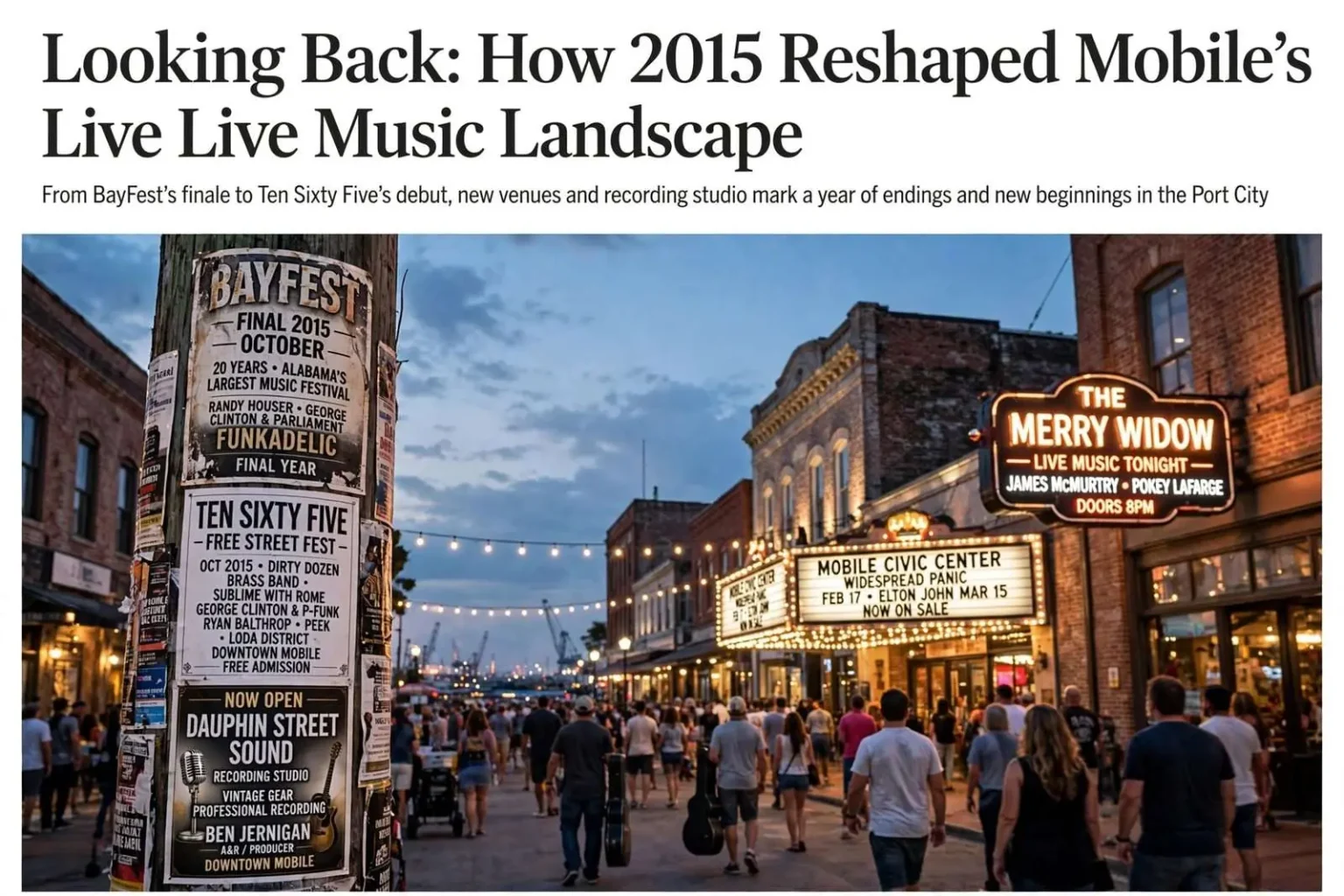
For 20 years, the festival filled downtown Mobile’s streets with major touring acts, eventually earning a reputation as “Alabama’s Largest Music Festival.” Over its run, BayFest hosted performers including Kid Rock, Motley Crue, R. Kelly, Al Green and Godsmack, while also giving local musicians a rare chance to perform for large crowds. The festival’s final lineup, featuring Randy Houser and George Clinton & Parliament Funkadelic among others, closed out two decades of history in 2015.
BayFest’s loss was felt on both ends of the bill. The festival’s headline stages put national acts in front of audiences that could not otherwise have seen them without a drive to New Orleans or Birmingham, while its smaller stages functioned as a proving ground where local bands played to the biggest crowds of their year. Its disappearance left both of those roles unfilled overnight, and it removed from the calendar an event that had anchored downtown hotels, bars and restaurants on an October weekend for two decades.
Ten Sixty Five rises to fill the void
Almost immediately, a new event rose to fill the void. Ten Sixty Five, part street party and part music festival, came together quickly as production crews built stages in the streets of downtown Mobile and organizers scrambled to book bands with open dates. The gamble paid off: alongside local acts such as Ryan Balthrop and Peek, the free event landed performances from George Clinton & P-Funk, Dirty Dozen Brass Band and Sublime with Rome, drawing praise from both fans and downtown businesses in the LoDa district.
The speed of the assembly was the remarkable part. Festivals normally take a year or more to book, permit and promote; Ten Sixty Five went from idea to stages-in-the-streets in a matter of weeks, riding the momentum of bands whose summer tour schedules had just been disrupted by BayFest’s cancellation. The free-admission model traded guaranteed revenue for crowds, and the crowds came — filling LoDa’s blocks with an audience size that surprised even veteran observers of the scene.
Whether Ten Sixty Five returns, and what it might eventually charge for admission, remained an open question as the year closed, along with speculation about whether it could ultimately claim BayFest’s old title as the state’s largest music festival. Free events are easy to love and hard to sustain, and the debate over a ticket price — however modest — would decide whether the festival could afford the production values that made its first year feel like a real replacement rather than a one-time street party.
Jake Peavy invests in the city’s sound
Former Major League Baseball pitcher and Mobile native Jake Peavy was among Ten Sixty Five’s biggest backers, a reflection of his continued investment in the city’s music identity. Peavy and his brother, Luke, also opened Dauphin Street Sound, a recording studio housed in the space that formerly held Jada Recording Studio. Billed as a full-service production facility built around vintage instruments, the studio has also brought on local guitarist Ben Jernigan as an A&R representative, producer and ambassador to the local scene, with the Peavys hoping the operation will help fuel a broader musical vitality along the Gulf Coast.
A professional-grade studio on Dauphin Street changes the math for local artists. Recording a proper album once meant traveling to New Orleans, Nashville or Atlanta; a facility with vintage gear in downtown Mobile keeps that work — and its spending — in the city, and gives touring acts passing through a reason to book studio time between dates.
The Civic Center question
The Mobile Civic Center also generated headlines in 2015. Outside of the annual run of Mardi Gras balls, the aging venue has mostly hosted occasional concerts and dance recitals in recent years, and Mayor Sandy Stimpson announced plans to close it in April 2016. That announcement drew pushback from Mardi Gras mystic societies, whose ballroom seasons are built around the facility, and not long after, the Civic Center booked two major shows: Widespread Panic in the Civic Center Theater on Feb. 17, and Elton John on March 15.
The bookings were read two ways at once: as proof the aging venue could still draw arena-class acts when booked aggressively, and as a last showcase before a decision on its future. For the music scene, the distinction mattered — a city of Mobile’s size needs a mid-size indoor room between the clubs and the football stadium, and the Civic Center, whatever its maintenance bills, was the only building that had ever consistently filled that role.
The dispute also exposed how entangled the venue was with Carnival. Dozens of mystic societies stage their balls there each season, and the ball calendar is booked years in advance. Any plan for the Civic Center had to account for Mardi Gras as much as for concerts — a reminder that in Mobile, music and Carnival infrastructure are often the same buildings.
The Merry Widow completes the club ladder
Downtown also gained a new stage with the opening of The Merry Widow, which cleared a series of legal hurdles before debuting a strong sound system and interior that quickly attracted touring acts such as James McMurtry and Pokey LaFarge alongside local favorites.
Its arrival gives Mobile three stable, original-music venues for the first time in years, creating a kind of tiered system for local bands: acts can build a following at the intimate Blind Mule, graduate to Alchemy Tavern as their draw grows, and eventually headline The Merry Widow, a structure that gives Mobile artists a way to test whether they are ready to tour beyond the city while still being able to fill a hometown room.
That ladder matters more than any single venue. Scenes thrive when a band can measure its growth room by room — fifty people at the small stage, a hundred and fifty at the mid-size room, four hundred at the newest hall — because each step gives the band a reason to keep improving and the audience a next venue to graduate to. Touring acts noticed the system too: McMurtry and LaFarge are precisely the kind of national and regional touring artists who route through a city when there is a reliable room at each capacity level.
Groundwork, not a finished product
Taken together, these developments suggest 2015 laid groundwork rather than delivering a finished product. Whether that groundwork translates into lasting momentum will depend on local bands staying visible, fans continuing to turn out and spend money on music and merchandise, and venues continuing to balance national acts with homegrown talent.
The year’s lesson, if it taught one, was that Mobile’s music economy runs on audacity. BayFest’s two decades were built by volunteers who kept scaling up a street festival until it became the state’s largest. Ten Sixty Five was assembled in weeks by people who refused to let the calendar go dark. A big-leaguer built a recording studio on the street where he grew up, and a new club bet on original music in a market long skeptical of it. None of it was guaranteed — and none of it would have happened without people willing to build first and ask permission after. For a scene that spent 2015 losing its biggest institution, that turned out to be a decent trade.
What the studio means for local artists
Dauphin Street Sound’s opening rippled through the scene in ways that went beyond its gear list. A studio owned by someone with national visibility — and staffed by a working local guitarist whose job was explicitly to connect with the scene — signaled to regional artists that Mobile intended to be a place where records were made, not just performed. Producers and engineers followed the work, and young bands who had never considered recording professionally suddenly had a facility a short drive from their practice rooms.
The vintage-instrument angle also shaped the sound coming out of the building. Vintage guitars, amps and keyboards carry tonal character that digital simulations approximate but never quite match, and a studio built around them attracts artists chasing the analog textures that define much of the soul, country and roots music the Gulf Coast has always produced. That lineage — from the region’s muscle-shoals-adjacent soul tradition to its barroom country — is precisely the catalogue such a facility is built to record.
How the pieces fit together
Seen separately, the year’s developments were a series of disconnected headlines. Seen together, they formed an infrastructure: festivals to create audiences, venues to develop bands, and a studio to capture the results. That is the full chain a music scene needs, and Mobile ended 2015 with every link at least provisionally in place — something the city could not claim the year before.
The weak points were as visible as the strengths. Ten Sixty Five’s business model was unproven. The Civic Center’s future was unresolved, and with it the city’s only true mid-size indoor room. The Merry Widow’s legal troubles, whatever their final resolution, were a reminder that opening a venue in Mobile meant navigating a permitting and licensing system not designed with music venues in mind. And BayFest’s absence left a hole in the nonprofit and volunteer infrastructure that had taken twenty years to build — institutional knowledge no single replacement event could recreate in one season.
The year ahead
For the musicians, the practical takeaway was opportunity. A local band in early 2016 could record at a professional studio on Dauphin Street, play three rooms downtown at increasing capacity, and aim for a festival stage in the fall — a career path that simply did not exist in Mobile a year earlier. For fans, the choice was broader than at any point in recent memory: national touring acts at the new club, homegrown songwriters at the taverns, and the possibility of a new festival carrying the flag BayFest left behind.
Scenes are built in years like this one — not the triumphant years, but the contested ones, when institutions fall and replacements are improvised under pressure. By that measure, 2015 may prove one of the more consequential years in Mobile music history, whichever way the follow-up questions resolved.