Love Your Community Anti-Litter Campaign Relaunches in Mobile County on Earth Day
Mobile County's Love Your Community anti-litter program relaunches on Earth Day, offering grant funding to volunteer teams for cleanup and environmental.
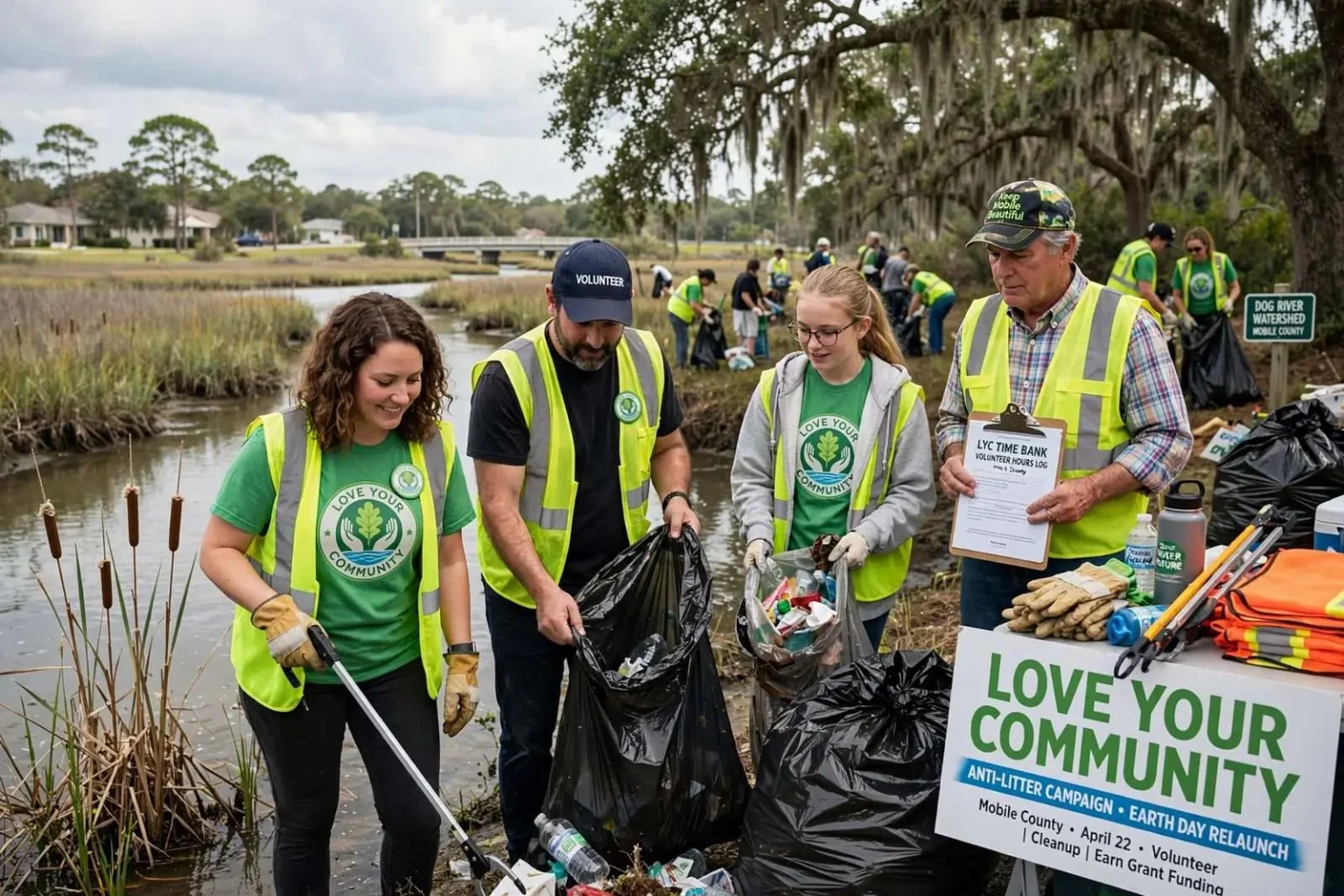
The Love Your Community (LYC) anti-litter program has relaunched in Mobile County with an Earth Day kickoff, offering volunteer teams the chance to earn thousands of dollars in grant funding for environmental improvement projects. The return of the program reopens one of the county’s most successful volunteer initiatives at a moment when litter and its downstream effects on waterways remain a persistent concern across the Gulf Coast.
The program, which began in 2018, mobilized more than 65 teams and 600 volunteers in its first two years before the pandemic put activities on hold. That early record made LYC one of the region’s more visible environmental volunteer efforts, pairing the practical work of roadside and neighborhood cleanups with a funding mechanism that converted volunteer hours into money for lasting projects. The Earth Day relaunch signals the county’s intention to rebuild that momentum after more than a year of suspended activity.
Under the initiative, teams of one to 50 or more members select locations within Mobile County to monitor, organize, and schedule cleanup activities. The flexibility is deliberate: a team can be as small as a single household adopting a corner or as large as a corporate volunteer corps covering a multi-mile corridor. Equipment and cleanup supplies are provided by the county, removing the cost barrier that keeps many would-be volunteers from starting their own cleanup efforts. Teams commit to monitoring their chosen locations over time, which turns one-time events into sustained stewardship.
“This is a great opportunity for neighborhood associations, workplace groups, schools and community service organizations to get involved and earn funds for environmental improvement projects,” said District 2 Commissioner Connie Hudson, who led the effort to establish the program. “Together we can keep litter out of our community and waterways and make Mobile County a cleaner, healthier, and more attractive place to live.”
How the Time Bank Works
A new time-banking initiative allows teams to deposit volunteer hours through the LYC website or by mail. Hours accumulate in the Love Your Community Time Bank and can eventually be exchanged for grant funding. The design links effort directly to reward: the more hours a team logs cleaning and monitoring its adopted areas, the greater its eventual claim on grant dollars.
Grants must be used for projects in public rights-of-way and common areas, including recycling efforts, community gardens, park projects, and beautification initiatives. That scope ensures the money produced by volunteer labor flows back into shared spaces — the roadside ditches, neighborhood parks, and common areas where litter accumulates and where improvements benefit everyone. A team that spends a year clearing debris from a roadway can channel its earned hours into a community garden or a recycling station that serves the same neighborhood.
The time-bank model also addresses a chronic weakness of volunteer programs: sustaining engagement between cleanup events. By accruing value continuously, the system gives teams a running score and a tangible stake in staying active month after month, rather than appearing once for a photo opportunity and disappearing.
Partners Behind the Program
The program is coordinated in partnership with Keep Mobile Beautiful, Inc., the Alabama Coastal Heritage Trust, and Clean Water Future. Each partner brings a piece of the expertise a countywide anti-litter effort requires. Keep Mobile Beautiful has long operated in the space of litter prevention and community cleanup; the Alabama Coastal Heritage Trust connects the work to the protection of coastal resources; and Clean Water Future focuses on the water-quality stakes that make litter more than a cosmetic problem.
The partnership structure reflects the way litter actually moves through a coastal county. Debris dropped on a Mobile County roadside travels through storm drains into creeks, rivers, and eventually Mobile Bay and the Gulf, where it threatens wildlife, water quality, and the tourism economy that depends on clean beaches and waterways. Anti-litter work in a place like Mobile County is therefore never just about appearances; it is an environmental intervention that begins on the roadside and ends in the Gulf.
Mobile County’s geography makes that connection especially visible. The county’s neighborhoods sit within a network of watersheds — including those feeding Dog River, Three Mile Creek, and Mobile Bay — where stormwater carries whatever the rain washes off streets and parking lots. Volunteer teams that clear litter before storm events directly reduce the load reaching those waterways, which is why programs like LYC count waterway protection among their core goals rather than treating it as a distant side benefit.
Why the Earth Day Timing Matters
The Earth Day relaunch ties the program’s return to the calendar’s most recognizable environmental occasion, a date that reliably draws schools, employers, and civic groups toward hands-on projects. For organizations deciding whether to field a team, the holiday provides both a reminder and a natural starting point: sign up in the spirit of the season, then carry the commitment through the rest of the year.
Commissioner Hudson’s role in establishing the program in 2018 has also shaped its design. Her description of the opportunity — aimed squarely at neighborhood associations, workplace groups, schools, and community service organizations — lays out the intended coalition. Schools can use participation to teach environmental stewardship while earning grant money for campus projects; workplace groups gain a structured team-building activity with visible local results; and neighborhood associations get a tool for tackling the chronic dumping sites and roadside clutter that drag down their communities.
The program’s first two years offered a proof of concept. More than 65 teams and 600 volunteers represented a base of experience the county can reactivate as LYC returns, and many of those teams are expected to re-register for a second run. The challenge now is reaching new participants — the employers, congregations, and civic clubs that never joined before the pandemic interruption.
Getting Involved
Interested teams can register at LoveYourCommunity.com or call 251-444-7144. Registration begins the process of selecting a location, scheduling activities, and arranging for the county-provided equipment and supplies. From there, logged hours begin accumulating in the time bank, and grant eligibility follows.
For residents weighing whether to participate, the program’s structure offers a straightforward proposition. The county supplies the tools, the partner organizations supply the coordination and expertise, and the volunteers supply the labor — and the labor, banked hour by hour, converts into grant funding for whatever improvement project the team chooses to pursue in a public space. In an era when local environmental budgets rarely stretch far enough, LYC turns the county’s most abundant renewable resource — people willing to spend a Saturday morning with a trash bag — into measurable, lasting improvements to public spaces and waterways across Mobile County.
The relaunch also arrives as communities across Alabama confront the true cost of litter, which extends well beyond the aesthetic. Roadside debris clogs drainage infrastructure, contributing to localized flooding during heavy rain events. Illegal dump sites attract more dumping, converting a few discarded items into entrenched blight. Cleanup itself costs municipalities and county crews substantial labor and equipment time every year, money that could otherwise fund parks and infrastructure. Volunteer programs like LYC attack the problem at its source by putting eyes and hands on the locations most prone to accumulation.
Lessons From the First Two Years
The 2018-2019 run of the program produced lessons that carry into the relaunch. Teams that succeeded tended to be those with a specific, recurring stake in their chosen locations — the association whose entrance corridor they adopted, the business whose adjacent roadway they patrolled, the school whose students walked the route daily. That ownership dynamic turned cleanup from a chore into an extension of an existing identity, which is precisely the behavior the time bank is designed to reward and reinforce.
The scale flexibility — from one member to fifty or more — also proved its value in the program’s early years. Small teams could cover places too minor for a large organized effort, while big corporate or church groups could take on heavily littered corridors in single ambitious events. The county’s provision of equipment meant that neither type of team needed to invest in its own grabbers, vests, bags, or disposal arrangements, keeping the barrier to entry near zero.
The Earth Day kickoff positions the relaunched program to rebuild toward and beyond its pre-pandemic participation. The original cohorts demonstrated that Mobile County residents will turn out for environmental work when the structure makes it easy; the task of the relaunch is to remind those volunteers and recruit their successors. With registration open, equipment available, and grant funding tied to hours worked, the county has restored the framework that produced more than 600 volunteers in the program’s first incarnation.
What Teams Can Earn Toward
The menu of eligible grant projects gives teams meaningful latitude within a shared environmental purpose. Recycling efforts might mean establishing collection points in common areas or organizing recycling drives for materials that curbside service does not reach. Community gardens convert vacant or underused public ground into productive green space that feeds neighbors and builds social ties. Park projects can range from new amenities to habitat-friendly landscaping, and beautification initiatives cover the plantings, murals, and improvements that make public spaces places people care for rather than pass through.
What unites the eligible categories is permanence. Unlike the cleanup events that generate the hours, the grant projects leave something behind: infrastructure, green space, or a system that continues functioning after the volunteers go home. That two-stage design — labor now, legacy later — is the program’s central insight, and it explains why the county and its partners describe LYC as an environmental improvement program rather than a cleanup program.
For the moment, the practical next step for any interested group is registration at LoveYourCommunity.com or a call to 251-444-7144. The Earth Day relaunch opened the door; the teams that walk through it will decide how much of the county’s litter problem — and how many of its community projects — get addressed in the program’s second act.