Lurleen B. Wallace: The Story of Alabama’s First and Only Female Governor
How Lurleen B. Wallace became Alabama's only female governor, from her 1966 landslide to her Baldwin County visits and legacy.
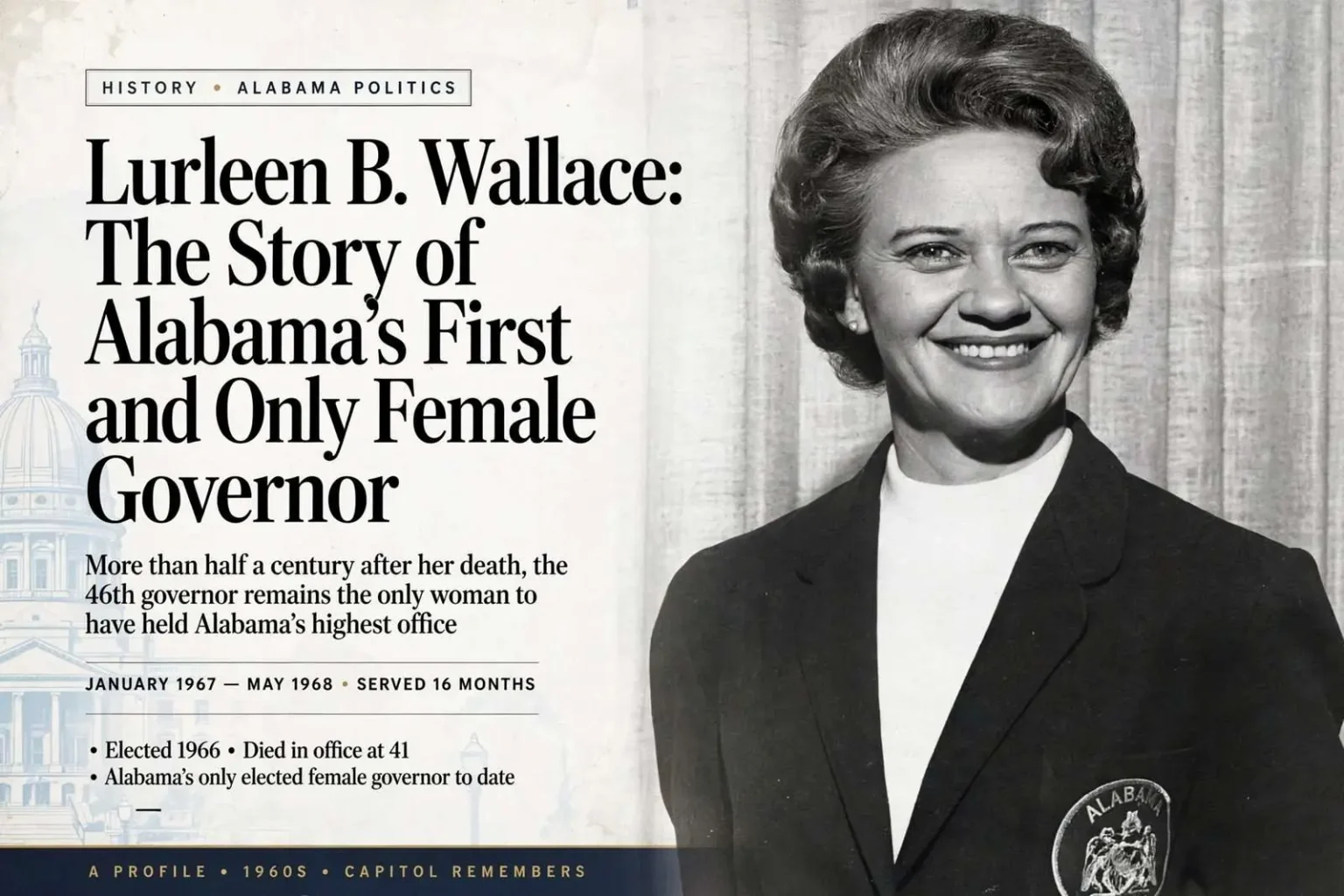
More than half a century after her death, Alabama has still elected only one woman as governor: Lurleen B. Wallace, the state’s 46th chief executive, who took office in January 1967 and died before finishing her term.
Her path to the governor’s office was unlike any other in state history. Born in 1926 and raised in north-central Alabama, she graduated from Tuscaloosa High School and went to work in a local store, where she met George C. Wallace. The two married in May 1943, and for the next two decades she raised four children while running campaign after campaign as her husband climbed from the state legislature to a judgeship and finally the governor’s office.
The campaigns were a family enterprise in the fullest sense. Lurleen Wallace organized, traveled and kept the household running through races that took the Wallaces into every corner of Alabama, building the political operation that would eventually carry her own name to the top of the ticket.
A candidate of her own
Banned by term limits from succeeding himself, George Wallace eyed a 1968 presidential run — and Lurleen agreed to run for governor in his place. Early in the race she let her husband set the pace, but she soon took center stage at rallies across the state.
“I’m excited, yes, but not frightened,” she told an interviewer during the campaign, adding, “If I run, I expect to win.”
The arrangement made constitutional sense in Alabama, where the 1901 Constitution’s term limits barred a governor from succeeding himself. A stand-in candidacy kept the Wallace political machine in the governor’s office while its leader pursued the national stage, and voters understood exactly what they were being offered — a campaign that promised a continuation of the Wallace agenda, delivered by the person closest to it.
What the arrangement could not plan for was how good a candidate Lurleen Wallace turned out to be. Shy in early appearances, she grew into the role of a statewide campaigner, and by the end of the race she was drawing crowds and delivering the pitch in her own voice.
In the May 3, 1966 Democratic primary she won decisively, drawing more than 480,000 votes against roughly 172,000 for former Attorney General Richmond Flowers, her closest competitor. That November she captured 63 percent of the general-election vote — 512,970 ballots — nearly double her opponent’s total.
The margins made the point that this was more than a placeholder’s victory. Alabama’s Democratic primary was, in that era, the decisive contest in state politics, and the general election confirmed a level of support few candidates matched. She would be inaugurated in January 1967 as the first woman elected governor of Alabama — and, so far, still the only one.
The Baldwin County connection
South Alabama figured prominently in her brief tenure. She made her first official visit to Baldwin County representing Gov. George Wallace in May 1966, appearing at the opening of Gulf Shores’ new tourist information center, and returned that October with the governor to speak at venues including the Baldwin County Fair in Robertsdale.
Her father, Henry Morgan Burns, had worked as a crane operator in Mobile during World War II.
The family tie to the coast gave her visits here a homecoming quality, and Baldwin County’s explosive mid-century growth made it a stop no statewide politician could skip. The tourist information center she opened in Gulf Shores marked the city’s arrival as a destination — the beginning of the beachfront tourism economy that now defines Alabama’s coastal strip — and her appearances at the fairgrounds in Robertsdale drew the kind of crowds that county fairs have always promised.
A governorship cut short
Cancer, first diagnosed during George Wallace’s initial term, cut her governorship short. She died in May 1968 at age 41, less than halfway through her term, becoming one of the few governors in American history to die in office while the state watched a story of illness and duty unfold in public.
She had continued working through a diagnosis she initially kept private, making public appearances and pressing the agenda she had campaigned on even as her health declined. Her final months in office drew national attention — a sitting governor, a wife and mother, facing a terminal illness while leading a state — and Alabama watched her fight it as her condition worsened through 1967 and into 1968.
Her death in May 1968, less than a year and a half into the term, stunned the state. Flags flew at half staff, and thousands of Alabamians filed past her casket in the Capitol — the same building where she had taken the oath sixteen months earlier. She was buried with the distinction of a governor who had earned the office, whatever the circumstances of her candidacy.
What she accomplished in sixteen months
Her brief tenure was more consequential than its length suggests. Lurleen Wallace used her time in office to press for increased funding for the state’s mental health system, an issue she championed after witnessing conditions in Alabama’s aging institutions, and she worked with the Legislature on improvements that outlasted her administration.
The governor’s office also gave her a platform on the issues her husband’s presidency campaign had raised, and she defended the administration’s positions in public appearances while managing a state. Observers who expected a figurehead found a governor who took the work seriously, and lawmakers who might have tested the new governor instead found her engaged in the details of legislation and budgets.
Her illness also changed the state’s political calendar in an unexpected way. As her condition deteriorated, questions of succession moved to the forefront, and Alabama’s constitutional machinery — which had made her candidacy possible — was tested by her incapacity and death. The lieutenant governor stepped into the office upon her death, and George Wallace, freed by her election from the term limit, returned to the governorship in the election that followed.
A legacy that outlasted her
Half a century later, the landmarks of her legacy are scattered across the state. The community college that carries her name in south Alabama, the hospital and public buildings named for her, and her place in the state’s history books mark a career compressed into fewer than two years of office.
Her record also stands as a milestone in Southern political history. At a time when women held few statewide offices anywhere in the country, Alabama’s voters put one in the governor’s office — and, in the half century since, no other woman has won the job in this state. The fact is cited often in discussions of Alabama politics, and it keeps her story in circulation decades after her death.
Historians who study her governorship note the paradox at its center: a candidacy conceived as a proxy arrangement became, through her own ability and her battle with cancer, one of the most memorable administrations in modern Alabama history. The woman who agreed to run in her husband’s place ended the race as a political figure in her own right — and left the office, at 41, as the state’s 46th governor and its only elected woman chief executive.
The campaign of 1966 remains a case study for those who follow Alabama politics. Wallace’s primary victory over Richmond Flowers — a total of more than 480,000 votes to roughly 172,000 — came in a contest that doubled as a referendum on the Wallace agenda, and the general election margin of 63 percent confirmed that the state wanted the continuity the candidacy promised. Political writers of the era noted that Lurleen Wallace campaigned less like a surrogate than like a principal by the end, a development that surprised allies and opponents alike.
Her inauguration in January 1967 drew national press to Montgomery. A state that had never elected a woman to any statewide executive office put one in the governor’s mansion, and photographers recorded the scene of a 41-year-old mother of four taking the oath her husband could not. The image has outlived every expectation anyone held for the term.
The coast she knew
Baldwin County’s bond with the Wallace family predates her governorship. Her father’s wartime work as a crane operator in Mobile was one strand; the family’s political history on the coast was another, built through campaign stops in every beach town and county seat south of the bay. When she appeared in Gulf Shores in May 1966 to open the new tourist information center, she was representing a governor whose administration had made coastal tourism a state priority — and making her own first official visit in the role she would soon hold.
The October return trip, with appearances that included the Baldwin County Fair in Robertsdale, folded the county into the campaign’s final stretch. Fair crowds in those years were political gatherings as much as agricultural ones, and candidates who worked them well — as both Wallaces did — built the personal recognition that statewide races in Alabama ran on.
Gulf Shores in the mid-1960s was a town just beginning its transformation. The information center she opened stood at the edge of a tourist economy that would grow within a generation into the engine of Baldwin County’s population boom, and the officials who gathered for its opening understood they were marking the city’s arrival as a destination rather than a sleepy strand of cottages and fishing camps.
Remembering the 46th governor
The observances of her life have continued long after her death. Anniversaries of her inauguration and death bring retrospectives in Alabama newspapers, and exhibits at the state archives preserve the photographs, letters and campaign material from a race that remains unique in the state’s record. Schoolchildren who learn the list of Alabama’s governors learn her name and the fact that attaches to it: the first woman to hold the office, and still the only one elected.
Her family carried on in public life. George Wallace’s later campaigns — his return to the governorship and his national runs — drew on the foundation she helped build, and their four children grew up in the middle of Alabama’s most consequential political family. The dynasty’s later chapters owed much to the 1966 campaign she fought and won.
More than fifty years on, the question her story poses has not changed: why has a state that elected Lurleen Wallace in 1966 elected no other woman to the office since? The answer belongs to the state’s political history, but the fact itself keeps her in the conversation — the 46th governor of Alabama, elected with more than 512,970 votes, who served sixteen months and left an imprint the decades since have not erased.