Special Fiduciary’s Report Finds Self-Dealing in Mabel Amos Scholarship Fund, Lists Recipients
A special fiduciary's report in the Mabel Amos Memorial Fund suit concludes board members engaged in self-dealing; Tom Albritton has denied wrongdoing.
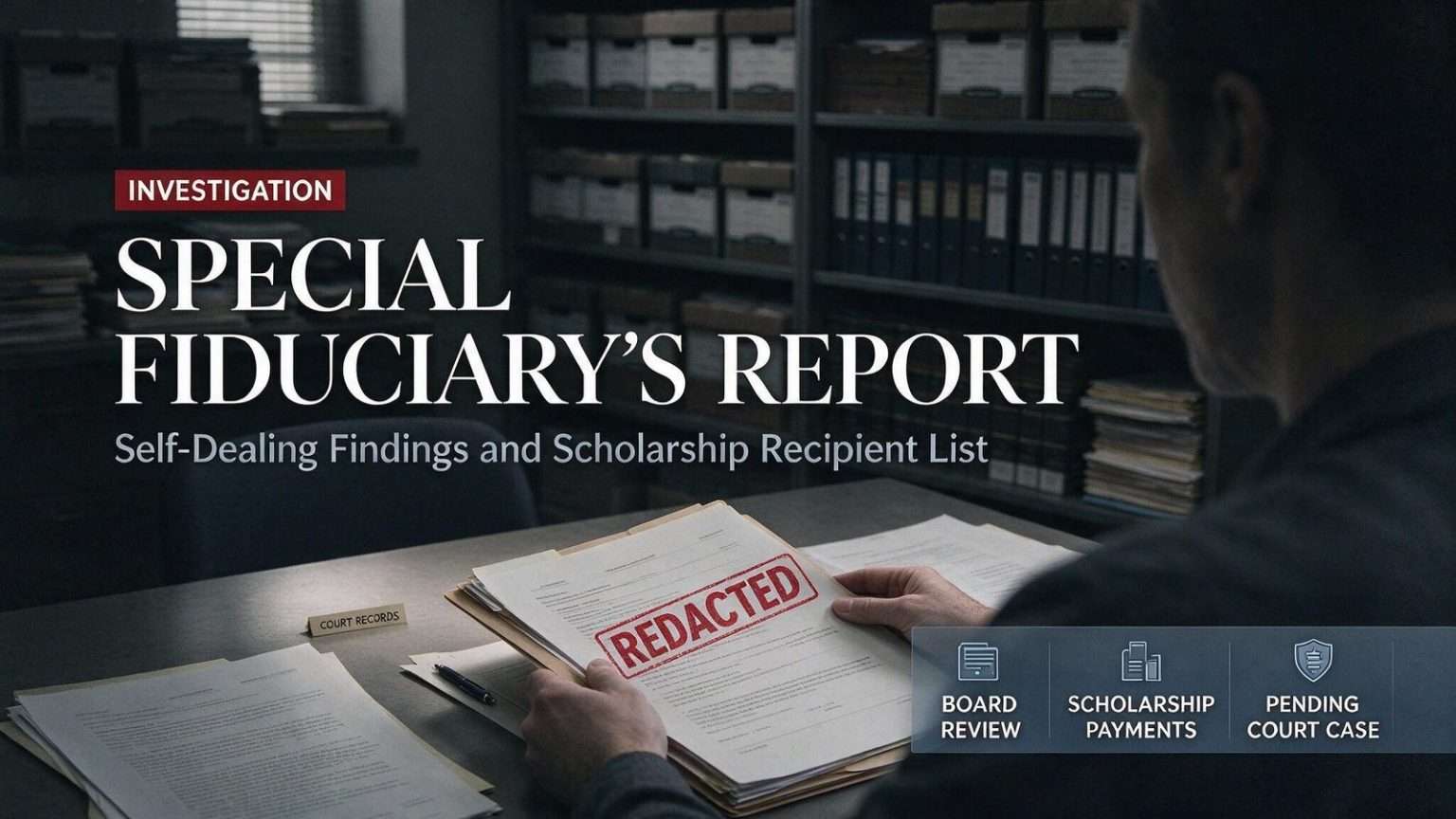
MONTGOMERY, Ala. — A special fiduciary’s report in the long-running civil suit over the Mabel Amos Memorial Fund concludes that board members engaged in self-dealing by awarding scholarships to relatives and associates, and it lists scholarship recipients whose names had been withheld from public filings for more than a decade.
The report, compiled by Special Fiduciary James C. White Sr., a certified public accountant, has not been publicly released by Montgomery County Circuit Judge Greg Griffin. Its contents are described here from a copy of the report. According to the report, the list of recipients from 2014 through 2024 includes the children of many prominent Andalusia and Covington County residents.
Tom Albritton, executive director of the Alabama Ethics Commission and a former trustee of the fund, has denied self-dealing or other unethical conduct. The case remains pending.
How the fund was created
Amos, a two-term Alabama secretary of state, died in 1999 at age 99 and left roughly $500,000 to create the fund. She stipulated that it provide scholarships to Alabama students based on four criteria: “The character of the individual; the intelligence of the individual, which shall be above average; the scholastic record of the individual; and the financial need of the individual.”
Albritton’s law firm drew up the charitable trust in Amos’ last will and testament. The will’s language gave the Albritton firm two of the three board positions overseeing the fund, which were filled by Albritton and his law partner Rick Clifton. John Bell of Regions Bank served as the third member, representing the bank as trustee.
Clifton died in June 2025. Bell resigned from the board in 2021 and was replaced as the Regions representative by Drew McNeese, who has also left the board. The court removed Albritton from involvement in selecting scholarships in 2023, and he formally resigned from the board in March.
According to IRS Form 990 records, the board awarded relatively small scholarships during the fund’s first 10 years. White wrote that “It must be noted here that the scholarship application process was practically nonexistent earlier in the life of the Trust.” From 2002 through 2013, the 990 forms listed the names of recipients and scholarship amounts. By 2014, the discovery of oil on Amos-owned land in Conecuh County had brought millions of dollars into the fund, scholarships grew much larger, and recipients’ names were no longer listed in the public filings.
What the report found
White’s report concludes that self-dealing took place, citing violations of three articles of the fund’s formation.
“Disbursements on behalf of students appear to violate Article V, part E and F as it relates to personal inurement and self-dealing. Particularly, when scholarships are awarded to the children of the members of the Board and associates of the members of the Board. There were several scholarships awarded by the Trust that fit into that category and totaled $257,844,” White wrote.
White identified six recipients with direct connections to Albritton and Clifton:
- Albritton’s son and daughter, who each received $67,500 to attend the University of Texas at Austin, a combined $135,000, according to the report. Those distributions began in 2012, three years before Albritton was chosen to lead the Ethics Commission, and continued until 2019.
- The daughter of Judge Ben Bowden, a former partner in the firm of Albritton, Clifton, Alverson, Moody and Bowden, P.C., who now serves on a state appellate court. She received $60,000 to attend Southern Methodist University. In a 2021 interview, Bowden acknowledged when asked that his daughter had received $45,000 in scholarships. Bowden and Albritton are childhood friends.
- The granddaughter of a secretary to Clifton at the law firm, who received $26,120, according to the report.
- Two children of another secretary at the firm, who received $14,997 and $21,727, according to the report.
White also cited as violations of the trust’s bylaws nearly $470,000 given directly to colleges and universities as “endowed scholarships,” which he wrote was not consistent with the articles forming the fund. In total, White tallied $725,000 in unallowed spending that would be required to “make this Trust whole.”
Albritton’s responses
Albritton said in 2021, when the scholarships to his children first became public, that he had abstained from voting on money for his children, leaving those votes to Clifton and Bell.
“Regarding my kids’ scholarships, there’s no restriction within the trust for who can get it. Where my kids are concerned, I didn’t participate in that decision. It was made by one of the other trustees and a Regions representative, who at the time was John Bell,” Albritton said in 2021.
He also said then: “Don’t forget that at the time the decision was made about my kids, I was still in private practice. At that time, however, I just didn’t see the point in creating an issue where there wasn’t one by putting myself out there with a vote.”
In answers to plaintiffs’ interrogatories filed with the court on May 26, Albritton responded to several of the plaintiffs’ allegations. The 2012 Form 990 lists a $15,000 scholarship to “Martha A. Hunter.” Plaintiffs have alleged that the award went to Albritton’s daughter and was not identified as going to a board member’s child. Albritton admitted the 2012 distribution went to his daughter but denied that the transposed name was an attempt to “disguise the true identity of the scholarship recipient,” as plaintiffs contend. He said “All disclosures were handled solely by Regions Bank.” Beginning with the 2013 Form 990, awards to Albritton’s children carried a notation identifying the recipient as a board member’s child, such as “Daughter of Board Member.”
Asked about the scholarships awarded to Bowden’s daughter from 2014 to 2017, Albritton said the board made that decision. “All scholarship awards were made by the agreement of all board members, including Regions Bank,” he answered. Bowden served as Covington County probate judge from 2008 to 2016, and Albritton acknowledged in his answers that members of his firm appeared before Bowden during that time.
Albritton said he was “without sufficient information to admit or deny” plaintiffs’ questions about scholarships to the children and grandchildren of secretaries at his law firm.
Asked about scholarships to the children of two families plaintiffs identified as clients of the firm, Albritton admitted they received money. Asked whether firm clients who did not need financial assistance were given money, Albritton said Regions Bank determined need.
Other recipients
The recipients White identified as meeting the criteria for self-dealing were largely known before his report, through earlier reporting or filings by plaintiffs’ attorney Byron B. Mathews Jr. Who received the rest of the nearly $4 million distributed by the board had been unclear.
The report lists all recipients from 2014 through 2024 and the amounts they received. Several families with administrative positions at PowerSouth Energy Cooperative received scholarships. The Albritton firm represented the Alabama Electrical Cooperative, PowerSouth’s predecessor, in lawsuits in the 1960s and 1980s. Albritton did not respond to questions about whether his firm continued to represent PowerSouth while the scholarships were disbursed.
Other names on the list appear to be connected to Andalusia city employees, local attorneys, a school superintendent and a principal, a former editor of the local newspaper, bankers, doctors, heads of large businesses and a state representative. Some parents of recipients were contacted about the awards and how they applied; none had responded.
Regions fees found reasonable
White’s report rejected plaintiffs’ claims that Regions Bank had substantially overcharged the fund. In the 990 forms, Regions consistently listed the time spent overseeing the fund’s assets as five hours a week, an estimate that did not change as millions of dollars in oil royalties flowed into the fund.
“My review of the fees charged by Regions Bank to this Trust revealed that they were not unreasonable under the circumstances. The amount charged for managing the investments in marketable securities was entirely reasonable and in line with their published fee schedules which are comparable to those in the industry of asset management,” White wrote. He said fees for managing oil and gas leases were also reasonable and that administering the scholarship program required “a full-time person to provide the services.”
The lawsuit and the attorney general
After the scholarship payments to Albritton’s children were first reported in 2021, Amos’ grandniece, Leigh Manning, and great-grandniece, Megan Carmack, filed a civil suit that named Attorney General Steve Marshall as a defendant. Marshall later petitioned to be added as a plaintiff, citing his office’s duty to oversee charitable trusts.
As a plaintiff, Marshall’s office filed motions accusing Albritton of self-dealing and fraud. Both can carry criminal penalties, but the attorney general has not opened a criminal investigation.
A separate suit filed by Conecuh County student Tyra Lindsay, represented by Mathews, was later consolidated with the Carmack and Manning suit. Mathews has been the principal advocate for a full accounting of the money spent and for the removal of Albritton, Clifton and Regions from the board.
Marshall has sought to have the other plaintiffs removed from the suit, arguing that only he has standing, but the court has not agreed. His office twice asked the Alabama Supreme Court for emergency stays to stop Griffin from appointing White, first as special master and then as special fiduciary, arguing the appointment would be costly to the fund. The Supreme Court rejected the second attempt.
Marshall’s representatives have for two years sought approval of a settlement negotiated with Regions Bank that they have said would make the fund “whole,” but they have not made its terms public or shared them with counsel for the other plaintiffs. Griffin has said a main reason he wanted a full accounting is that without one he would have no way of knowing whether a settlement was fair.
Cost of the accounting
Griffin granted White a payment of $336,725 in July 2025. White has since submitted invoices for $11,000 for a surety bond, $108,000 for reviewing emails and scholarship payments, $52,305 for reviewing scholarship applications and payments, and $49,075 for reviewing emails about payments to colleges and universities and scholarships. In total, White has billed the fund $557,105, according to filed invoices and court records.
What comes next
A hearing was scheduled for Sept. 3. Some involved in the case have said the main pending issues are how much it will take to make the fund whole and who will pay.