Madame Rose Vocal Scholarship Competition Opens Applications for Regional College Singers
The Madame Rose Vocal Scholarship Competition is accepting applications from college and graduate vocalists across seven states, with a Nov. 15 deadline and a Jan. 9 final round in Mobile.
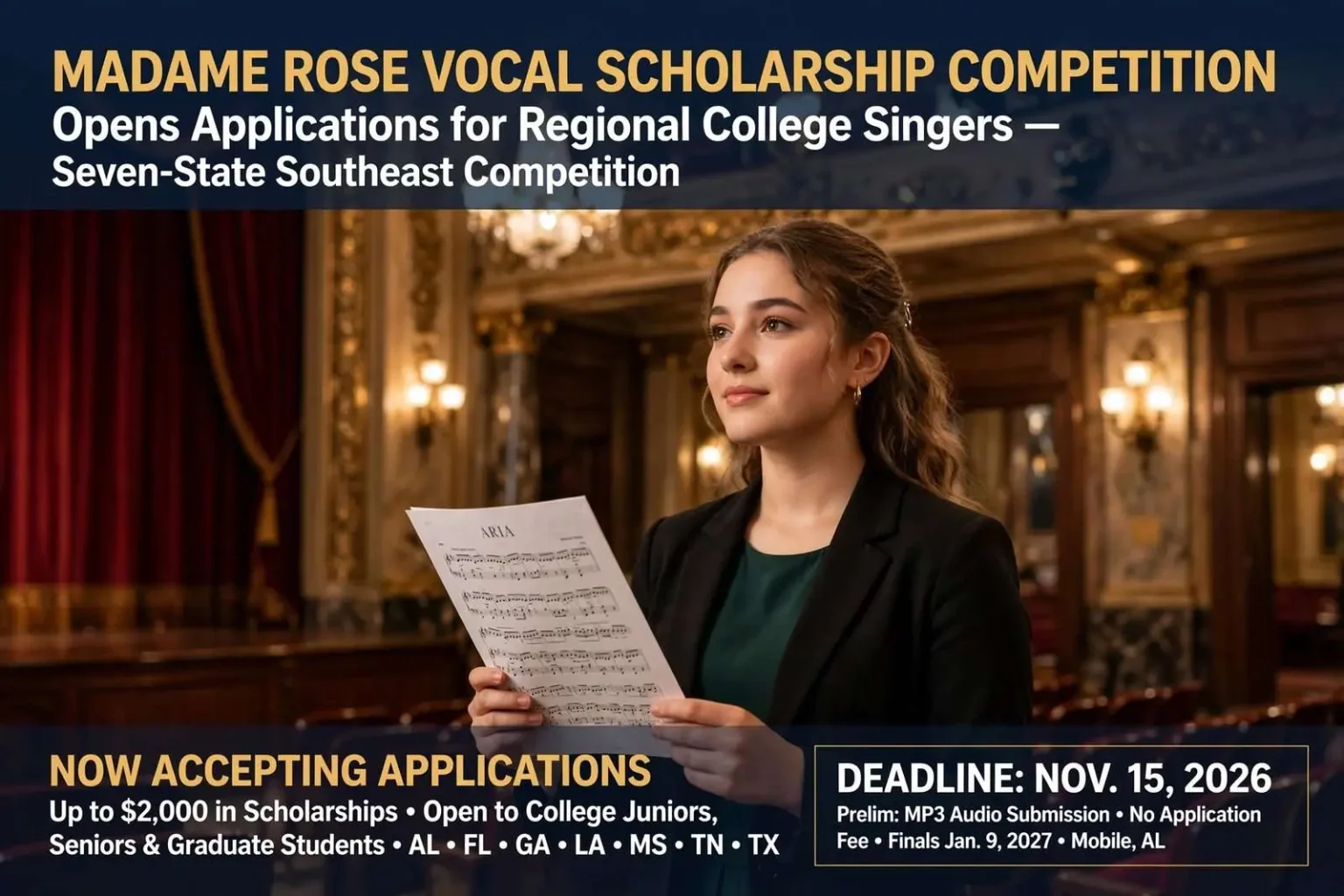
College vocalists across the region are being invited to apply for the Madame Rose Vocal Scholarship Competition, an annual opera competition offering up to $2,000 in scholarship money to top performers. The competition is open to college juniors and seniors, graduate students, and anyone completing a degree no earlier than May 2026 at any school in Alabama, Florida, Georgia, Louisiana, Mississippi, Tennessee or Texas.
That seven-state footprint makes the competition one of the broader audition opportunities available to young singers in the Southeast. Students at major university voice programs and small-college music departments alike can enter, and the scholarship dollars go directly toward degree costs — money that in vocal performance programs, where lesson fees, accompanist costs and travel to auditions accumulate quickly, is rarely incidental.
Prizes and How to Apply
First place will receive $2,000, second place will receive $1,000 and third place will receive $500. Preliminary judging is based entirely on a digital audio recording of one aria, submitted by email in MP3 format; the competition does not accept applications by mail or video submission.
Entries must include the applicant’s name, address, email address, phone number and school status, but should not include a resume or head shot at this stage. The deadline to apply is Nov. 15, 2026. There is no application fee for the preliminary round.
The all-audio, no-fee preliminary round is deliberately low-barrier. A singer needs nothing but a recording of a single aria and an email — no travel, no accompanist booking, no application check — which means the first cut is a pure test of the voice itself. Judges cannot be influenced by a head shot, a famous teacher or an expensive recording session, only by what comes through the microphone.
That format also puts a premium on aria selection. Voice teachers routinely tell students to choose a competition aria that sits comfortably in the center of the voice rather than one that flatters at the extremes; with one track and roughly three minutes of singing, there is no second chance to show another side of the instrument. A panel of three judges will review the submitted recordings and select ten finalists, along with alternates, to advance to the final round.
From Finalist to the Final Round
Finalists will be notified by email when invitations to the final round go out on Dec. 1, 2026. Those selected must confirm their acceptance by Dec. 15, 2026, along with a non-refundable $50 application fee, brief biographical information and a head shot.
The fee covers the cost of a collaborative pianist for the final performance; artists who prefer to bring their own pianist may do so at their own expense, though the standard fee is not waived in that case. Travel costs and accommodations remain the responsibility of each artist. Finalists coming from outside Mobile — and the eligibility map suggests most will be — should plan for a winter drive or flight into the Gulf Coast’s regional airports, with an overnight stay likely for a 1 p.m. competition call.
The final competition will be held Saturday, Jan. 9, 2027, at 1 p.m. at the Larkins Music Center, located at 257 Dauphin St. in Mobile. Each finalist will perform two arias from the standard opera and operetta repertoire, with the order of performance determined by a random drawing.
The two-aria format is standard for competitions at this level, and it rewards preparation across contrasting styles. Singers typically pair a lyric selection with something dramatically different — a baroque piece against a verismo showstopper, or an operetta number against a dramatic scene — so the judges can hear range rather than repetition. Because the running order is drawn at random, finalists must be warmed up and ready from the first position onward, a discipline in itself.
The venue adds its own character. The Larkins Music Center on Dauphin Street sits in the heart of downtown Mobile’s entertainment district, and the building serves as a working home for opera in the city — a stage where audiences gather regularly for full productions. For student singers, performing in a real opera house rather than a recital hall is part of the education: different acoustics, different sight lines and a house that must be filled with the voice alone.
What Competitions Mean for Young Singers
Scholarship competitions occupy a crucial rung on the ladder of a classical voice career. Conservatory training is expensive, and the path from a bachelor’s degree to young-artist programs and professional contracts runs through years of summer programs, graduate study and competition placements. Cash prizes at the student level do more than cover tuition; they become resume lines that graduate committees and young-artist program panels look for when sorting hundreds of applicants.
The regional structure matters too. A singer can build early confidence close to home, before facing the national competitions that demand travel to New York or Chicago. Competitions that draw from a seven-state region give Southeastern students a meaningful field — enough competitors to make a win mean something, without requiring the resources that national circuits assume.
For the audience, finals day is a bargain by any standard: ten of the region’s best young voices, two arias each, in one afternoon. Competitions of this kind are open to the public and regularly draw vocal teachers, choir directors and opera lovers who enjoy watching a judge’s-eye view of the region’s emerging talent.
Keys to a Strong Application
Voice teachers’ advice for rounds like this one is consistent. Record in a real space — a recital hall or church, not a bedroom with soft walls — and listen on good speakers before submitting. Choose the aria that shows the voice’s core, not just its top. Follow the entry instructions exactly: this competition asks for MP3 audio only, no video, no resume, no head shot at the preliminary stage, and applications that ignore the format risk a technicality doing what the judges would not.
Timing matters as well. The Nov. 15, 2026 deadline arrives in the middle of the fall semester, when recital schedules and juries compete for studio time, so singers who record early in the term generally submit stronger takes than those scrambling the week of the deadline. Finalists then face a quick turnaround — notification Dec. 1, confirmation and fee by Dec. 15 — before the holidays, and another stretch of coachings before the January final.
For college vocalists across the Southeast, the math is simple: no fee to enter, one aria to record, and up to $2,000 — plus a finals performance in a downtown Mobile opera house — waiting at the other end. Applications are being accepted now through Nov. 15, 2026.
Opera on the Gulf Coast
Mobile’s opera tradition runs deep for a city of its size. The Larkins Music Center anchors a scene that has supported professional opera on the Gulf Coast for generations, staging full seasons with orchestra alongside the educational and community programs that feed the next wave of singers. Competitions like the Madame Rose fit naturally into that ecosystem: they connect the region’s university voice studios to the professional stage, and they give local audiences a reason to hear voices they will likely encounter again in principal roles.
The Dauphin Street location also puts the competition in the middle of downtown’s cultural strip. Finals-day crowds can pair the afternoon of singing with the restaurants and galleries that line the street, and out-of-town families who make the trip for a finalist’s performance often turn it into a weekend on the coast — one more way the arts economy and the hospitality economy prop each other up in Mobile.
Preparing for the Finals
For the ten singers who advance, the weeks between the Dec. 1 notification and the Jan. 9 final are where competitions are won. Coaches typically use the interval to refine diction in the aria’s language, polish transitions between pieces and rehearse with the collaborative pianist — a musician whose partnership can lift or sink a performance and whom finalists will meet, in most cases, only days before they sing.
The random drawing for performance order adds a strategic wrinkle. Singers early in the order must deliver peak energy to a fresh panel; those late in the order must distinguish themselves from a long string of predecessors, often in repertoire the judges have now heard several times. Veteran competitors prepare both arias to full performance pitch rather than “saving” the second selection, on the theory that judges score what they hear, not what was rehearsed.
The $50 finalist fee and the travel costs are real considerations for students on budgets, but they compare favorably to the economics of the national circuit, where a single competition weekend can cost several hundred dollars before a note is sung. For singers based anywhere from Atlanta to Baton Rouge to Starkville, the January final in Mobile is an achievable drive.
The Bottom Line for Applicants
The essentials bear repeating for students planning to enter: eligibility extends to college juniors and seniors, graduate students and anyone completing a degree no earlier than May 2026, at any school in the seven-state region. The preliminary round requires one aria recorded as an MP3 and emailed with basic contact and school-status details by Nov. 15, 2026, with no application fee. Three judges will name ten finalists and alternates, notified Dec. 1, 2026, with confirmation and the $50 fee due Dec. 15, 2026.
From there, the final round convenes Saturday, Jan. 9, 2027, at 1 p.m. at the Larkins Music Center, 257 Dauphin St. in Mobile, where each finalist sings two arias from the standard opera and operetta repertoire in an order set by lot. Prizes of $2,000, $1,000 and $500 await the top three — and, for the winner, a credential that travels.
For a region rich in university voice programs, the competition is a rare convergence: a low-cost entry point, a respected local stage and scholarship money that arrives exactly when students need it. Aspiring applicants should mark the November deadline now, pick the aria that tells the truth about their voice, and hit record.