Made in Dagenham, Rocky Horror and an Oscar-Nominated Illusionist: The Crescent Theater’s Packed Winter Slate
Downtown Mobile's Crescent Theater lined up Made in Dagenham, 127 Hours, Rocky Horror during Mardi Gras and Oscar-nominated The Illusionist.
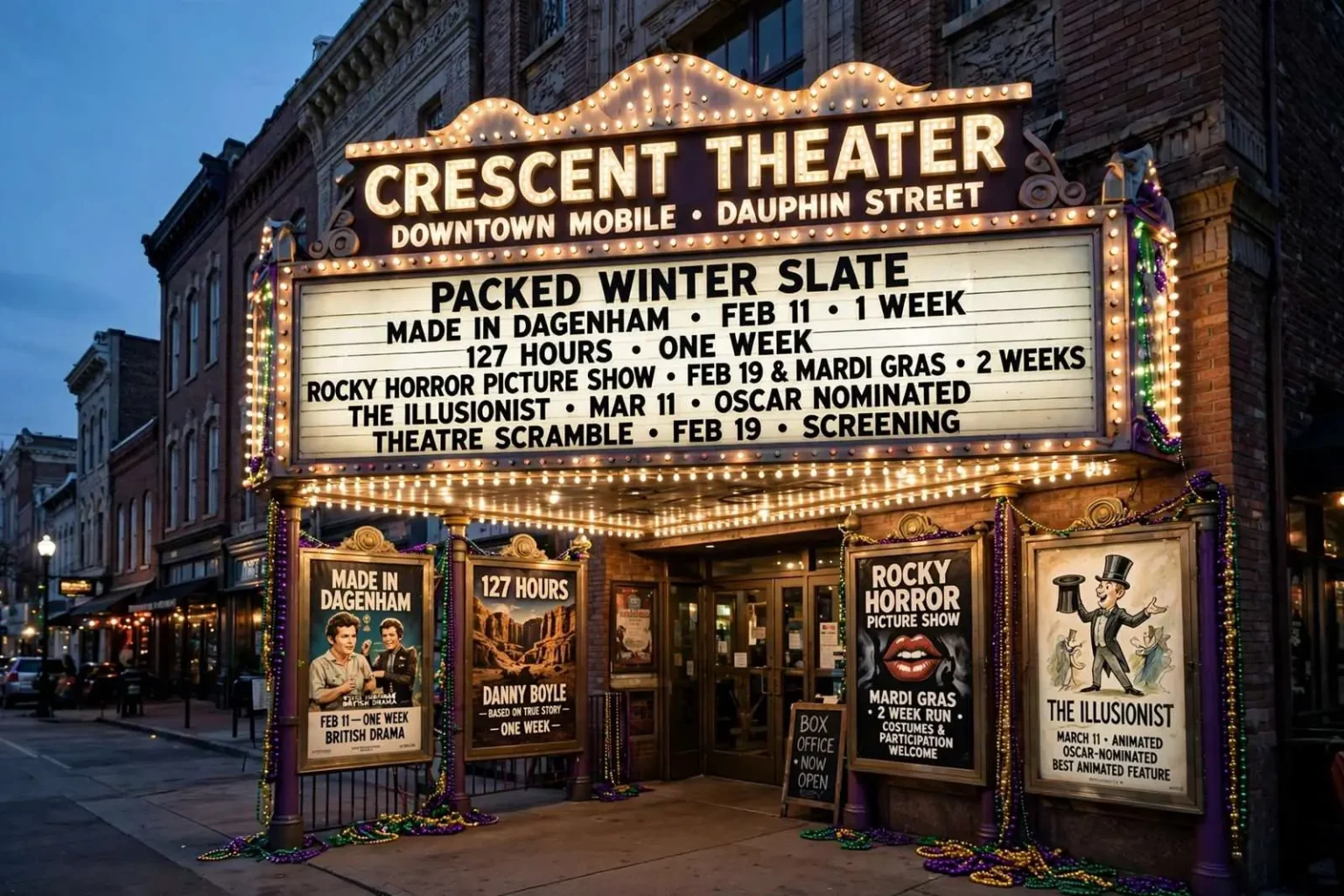
Downtown Mobile’s Crescent Theater stacked its late-winter calendar with a run of one-week exclusives, a Mardi Gras cult classic and an Oscar-nominated holdout, giving moviegoers along Dauphin Street a reason to keep coming back week after week. The lineup started Friday, Feb. 11, with “Made in Dagenham” for a single week, and rolled straight through Mardi Gras and into March with a slate that mixed British social drama, desert-survival tension, midnight-movie ritual and hand-drawn French artistry. For a single-screen house in the heart of the entertainment district, it was an unusually dense stretch of programming, and it showed how the Crescent has carved out a niche as downtown Mobile’s home for films the multiplexes pass over.
The Crescent, which opened in 2008 in the space of the old Crescent theater on Dauphin Street, has long positioned itself as Mobile’s art-house option — the place where independent films, documentaries and foreign-language titles get a run that the suburban megaplexes rarely offer. Its winter schedule leaned into that identity. Rather than locking in long, open-ended engagements, the theater booked a string of limited one-week runs, a strategy that creates a sense of urgency for filmgoers who might otherwise wait for home video. Each title got a defined window, and audiences who wanted to catch a film downtown had to show up during that film’s week or miss it.
From England’s Factory Floor
The winter slate opened with the British dramedy “Made in Dagenham,” which dramatizes the real 1968 strike at Ford’s Dagenham car plant outside London, where female workers walked out over sexual discrimination and helped force the fight for equal pay onto the national stage. The film follows the sewing machinists who stitched car seats at the plant and who discovered they were being paid a fraction of what their male counterparts earned for comparable work. Their walkout idled production across the enormous complex and eventually drew the attention of government ministers, union leaders and the press, turning a shop-floor grievance into a milestone in the British labor movement and a spark for the Equal Pay Act that followed.
The film portrays its working-class heroines — equal parts kitchen, factory floor and Top of the Pops — as unlikely architects of lasting social change. It plays the story with a light touch, leaning on humor and period detail, but the underlying history is real: the Dagenham strikers became a symbol of the wider struggle for wage equality, and their action is frequently cited in British discussions of pay equity to this day. For Mobile audiences, the subject carried its own resonance. Alabama’s industrial history is built on textile mills, shipyards and manufacturing floors, and the question of what women earn for the same work has echoed through those workplaces for generations. The film offered a portrait of ordinary workers discovering that their grievance was not a private complaint but a matter of principle worth striking over.
The single-week engagement was classic Crescent programming: a critically praised import with no franchise hook, the kind of film that depends on word of mouth and a devoted downtown audience. Moviegoers who caught it during its Feb. 11 week saw one of the year’s better-reviewed British ensemble pictures on the big screen, a chance that would not come around again once the run ended.
Theater Scramble Comes to the Screen
On Saturday, Feb. 19 at noon, the Crescent screened the first-ever Theatre Scramble Mobile performance, filmed live at the Mobile Museum of Art by Jolt Productions. The event brought a local theatrical experiment off the stage and onto the movie screen, extending the theater’s reach beyond conventional film bookings.
A “theater scramble” challenges local performers to devise a short play under a brutally tight deadline before everyone reconvenes to perform the results. The format has been a favorite of theater communities elsewhere: writers, actors and directors are thrown together, handed constraints — a theme, a prop, a limited number of pages — and given only hours to create something coherent. There is no time for polish, which is precisely the point. The audience sees theater at its most raw and immediate, complete with the seams showing, and the energy of the deadline becomes part of the performance itself.
Filming the scramble at the Mobile Museum of Art gave the event an appropriately civic backdrop. The museum, set in Langan Park, has been a gathering place for the city’s creative community for decades, and pairing it with Jolt Productions — a local video company — meant the one-time performance was preserved rather than lost to the moment. Screening the result at the Crescent let a wider audience see what the participating artists had managed to build overnight, and it doubled as a showcase for the collaboration between Mobile’s film and theater scenes.
Interest in the format proved immediate. Sign-ups for the second scramble opened right after the screening, a signal that the first event had found its audience and that organizers intended to keep the experiment going. For performers, scrambles offer a low-stakes way to sharpen improvisational muscles and meet collaborators; for audiences, they deliver the appeal of watching something genuinely unrepeatable. The Crescent’s screening put a bow around the whole cycle — creation, performance and now exhibition — and tied the theater even more closely to the artists who fill downtown’s stages and galleries.
What Followed
The slate rolled on from there. Danny Boyle’s “127 Hours” arrived for a week, bringing the true story of canyoneer Aron Ralston’s harrowing ordeal trapped in a Utah slot canyon to Mobile audiences. The film, built around a remarkable central performance and a famously intense sequence that left some viewers light-headed, was one of the most talked-about releases of the awards season. Its single-week run fit the Crescent’s model: a prestige title with a built-in conversation attached, screened downtown for those willing to make the trip.
Then came two weeks of “The Rocky Horror Picture Show,” timed to Mardi Gras. The choice was a natural fit for the season. Mobile’s Carnival celebration fills downtown with costumed revelers, parades and late-night crowds, and “Rocky Horror” is nothing if not a costume party with a movie attached. The 1975 cult musical, starring Tim Curry as Dr. Frank-N-Furter, has sustained one of the longest-running audience-participation traditions in film history: fans dress as the characters, shout callback lines at the screen, throw rice and toast and newspapers at prescribed moments, and generally treat the screening as a ritual rather than a passive viewing. The Crescent’s two-week booking gave Mardi Gras crowds a downtown destination that matched the holiday’s anything-goes spirit, and it is the kind of programming a suburban multiplex would never attempt.
The calendar closed with “The Illusionist” on March 11, the hand-drawn French film based on a Jacques Tati script that follows a struggling stage magician through Scotland as variety theater fades from British life. Nearly wordless, gorgeously animated and quietly melancholy, it was a film that depended entirely on being seen in a theater — exactly the sort of picture the Crescent exists to show.
That last date carried an apology from the theater. After the animated film earned an Academy Award nomination for Best Animated Feature, prints became extremely hard to secure, forcing repeated scheduling changes before it could finally reach Mobile screens. The nomination turned a modest art-house release into a must-book title, and theaters across the country found themselves competing for a limited supply of available prints. The Crescent’s staff moved the film’s dates more than once before locking in March 11, and the public apology for the churn was a small window into the logistics behind the schedule: a one-screen theater negotiates for what it can get, and awards season reshuffles everything.
For downtown Mobile, the winter slate mattered beyond the marquee. The Crescent sits in the lower Dauphin entertainment district, where restaurants, bars and galleries depend on a steady flow of evening foot traffic. A theater with a rotating calendar of distinctive films gives people one more reason to park once and spend the whole evening downtown, and the theater’s one-week exclusives create a rhythm — a new reason to return every Friday — that an open-ended booking pattern cannot match. The Mardi Gras-timed “Rocky Horror” run in particular placed the theater squarely inside the Carnival economy, when downtown swells with visitors and locals looking for things to do between parades.
The schedule also underlined the Crescent’s role as a civic stage for Mobile’s arts community. By hosting the filmed Theatre Scramble, the theater linked itself to live theater practitioners; by fighting for “The Illusionist” through scheduling chaos, it demonstrated the kind of persistence that art-house booking requires. And by opening with a film about workers who demanded to be valued equally, the season offered, perhaps unintentionally, a small parallel: a small independent house making its case, week by week, that downtown audiences will show up for something different.
From “Made in Dagenham” in mid-February through “The Illusionist” in mid-March, the Crescent’s packed winter slate delivered variety, urgency and a distinctly downtown sensibility — a run of programming that treated Mobile filmgoers as curious, adventurous and worth booking for.