Mama Bear and Her Three Cubs Spotted Again in Saraland Neighborhood
A mama bear and her three cubs have been spotted several times in a Saraland neighborhood over the past week, including on one resident's Ring camera.
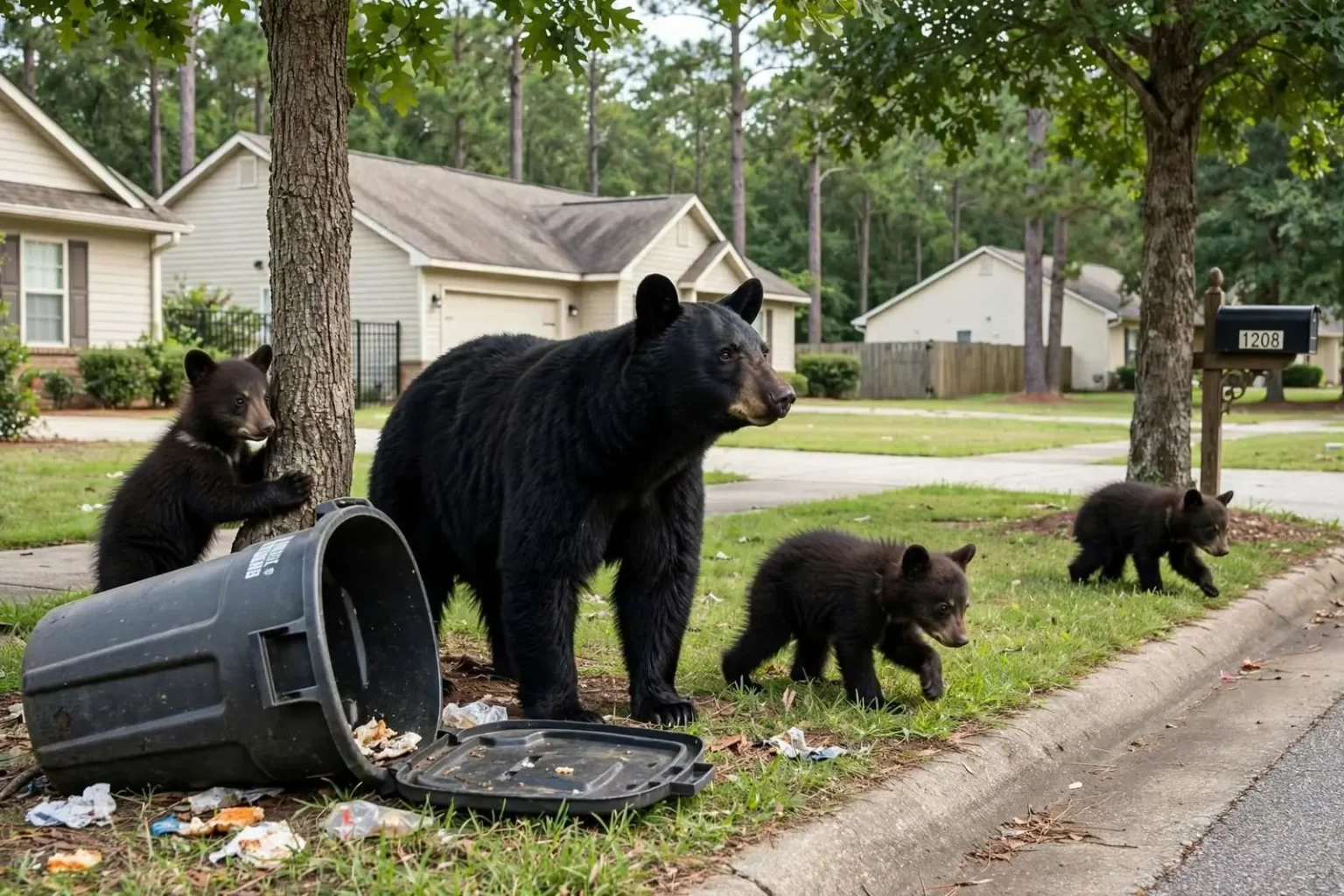
A mama bear and her three cubs have been spotted repeatedly in a Saraland neighborhood over the past week, giving residents an up-close look at wildlife not often seen wandering through their yards. The family group has turned up on doorbell cameras, in front yards and along streets where houses back up to patches of timber, and so far the visits have produced curiosity and a parade of cellphone videos rather than any harm. Neighbors have traded photos and warnings in local social media groups, keeping one another aware of where the bears were last seen.
Saraland resident Erica Branch said her Ring doorbell camera caught the mother bear tipping over her trash can on Sunday, Aug. 16, while the three cubs stayed close together near a tree in the yard. The footage shows a scene that has become familiar to homeowners across southwest Alabama’s bear country: a sow working a garbage container with surprising dexterity while her young keep within a few feet of cover. Branch’s camera captured the visit in the middle of the day, a reminder that bears here are not strictly nocturnal when food is easy to find.
Branch also said she encountered the bear family in person, telling neighbors she was pulling into her driveway when the mother bear and her cubs crossed through her front yard. She said the group moved along without incident, and her account matches what wildlife biologists consistently describe: a sow with cubs generally wants to keep moving and wants nothing to do with people, provided she is given room and an exit.
A recurring visitor to the area
This is not the first time a black bear has wandered through the Saraland area. In January, a black bear was seen walking near the local Cracker Barrel, drawing onlookers and a round of social media attention. And in May 2025, residents reported spotting two bears and a cub along Forest Avenue. Taken together, the sightings sketch a pattern rather than a fluke: bears are using the wooded corridors that thread through and around the city, and some of them are passing close to busy commercial strips along the way.
Saraland sits in Mobile County just north of the city of Mobile, where pockets of woods border residential streets, creating a natural corridor for animals like black bears to pass through. Creeks, drainage easements and undeveloped tracts connect those pockets to the larger bottomland hardwood and swamp habitat west and south of town, and a bear traveling that network can cross a subdivision in a single night. New streets and rooftops keep extending into that green framework, which means sightings like this week’s are likely to keep happening as the city grows.
There is no indication yet whether this week’s sow is the same bear involved in any of the earlier area sightings, and wildlife officials generally avoid making that call without clear photos, video or tracking data. Bears show up frequently on cameras, and similar-looking animals are easy to confuse. What matters more than the individual’s identity is the bigger pattern the sightings reveal: bears are moving through the Saraland area often enough that residents should treat bear awareness as a normal part of living here, the same way they already treat traffic and tropical weather.
The bears of southwest Alabama
The black bears native to southwest Alabama are tied historically to the bottomlands of the Mobile-Tensaw Delta and the river swamps of Washington and Mobile counties, and biologists have associated the region’s bears with the Louisiana black bear lineage. The species was largely wiped out in Alabama by habitat loss and unregulated killing in the 1800s and early 1900s, but bears have been slowly re-establishing themselves over recent decades, moving down from the Delta country and occasionally wandering in from neighboring states. Today the Alabama Department of Conservation and Natural Resources confirms bear activity in the southwest part of the state every year.
Under Alabama law, black bears receive strong protection. There is no hunting season for them, and it is illegal to kill, capture or harass a bear, with violations carrying significant fines and potential restitution. That legal shield matters in a case like the Saraland sow, because the state’s approach is to let a healthy bear pass through developed areas on its own rather than trap and relocate it, which biologists say is stressful for the animal and rarely solves the underlying attraction to food.
Late summer is a demanding stretch for bears everywhere. The spring green-up has faded, acorns have not yet dropped, and sows raising cubs are working hard to pack in calories before winter. That is why trash cans, pet food and grills become such targets in August: they are concentrated, predictable sources of food in a season when natural forage is spread thin. Biologists note that bears can eat huge amounts in a day at this time of year, and an unsecured garbage can is simply the easiest meal available in a neighborhood.
A sow with three cubs represents particularly good news for the population, because cub survival is the bottleneck for bear recovery. Female black bears in this region typically breed every other year, and the cubs stay with their mother for roughly a year and a half while she teaches them where to find acorns, berries, insects and other food. A litter of three being raised close enough to Saraland to show up on doorbell cameras suggests the local bear population is doing more than hanging on.
What residents should do
Wildlife experts generally recommend that residents who spot a bear keep their distance, avoid approaching cubs, and secure trash cans and pet food that could draw the animals closer to homes. A mother bear with cubs is the one scenario in which a black bear is most likely to act defensively, so the standard advice is to stay inside or well back, give the family a clear escape route, and let the sow lead her cubs away on their own. Dogs should be kept on a leash or brought indoors, since a barking pet can trigger an encounter that would never happen otherwise.
Doorbell and security cameras have changed how sightings like this one unfold. A generation ago, a bear passing through a subdivision might have been known only through a few blurry photographs and word of mouth; now every visit leaves timestamped video that spreads through neighborhood group chats within minutes. Wildlife officials say the cameras are genuinely useful for tracking bear movement, but they also encourage crowds, and crowds are the one thing that makes a bear encounter riskier. The advice is to watch the video, not the bear.
Communities that live alongside growing bear populations, in states with far denser numbers than Alabama’s, have learned that prevention beats reaction. Some cities eventually adopt ordinances requiring wildlife-resistant containers in bear-active neighborhoods, and the pattern is consistent wherever that happens: complaints drop sharply once the food reward disappears. Saraland is nowhere near that point, but this week’s visitors are a reminder of how quickly a passing bear can become a routine one if garbage stays accessible.
Garbage management is the single most effective step. Cans that sit at the curb overnight are an open invitation, and a sow that learns where easy meals are will teach the lesson to her cubs, making the problem generational. Residents are advised to keep containers secured until morning pickup, rinse them periodically to cut odors, and bring in pet food dishes, birdseed and grill drippings that can also attract wildlife. Feeding a bear, even unintentionally, is the fastest way to turn a passing wild animal into a repeat visitor that has to be dealt with.
What happens to the cubs themselves is a story for another season. Young bears stay with their mother until they are about a year and a half old, then disperse to find home ranges of their own, with young males sometimes traveling remarkable distances across unfamiliar ground. The roads and developments between Saraland and the region’s swamps make dispersal hazardous, which is why sightings of lone young bears tend to multiply in developed areas even as family groups stay closer to core habitat.
Biologists also ask the public to report bear sightings to the state. Reports help conservation officials track where bears are moving, confirm reproduction in new areas and advise neighborhoods on staying ahead of conflicts. A sighting like the one in Saraland, documented with timestamps and locations, is exactly the kind of information wildlife managers use to map the species’ expansion across south Alabama.
So far, no harm done
No injuries or damage beyond the overturned trash can have been reported in connection with the recent sightings. That outcome fits the broader record: black bears in Alabama have not been involved in attacks on people, and encounters almost always end with the bear leaving. The animals are intelligent, shy and generally far more interested in garbage, acorns and insects than in human contact.