Man already jailed on domestic violence charge now accused of murder in Mobile backyard death
A Mobile man already jailed on a domestic violence charge has been charged with murder after a woman was found severely burned in a Bonneville Drive backyard, with a second suspect also facing charges.
A man already being held in Mobile County Metro Jail on a domestic violence charge has now been charged with murder after investigators say the woman he was accused of assaulting days earlier was found dead and severely burned in a Mobile backyard. The case, which unfolded across two separate 911 calls days apart, moved from a parking-lot assault report to a homicide investigation before detectives had finished processing the first scene.
The Discovery
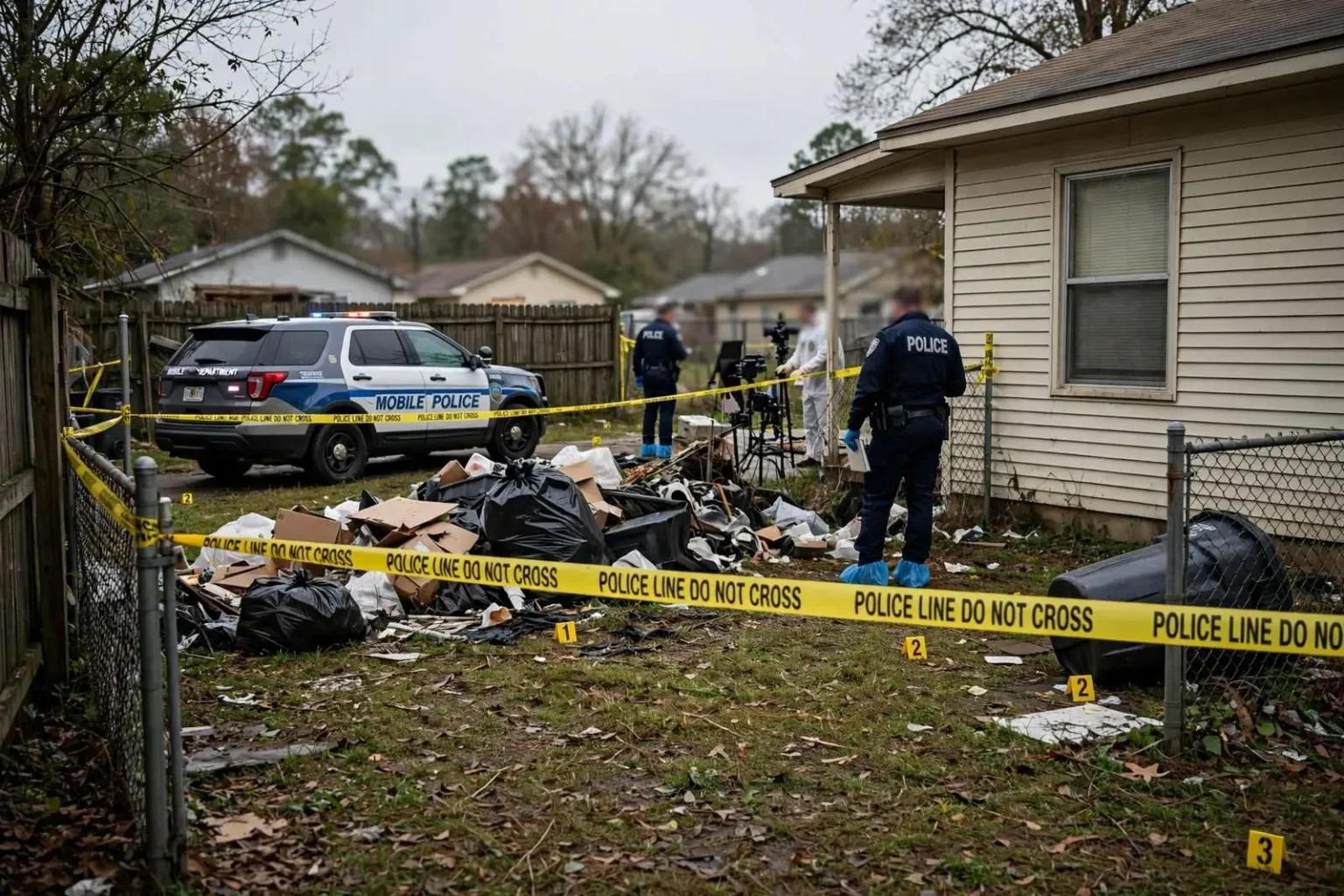
Mobile Police charged Timothy Buford, 35, with murder and abuse of a corpse after officers responded to a missing person call at a home on Bonneville Drive. Responding officers found the body of 57-year-old Tracy Giffin in the back yard of the residence, lying atop a trash pile and showing severe burns. The discovery transformed a missing person report into a death investigation in the span of a single visit to the property.
Investigators believe Giffin was killed several days before her body was discovered, and detectives worked through the intervening time to piece together what happened at the home. That gap — between a death and its discovery — shapes every part of a case like this one, forcing investigators to reconstruct a victim’s final days from records, witnesses and physical evidence rather than from a fresh scene.
Her remains were sent to the Alabama Department of Forensic Sciences for an autopsy to determine the exact cause and circumstances of her death. The state medical examiner’s findings on the burns and the cause of death would become central to the case, establishing whether the fire damage occurred before or after death and providing the forensic timeline on which any prosecution would rest.
From Jail Cell to Murder Charge
As detectives worked the case, Buford quickly emerged as a suspect. He did not have to be tracked down, however, because he was already in custody at Mobile County Metro Jail. Officers had arrested him in the early morning hours days earlier after a domestic violence call in the parking lot of a Target store on Schillinger Road, where he was accused of assaulting a woman later identified as Amber Kuta, 37.
The earlier arrest meant Buford was behind bars when Giffin’s body was found — a fact that would have excluded many suspects but, in this case, became the thread that tied the two scenes together. Detectives pursuing the missing person case worked backward through the days before the discovery, and the domestic violence arrest that had already put Buford in jail became a focal point of the homicide investigation.
As the murder investigation progressed, police said Kuta was also developed as a suspect in Giffin’s death. She was arrested and charged with murder and abuse of a corpse as well, meaning both defendants now face identical charges in the case. The turn — from reported victim of an assault to co-defendant in a homicide within days — reflected the pace at which the investigation moved once detectives connected the two incidents.
What Remains Unknown
Mobile Police have not released a motive for the killing or detailed how investigators believe Buford and Kuta are connected to Giffin or to each other beyond the domestic violence incident that preceded the murder charges. In active cases, detectives typically withhold such details to protect the prosecution — a motive, once disclosed, locks investigators into a theory before all the evidence is in, and prosecutors guard the account of events a grand jury will hear.
The department has also not said how long Giffin’s body may have been in the backyard before the missing person report led officers to the home. Investigators believe several days elapsed, but the precise interval between death and discovery is among the questions the Department of Forensic Sciences’ autopsy and the detectives’ timeline work are meant to answer — and both remain part of the ongoing investigation rather than the public record.
The response to the missing person call followed the department’s standard escalation: officers who answer a report of a missing adult begin with a canvass of the residence and a check of the person’s recent contacts, and any sign of foul play — a scene that looks wrong, injuries that cannot be explained, remains discovered on the property — hands the case to the department’s homicide and major evidence units. On Bonneville Drive, that transition happened during the first visit to the home.
Bonneville Drive sits in a residential section of west Mobile, miles from the shopping center on Schillinger Road where the earlier assault was reported. The distance between the two scenes meant the investigation spanned the patrol areas of multiple precincts, requiring coordination that homicide detectives handle when a case stretches across the city — witness canvasses, video requests from businesses and the work of tying two locations into one timeline.
The Schillinger Road Target parking lot, where the domestic violence call originated, sits in one of west Mobile’s busiest retail corridors, and a disturbance reported there in the early morning hours drew a rapid patrol response. Parking-lot assault calls are among the most common the department answers, and arrests made in them typically proceed as ordinary misdemeanor or felony domestic violence cases — until, as here, a later investigation pulls the parties into something far more serious.
Mobile County Metro Jail, on the county complex west of downtown, holds defendants from every jurisdiction in the county, and an inmate facing new charges while in custody goes through the booking process in a distinct way: he is notified of the new charges at the jail, appears before a district judge by video or transport for the new case, and his status changes from short-term detainee to defendant facing the state’s most serious charges.
Abuse of a corpse charges, which both defendants now face alongside murder, are filed in Alabama when a body is treated in a way that offends public decency — typically when a body is moved, hidden or burned. In practice, the charge reflects what investigators allege happened to Giffin’s remains after her death and often carries penalties that run alongside any murder sentence rather than in place of it.
Murder in Alabama is a Class A felony, the state’s highest class of offense, and a conviction carries a potential sentence measured in decades up to life imprisonment. The co-defendant structure of the case — two people charged with the same murder — means prosecutors must eventually present a theory of each defendant’s role, and Alabama law allows accomplice liability, so the grand jury and trial record will have to sort out what each is alleged to have done.
Burned remains also bring specialized forensic work into the case. Determining whether fire damage occurred before or after death is a question for the medical examiner, whose findings on the burns, the cause of death and the estimated time of death will anchor the prosecution’s timeline. Investigators also document the scene for signs the body was moved, because the distance between a killing site and a dumping site becomes part of the narrative a jury eventually hears.
Domestic violence cases in Mobile County are handled by a dedicated unit in the district attorney’s office, and the county’s system — from the sheriff’s civil process to shelters such as Penelope House in Mobile — exists around a documented pattern: victims are most at risk in the days and weeks after an arrest, a protective order or an attempt to leave. The movement of this case from a domestic violence report to a murder charge is the trajectory that system exists to interrupt.
Detectives’ request for information from the public reflects the open threads: anyone who saw activity at the Bonneville Drive home in the days before the discovery, anyone who can account for Giffin’s movements, and anyone with knowledge of the earlier incident on Schillinger Road. In co-defendant cases especially, witness accounts of the days between the two 911 calls often determine which theory of events survives to trial.
The case remains under investigation, and additional charges are possible as the Alabama Department of Forensic Sciences completes its autopsy findings. Anyone with information related to the case is encouraged to contact Mobile Police, whose detectives continue to canvass for witnesses in both the Bonneville Drive neighborhood and around the Schillinger Road shopping center where the first incident was reported.
The Wider Pattern
The sequence of calls — a domestic violence arrest on Schillinger Road, then a body found days later across the city — illustrates the pattern police departments describe in domestic violence work: incidents that appear isolated often precede far worse, and the days after an arrest are among the most dangerous for those connected to a case. Advocates who work with domestic violence victims in Mobile County emphasize that separation and report-filing are the moments when risk peaks, a reality that cases like this one make painfully concrete.
Mobile County Metro Jail, where both defendants now await the court process, processes the arrests of every agency in the county, and cases involving co-defendants move through the same track: initial appearance and bond proceedings in district court, review of the forensic evidence as it comes back from the lab, and presentation to a grand jury to determine the formal charges that will carry toward trial.
For the neighborhood around Bonneville Drive, the investigation left questions that only the court process can answer — how a woman who lived her life in Mobile ended up dead on a trash pile days before anyone reported her missing, and what connected the people now charged with her death. The answers will come, if they come, through the forensic findings and the testimony assembled in the months ahead.