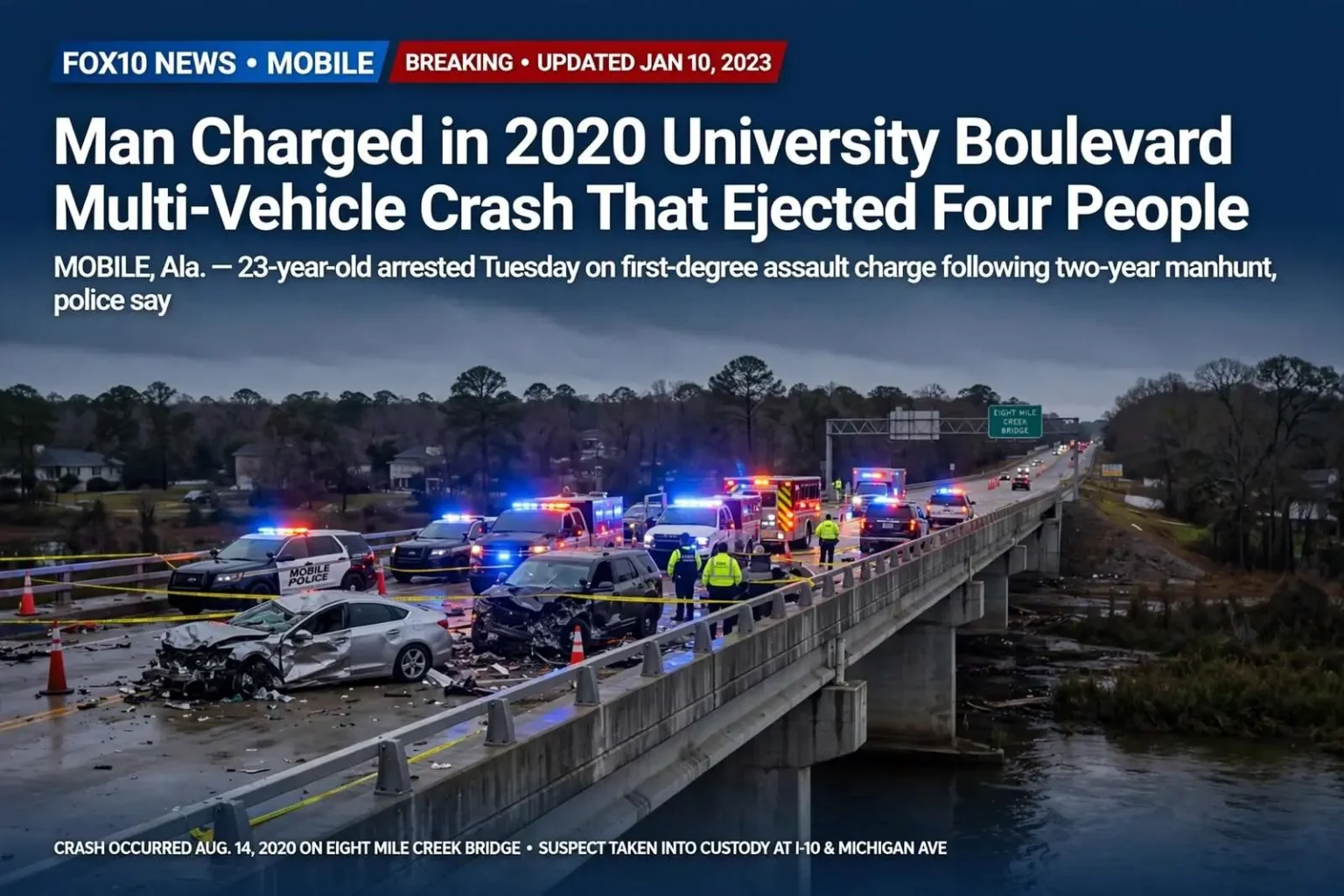
MOBILE, Ala. — A man wanted in connection with a violent 2020 multi-vehicle crash on University Boulevard that ejected four people from one of the cars has been arrested, Mobile police announced this week. Travon D. Coleman, 23, was taken into custody on Tuesday, Jan. 10, after officers pulled him over at I-10 and Michigan Avenue. He faces a charge of first-degree assault for the earlier wreck as well as two additional outstanding warrants.
The arrest closed a chapter on a wreck that had drawn attention across the city for the sheer violence of the collision and the length of time the suspect remained at large. University Boulevard is a busy corridor in west Mobile, carrying commuter and school traffic past residential neighborhoods and commercial strips between Airport Boulevard and Government Street, and the site of the crash — the bridge where the road crosses Eight Mile Creek — has long been a point where drivers converge in tight lanes with little margin for error.
Officers made the stop without incident, according to the department’s announcement, taking Coleman into custody at the interchange where Interstate 10 meets Michigan Avenue on Mobile’s west side. The location is one of the region’s major crossroads, a stretch of interstate that funnels port traffic, commuters and freight through the city day and night. A routine traffic stop there ended a search that had stretched more than two years from the night of the wreck.
How the Original Crash Unfolded
The five-car collision occurred on Aug. 14, 2020, on University Boulevard at the Eight Mile Creek Bridge, according to investigators. A Saturn heading northbound attempted to pass a Chevy truck, crossed into the southbound lane, and struck a Nissan Armada head-on. The Saturn then collided with a Lincoln Town Car following the Armada, at which point four occupants were ejected from the Saturn. The chain of impacts unfolded in seconds, but the wreckage it scattered shut the roadway and pulled in multiple rescue units.
The Chevy truck struck one of the people who had been thrown from the vehicle as that truck came to a stop. A U-Haul truck struck wreckage heaved onto the road surface. In total, six injured people were taken to the hospital that night. At the time, officials said four were being treated for serious injuries while two others suffered minor injuries.
Ejections in a crash of that kind reflect the forces involved when vehicles meet head-on at highway speeds. Occupants thrown from a vehicle face dramatically higher risks of death and catastrophic injury than those who remain restrained inside, which is why investigators reconstructing the scene weighed speed, lane position and restraint use so heavily. Four people thrown from a single car — plus a pedestrian struck on the roadway and a U-Haul driver whose vehicle plowed into debris — meant the night’s casualties came from nearly every vehicle involved.
The Eight Mile Creek Bridge section of University Boulevard has its own hazards that investigators considered. The roadway narrows over the creek, curves limit sight lines and traffic backs up at peak hours, conditions that make passing maneuvers there especially dangerous. Investigators did not say in their public statements what prompted the northbound Saturn’s attempted pass, but the geometry of the road has long made the stretch a focal point for city traffic engineers and patrol officers alike.
The Investigation and the Search for the Driver
The investigation into who was behind the wheel of the Saturn stretched from the night of the wreck into the winter of 2023. Mobile police worked the case through the standard stages of a serious-injury crash: reconstruction of the scene, interviews with witnesses and victims, and a review of the evidence needed to support criminal charges rather than only traffic citations. First-degree assault, the charge ultimately filed, is reserved under Alabama law for conduct that causes serious physical injury, and its use in a traffic case signals that investigators concluded the driving rose to a level beyond ordinary negligence.
Warrants followed the investigation, and the two-plus years between the crash and the arrest reflect how those cases move. A suspect who does not remain at the scene or cannot be located does not simply become forgotten; warrants persist, and their discovery is often a matter of chance — a routine traffic stop, a checkpoint, an unrelated investigation that turns up a name. Coleman’s capture at the I-10 and Michigan Avenue interchange came exactly that way, during a stop by patrol officers who recognized the outstanding warrants.
For the injured, the arrest carried significance beyond the courtroom. Six people went to the hospital from the August 2020 wreck, four of them with serious injuries, and victims of long-unsolved cases often describe the arrest itself as a milestone — the first concrete sign that the harm done to them was being answered by the justice system. Mobile police did not release details about the victims’ conditions since the crash, but the seriousness of the collision remained evident in the charges filed.
Additional Warrants
Jail records show Coleman was also wanted on separate outstanding warrants: a theft-of-property charge from Nov. 3, 2020, and a charge of giving a false name to a police officer stemming from July 22, 2021. The additional charges painted a picture of the intervening years — a theft case filed in the fall of 2020, months after the wreck, and a 2021 charge alleging that he identified himself falsely to an officer during an encounter with law enforcement.
The false-name charge is often filed when a suspect attempts to conceal an identity during an investigative stop, and in Coleman’s case it carried added weight: giving police a false identity is a common reason wanted suspects avoid capture for extended periods. Theft of property charges in Alabama range in severity by the value of the property involved, with felony classifications reserved for higher-value thefts.
Because the warrants were filed at different times by different parts of the justice system, the arrest consolidated cases that had been moving on separate tracks. Coleman’s initial court appearance addressed the outstanding warrants together, and prosecutors will now decide how the assault case proceeds in relation to the theft and false-name charges. Each case stands on its own evidence, but the combination means the 2020 crash case will not be the only matter before the courts as the process unfolds.
Danger on Mobile’s Major Corridors
The University Boulevard wreck belongs to a broader pattern of serious crashes on Mobile’s arterial roads. Corridors like University Boulevard, Airport Boulevard and Government Street carry heavy traffic through the heart of west Mobile, mixing commuter volume with commercial access points, and they generate a steady share of the city’s most severe collisions. Head-on crashes, though less common than rear-end and angle collisions, account for a disproportionate number of deaths and serious injuries because of the closing speeds involved.
Traffic safety officials have long urged drivers to treat passing maneuvers on multi-lane arterials with special caution. A failed pass on a two-way road — precisely what investigators described on the night of the Saturn crash — converts ordinary traffic into oncoming obstacles at combined speeds that can exceed 100 miles per hour, leaving almost no time for evasive action. Seat belts and other restraints, safety advocates add, remain the single most effective protection when a crash of that kind occurs; the four people ejected from the Saturn on Aug. 14, 2020, suffered the consequences of what happens when they are not.
The crash also illustrates the ripple effects of a single collision on a busy corridor. Five vehicles, six hospital patients, a closed roadway and a two-year investigation began with one car crossing the center line over Eight Mile Creek. For the families involved, the costs — medical, financial and emotional — extended far beyond the night itself, and the arrest this week marks the point where the criminal justice system, at least, has caught up with the harm.
What Comes Next
With Coleman in custody at the Mobile County Metro Jail, the case moves into the court system, where prosecutors will pursue the first-degree assault charge alongside the two outstanding warrants. Conviction on a first-degree assault charge in Alabama carries a potential sentence measured in years of prison time, and the outcome will depend on the evidence assembled from the 2020 crash reconstruction and the testimony of those injured that night.
Police used the announcement of the arrest to underscore a point that applies to every outstanding warrant in the city: cases do not close on their own, and stops as routine as a traffic violation on I-10 can end years of waiting for victims and their families. For the people injured on University Boulevard in August 2020, this week’s arrest does not undo the crash — but it does finally put a name, and a defendant, to the night that changed their lives.