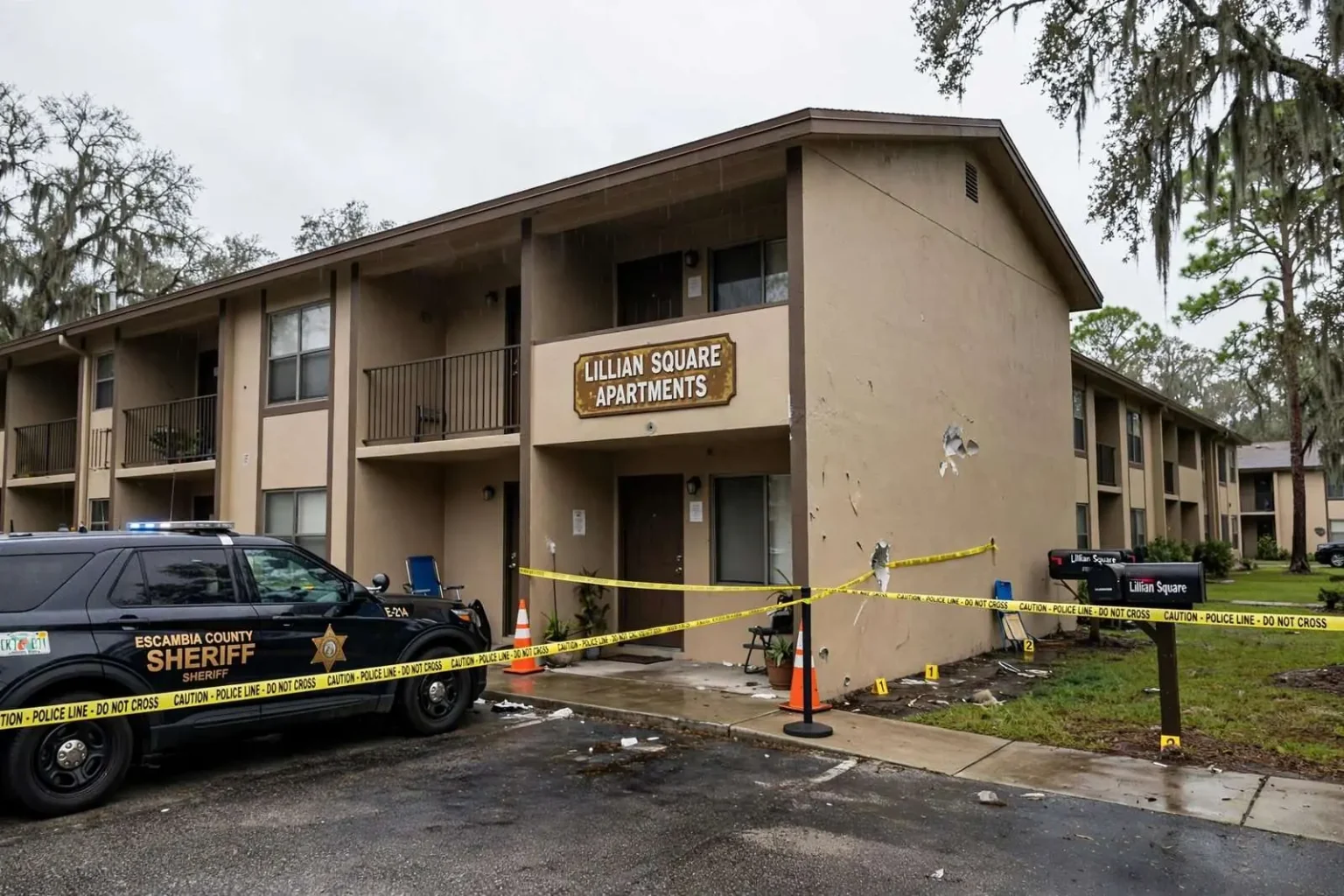
ESCAMBIA COUNTY, Fla. — A 22-year-old man has been charged with attempted homicide in connection with a March shooting at the Lillian Square Apartments. In addition to the attempted homicide charge, Darien Johnson faces a weapon offense charge for firing into a building, as well as a charge of weapon possession by a convicted felon. He was booked into the Escambia County Jail on Monday morning and is being held without bond.
The arrest closes a months-long gap between the gunfire itself and the charge, a span during which deputies with the Escambia County Sheriff’s Office worked to identify and locate the shooter. Attempted homicide charges are among the most serious a Florida defendant can face short of murder, carrying the possibility of decades in prison upon conviction, and the accompanying charge of firing into an building reflects the indiscriminate danger the spray of gunfire posed to everyone living in the complex — not only the intended target.
The charge of weapon possession by a convicted felon is a familiar second count in cases like this one, and it stands on its own regardless of how the shooting allegations resolve. Florida treats illegal firearm possession by a person with a prior conviction as a serious felony in its own right, and in this case the prior-conviction element is not in dispute: court records show a 2021 conviction in Escambia County on multiple charges that included weapon offenses.
Johnson is being held without bond, a detention status reserved in Florida for cases where the gravity of the charges and a defendant’s history convince a judge that no release conditions can reasonably protect the public. Pretrial detention without bond means the case will move toward its next court dates with the defendant already in custody, and it ensures the shooting charge — not release conditions — will be the focus of the proceedings to come.
The March shooting
The shooting happened the morning of March 6. Deputies arrived at the complex around 11 a.m. The sheriff’s office says the victim reported being chased by three people before he was shot in the leg. He was transported to the hospital with non-life-threatening injuries.
The circumstances as described — a daytime chase across the grounds of an apartment complex, ending with a gunshot wound — illustrate how quickly a pursuit can escalate into gunfire in the middle of a residential neighborhood. A wound to the leg is by any measure a fortunate outcome given the number of rounds apparently fired and the proximity of homes, vehicles and bystanders on a weekday morning when residents were home and children were nearby.
The gunfire caused damage to two apartments. One resident says a bullet came through her kitchen wall. That detail — a round traveling through an exterior wall into the room where a family prepares its meals — is the sharpest possible illustration of the risk the shooting posed to people who had nothing to do with whatever dispute preceded it. Bullets that penetrate walls do not distinguish between targets, and in apartment complexes the units are close enough that any volley of gunfire endangers every building in the arc.
For the residents of Lillian Square, the March morning’s violence and the months of uncertainty that followed have now given way to an arrest, which is what investigators promise but cannot always deliver in shooting cases where victims and witnesses are reluctant to come forward. The charges announced Monday indicate that the sheriff’s office assembled enough evidence to carry the case past the charging decision — typically a combination of the victim’s account, physical evidence at the scene, and witness interviews conducted in the weeks after the shooting.
A prior record
In April 2023, Johnson — then 19 — was one of two men charged with attempted homicide after a woman was shot in the head on Potomac Drive during the middle of the day. A jury later found him not guilty in January 2025, and he was released from jail. That acquittal is a reminder of how the criminal process works in both directions: charges are accusations, and a jury weighing the evidence found the proof insufficient to convict. It also means that, legally, the Potomac Drive case cannot be counted against him — but the experience of the prosecution, and the sheer number of cases now accumulating around one defendant, paints a picture of a young man whose adult life has been spent largely in the court system.
Earlier this year, on March 23, Johnson was arrested in Escambia County on charges of aggravated assault (domestic violence), battery (domestic violence), robbery, grand theft and weapon possession by a convicted felon. Court records show those charges were all later dropped in late June, and he was released from jail on July 1. The March 23 arrest came slightly more than two weeks after the Lillian Square shooting — meaning Johnson was arrested on a fresh set of felony charges while the apartment complex investigation was still active, before those charges were dropped and the shooting case finally produced Monday’s arrest.
Previously, in 2021, Johnson was convicted in Escambia County of grand theft auto, weapon possession by a delinquent, carrying a concealed weapon, resisting arrest and battery by a person in jail. He was sentenced to two years in state prison and released in October 2022. That record — a multi-count conviction including weapons charges, served in state prison before his twentieth birthday — is the foundation of the felon-in-possession charge he now faces, and it is the reason a single firearm allegation carries such weight in this case.
What happens next
With the arrest made and bond denied, the case moves into the standard machinery of Florida felony court. Prosecutors with the State Attorney’s Office for the First Judicial Circuit will present the case to a grand jury if required, formal charges will be filed, and the defense will have access to the state’s evidence through discovery. Arraignment, pretrial hearings and motion practice will fill the coming months, and any resolution — plea agreement or trial — lies well beyond that.
The attempted homicide charge will draw the courtroom’s attention, but the felon-in-possession count may be the state’s most straightforward path: it requires proof only that Johnson possessed a firearm and had a qualifying prior conviction, both of which the documentary record already establishes. Prosecutors routinely charge both counts so that the possession case stands even if questions arise about who fired which shots during the chaotic morning of March 6.
For the Lillian Square community, the arrest is a step toward closure on a frightening episode, but it does not erase the damage. Two apartments still carry bullet holes, a resident still remembers the round that came through her kitchen wall, and the questions residents always ask after shootings like this — who was involved, and whether it could happen again — now have at least a partial answer in the form of a defendant in custody.
The Escambia County Sheriff’s Office has not indicated whether additional arrests are expected in connection with the shooting. The victim’s account described three people in the chase that preceded the gunfire, and Monday’s arrest accounts for one of the three. Anyone with information about the case can contact the sheriff’s office directly, or leave an anonymous tip through Crime Stoppers of the Emerald Coast, which forwards tips to investigators without requiring a caller’s name.
The case is also a data point in a larger conversation Escambia County has been having about gunfire at apartment complexes. When rounds strike units rather than people, the incident often registers as property damage and a frightening memory rather than a homicide investigation — but the charge of firing into a building exists precisely because the law treats that risk as criminal in itself. Every bullet that passes through a shared wall in a complex like Lillian Square passes through rooms where families sleep, cook and watch television, and the difference between property damage and a death is usually nothing more than angle and chance.
Residents of complexes where shootings occur face a familiar set of worries afterward: whether the shooting was targeted or random, whether the people involved will return, and whether reporting what they saw will make them a target themselves. That hesitance is one of the recurring obstacles in cases like this one, and it is why anonymous tip lines and the promise of confidentiality matter so much to investigators working apartment-complex shootings. The three-month gap between the March 6 shooting and Monday’s arrest suggests investigators took the time to build the case rather than rushing to charge, which the seriousness of the charges now reflects.
The timeline of Johnson’s arrests and releases over the past two years — a 2025 acquittal, a spring arrest with dropped charges, and now an attempted homicide charge — will inevitably draw scrutiny to how the cases moved through the system. Each stage followed its own logic: a jury acquitted, prosecutors dropped a case when its proof fell short, and a new arrest followed new evidence. But for residents of the neighborhoods where the alleged conduct occurred, the pattern reads differently, and the question of what the courts will do with the chance they now have is the one the community will be watching.
Johnson is expected to appear for his first court appearances in the coming days, where the no-bond status will be formally addressed and future hearing dates set. As always in criminal cases, the charges are accusations, and the state will bear the burden of proving them beyond a reasonable doubt before a judge or jury in Pensacola’s courthouse — the same standard, applied the same way, that produced the acquittal in his previous case.