
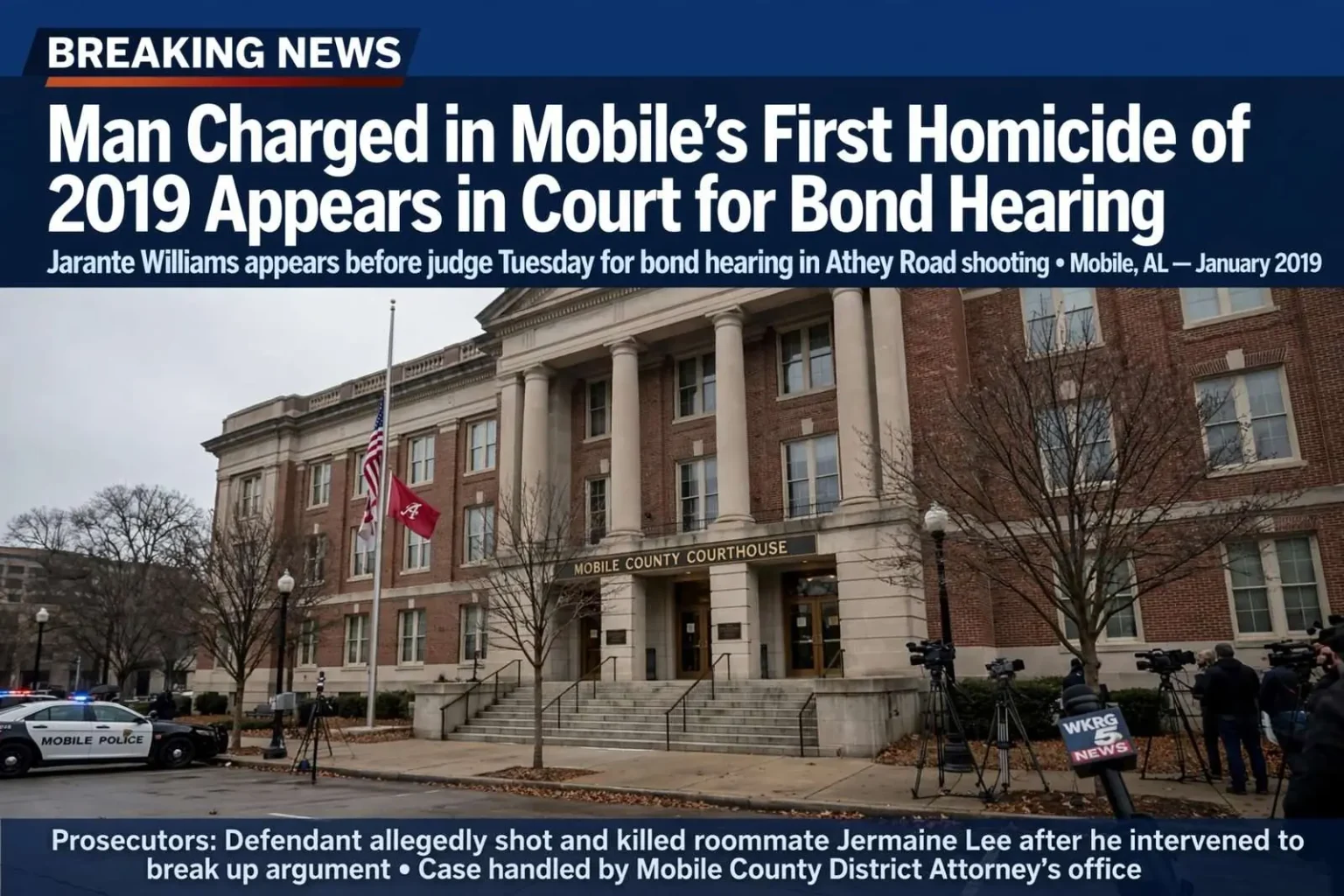
The man accused in Mobile’s first homicide of 2019 appeared in court Tuesday for a bond hearing, months after prosecutors say he shot and killed his roommate in an incident that began as an argument between other people.
Prosecutors say Jarante Williams shot and killed his roommate, Jermaine Lee, at a home on Athey Road after Lee tried to break up an argument. According to prosecutors, Williams was arguing with another person when Lee intervened to defuse the situation, putting himself between the disputing parties in an attempt to calm things down.
Williams then allegedly shot Lee, killing him, according to the account presented by the state. The allegation that the victim died while trying to stop a fight has hung over the case from the beginning, painting a portrait of a fatal encounter that escalated from words to gunfire in moments.
The incident marked Mobile’s first homicide of the new year, a grim distinction that drew attention to the case from the city’s earliest days of 2019. Mobile, like many mid-sized cities, tracks its homicide count from the first of January, and the Athey Road shooting set the city’s count at one.
Williams was taken into custody and appeared before a judge for a bond hearing this week. Bond hearings give defense attorneys and prosecutors their first opportunity to argue before a judge about whether the accused should be released pending trial, and under what conditions.
The case is being handled by the Mobile County District Attorney’s office, which will carry the prosecution from the bond stage through indictment and, if the case proceeds, trial in Mobile County Circuit Court.
The Alleged Events on Athey Road
Athey Road runs through a residential part of Mobile, and the home where the shooting occurred was the shared residence of Williams and Lee, according to prosecutors. Living situations that bring roommates together under one roof can also bring outsiders into the home, and it was during a dispute involving another person that the fatal argument began, per the state’s account.
Intervening in an argument is something family members, friends and roommates do every day without consequence, but prosecutors say that in this instance Lee’s attempt to defuse the situation placed him in the path of gunfire. The state’s theory of the case will center on Williams’ alleged decision to shoot during the confrontation.
Details of what preceded the shooting, including the identity of the other person involved in the argument and the specific words exchanged, have not been laid out fully in public proceedings. What prosecutors have outlined is the core sequence: an argument, an intervention by Lee, and the shot that killed him.
Homicides arising from arguments between acquaintances are among the most common categories of killing in American cities, and Mobile is no exception. Investigators treat such cases with the same thoroughness as any other, from scene processing to witness interviews, because the circumstances at the moment of the shooting determine the charges and possible defenses.
The Bond Hearing Stage
A bond hearing is the first major courtroom step after an arrest in a homicide case. The judge considers the nature of the charges, the evidence presented in outline form, the defendant’s criminal history and ties to the community, and the potential risk to public safety before setting bail or ordering the defendant held.
In Alabama, defendants charged with serious crimes have a right to have bond set, though judges may impose high amounts and strict conditions for violent offenses. Prosecutors at the Mobile County District Attorney’s office routinely argue for conditions that protect witnesses and the community in homicide cases.
Defense counsel, meanwhile, argue for terms their client can meet, pointing to factors like employment, family support and lack of prior record. The hearing is not a trial, and no evidence is tested by cross-examination; it is a preview based on the state’s allegations and the defense’s response.
Whatever the judge decided at Tuesday’s hearing, the case’s next milestones are the preliminary process and grand jury review. In Alabama, felony cases typically move through district court for a preliminary hearing before being presented to a grand jury, which decides whether to indict.
Mobile’s Homicide Count and What It Measures
Every January, newsrooms and police departments across the country begin tracking a new year’s homicide total from zero, and Mobile is no exception. The first killing of a year reliably draws outsized attention, both because it sets the tone for the count and because it often arrives before the city has processed the crimes of the year before.
Mobile’s homicide numbers in recent years have run in the range seen in comparable Gulf Coast cities, with the majority of cases involving arguments, domestic disputes or other circumstances between people who knew one another, rather than random violence. The Athey Road case, arising from an argument and an attempted intervention, fits that well-documented pattern.
The Mobile Police Department investigates homicides with a dedicated unit, working alongside the Mobile County District Attorney’s office from the earliest stages. Early coordination matters: prosecutors guide investigators on the evidence needed for grand jury presentation while the case is still fresh.
First-homicide-of-the-year cases also carry symbolic weight in the community. Civic leaders, clergy and neighborhood groups in Mobile have long responded to violence with calls for intervention programs, and each killing, especially the first of a year, renews public discussion about what can be done to stop disputes from turning deadly.
When Interventions Turn Deadly
The alleged circumstances of Jermaine Lee’s death, killed while trying to break up an argument, place the case in a category that resonates far beyond the courtroom. People step into disputes every day as peacemakers, and the vast majority of those interventions end without harm.
Safety experts advise that the best response to a escalating argument is usually to create distance and call for help rather than to place oneself physically between antagonists, particularly if weapons are present or if the disputants have been drinking or using drugs. Once a confrontation reaches a certain point, even a familiar voice cannot reliably defuse it.
The law recognizes these realities in various ways, including defenses and mitigating circumstances that arise when a victim intervened in a fight. Prosecutors and defense attorneys will each frame Lee’s intervention differently as the case moves forward, with the state emphasizing the alleged choice to shoot and the defense exploring the full context of the encounter.
For Lee’s family and friends, the courtroom process is about accountability for a life lost during an act of peacemaking. Cases that begin with such circumstances often draw community attention at each hearing, as loved ones follow the proceedings from the gallery.
The Road Ahead in Mobile County Circuit Court
If the grand jury indicts Williams, the case will proceed to Mobile County Circuit Court, where felony trials are held. Between indictment and trial come arraignment, motion practice, witness preparation and, in many cases, plea negotiations between the defense and the District Attorney’s office.
Homicide prosecutions in Mobile County typically take many months, sometimes more than a year, to reach trial. The timeline reflects the volume of the court’s docket, the complexity of the evidence and the constitutional protections afforded the accused.
The District Attorney’s office, which is handling the case, will rely on the investigative file assembled by Mobile police, including witness statements, forensic results and the account of events on Athey Road. Witnesses to the underlying argument may be called to testify about what they saw and heard.
For now, the case rests at the stage every prosecution passes through early: a bond hearing, a judge’s decision and a file that will grow thicker as the system moves toward resolution. The Athey Road shooting began Mobile’s 2019 homicide count, and the courts will spend the months ahead determining the legal answer to what happened there.
Roommate Homicides and the Questions They Raise
Killings between roommates occupy a difficult space in homicide statistics and in public understanding. The intimacy of shared living means there is rarely a mystery about who was present, but the closeness also means the courtroom story involves the everyday details of a shared household, from who owed whom money to who was visiting that night.
Investigators in such cases document the scene exhaustively, because the layout of a home, the position of shell casings and the movements of everyone present become central to reconstructing what happened. Witness interviews with neighbors, who often heard the argument even if they saw nothing, add the audio record that a home’s walls preserve imperfectly.
The allegation that another person was part of the original argument raises questions that the defense and prosecution will explore: that person’s account of events, whether any weapon was present before the shooting, and what role, if any, that individual plays in the case going forward.
Prosecutors will also examine Williams’ background as part of trial preparation. A defendant’s history can influence charging decisions, bond conditions and sentencing exposure, and both sides build their strategies around what the record shows.
For the neighborhood around Athey Road, the case is a local memory that court coverage will periodically revive. Mobile residents living near the scene followed the first reports closely in the days after the shooting, and each hearing brings the story back into view until the courts have the final word.
