Man Charged With Impersonating Mobile Officer Had Posted Videos of Himself at Prior Crime Scenes
A Mobile man accused of impersonating a police officer at a shooting scene had for months posted videos and photos online showing him in police-style gear responding to other crime scenes and traffic stops around the city.
A 34-year-old man arrested this week on charges of impersonating a police officer appears to have spent months building an online following by posing as law enforcement at crime scenes across Mobile, according to court records and social media posts reviewed after his arrest.
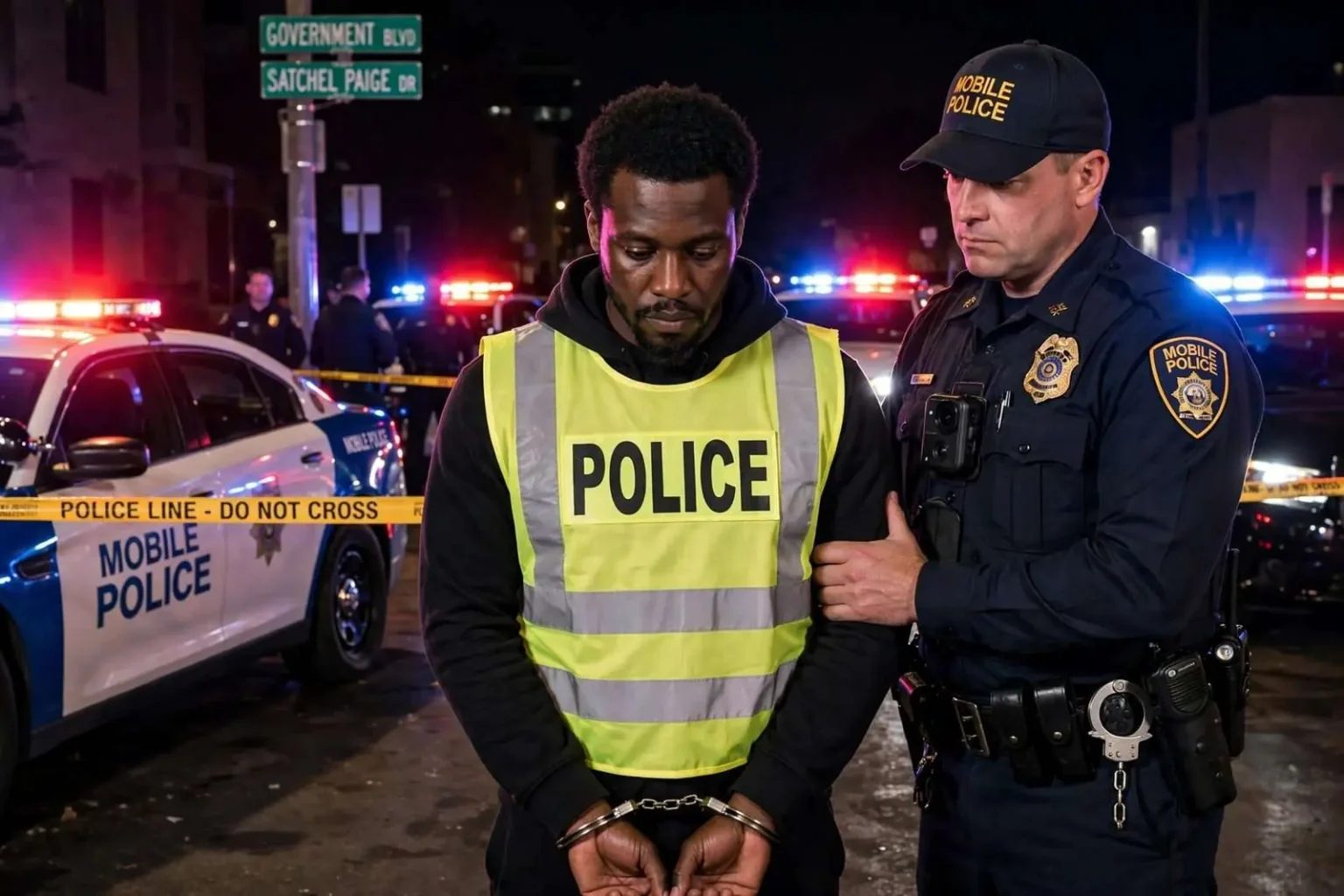
Tyonne Frazier was booked into Mobile Metro Jail shortly after 4 a.m. on Wednesday after being taken into custody near the intersection of Government Boulevard and Satchel Paige Drive, where Mobile police were investigating a shooting. Jail records show he was charged with impersonating a peace officer, carrying a pistol without a permit, and possession of marijuana and drug paraphernalia.
According to an arrest warrant filed in district court, officers on the scene noticed Frazier wearing a reflective vest marked “POLICE” and a badge clipped to his belt. The warrant states he was seen walking through the area “as if he was investigating the scene” of the shooting, though he reportedly never spoke with any of the actual officers working the case. He was ultimately identified as an outsider when an officer at the scene, David Reyes, realized he did not recognize him.
Investigators say the April 25 arrest was not an isolated incident. A review of Frazier’s public Facebook account turned up a string of videos and photographs, some dating back several months, showing him wearing police-style gear and, in several instances, inserting himself into active law enforcement responses around the city.
A pattern visible online for months
In one livestream posted in February, Frazier can be heard telling viewers he was responding to a domestic assault call at Windsor Apartments, describing details of the dispatch call and the people involved while a police scanner plays in the background. The footage shows his car pulling up near two marked Mobile police cruisers, after which he is seen in a yellow reflective vest and a shirt reading “POLICE,” walking the parking lot and narrating the scene for his online audience while uniformed officers spoke with a woman on a nearby balcony.
“Apparently we have a domestic situation with a black male and black female,” Frazier says in the video, adding that he intended to “patrol the area” to look for the man accused of assaulting the woman.
Another video posted in January shows Frazier using a radar gun from inside his vehicle to check the speed of passing motorists before tailing one of them, at one point referencing a real Mobile police narcotics operation that had taken place days earlier. It is not clear from the footage whether the driver was ever stopped.
The earliest known video, posted to YouTube and shared to Facebook in December, shows Frazier dressed in a police-style uniform handcuffing one man and questioning another about drinking in public before revealing on camera that the encounter was staged as a prank. That video, investigators noted, established the template for what followed: police-style clothing, police-style language and an audience encouraged to see him as something he was not.
Frazier’s Facebook page also includes a photo of a Ford Mustang fitted with aftermarket blue lights similar to those used on patrol vehicles, along with claims that he had completed the Mobile Police Department’s Citizens Police Academy, a biannual program that allows members of the public to observe police training and operations. A department spokeswoman disputed that claim.
“We have no record of anyone by his name attending the Citizens Academy,” said Mobile police spokeswoman Charlette Solis. “We checked all the rosters back to Class 1 from 2001, and he is not a member of the Mobile Citizens Police Academy Alumni Association.”
How the arrest unfolded
The arrest that finally ended the pattern came at a scene where actual officers were plentiful and strangers were few. Mobile police were working a shooting near Government Boulevard and Satchel Paige Drive, a corridor of restaurants and businesses west of downtown where officers are accustomed to knowing which investigators belong there. Frazier’s vest and badge were not enough to blend in once Officer David Reyes scanned the area and realized he did not recognize the man walking the scene.
Court records indicate that distinction mattered legally as well as practically. Impersonating a peace officer is a charge built on exactly the kind of conduct described in the warrant — presenting oneself as law enforcement through clothing, equipment and behavior. The additional charges of carrying a pistol without a permit and possession of marijuana and drug paraphernalia compounded the legal exposure Frazier faced once he was taken into custody.
Police leadership responds
Mobile Police Chief Lawrence Battiste acknowledged that Frazier’s repeated appearances near active police calls had not drawn department scrutiny sooner, saying the case had not been a top priority amid a recent increase in shootings across the city.
“It was alarming to us, and there are some things that we’re looking deeper into,” Battiste said. “We’ve got him detained, and we don’t expect him to get out any time soon.”
The chief’s remarks reflected the competing pressures on a department handling a rise in gun violence. With detectives stretched across active shooting investigations, a man filming himself near crime scenes did not rise to the level of a priority until the night he appeared at one wearing a vest marked “POLICE” and a badge on his belt. Battiste said the department is now looking more closely at the extent of Frazier’s activity, including how many scenes he may have visited and what he did with the footage he collected.
A record that predates the videos
Court and jail records show Frazier has faced a number of prior arrests in the Mobile area on charges including drug possession, theft, forgery and probation violations. The record suggests a long history with the local justice system, though none of the prior charges involved impersonating an officer before this arrest.
It remains unclear how many crime scenes or police calls Frazier may have responded to over the months captured in his social media posts, or whether anyone he encountered believed him to be a genuine officer. Investigators have not said whether any of the people who appeared in his videos — the woman on the Windsor Apartments balcony, the motorists he tailed, the men in the December prank video — were ever told the truth about who he was.
The case remains under investigation, and prosecutors have not said whether additional charges could follow if the review of Frazier’s social media history turns up further incidents.
Why impersonation cases worry police
Incidents of fake officers occupy an uneasy place in policing. Departments rely on the public’s instinct to comply with and trust a uniform, and that trust is exactly what an impersonator exploits. In Mobile’s case, the concern was sharpened by the fact that Frazier was armed, according to jail records, and that he inserted himself into genuinely dangerous situations — active shooting scenes and domestic calls — where a mistaken identity could have ended badly for him or for the officers working the scene.
Residents who encounter someone claiming to be an officer and whose identity is uncertain can ask for a name and badge number and request confirmation through the department’s non-emergency line, guidance that police agencies commonly repeat after cases like this one. For now, the man whose videos showed him walking Mobile’s crime scenes as a self-appointed investigator is in a jail cell, and the department he pretended to belong to is still counting the scenes he visited.
The gap between spectator and participant
What distinguished Frazier’s activity from ordinary spectating was his repeated movement from watching to participating. Civilian livestreamers and scanner enthusiasts frequently broadcast from or near police activity, and departments generally tolerate that distance. The warrant describes something closer: a man in police-identified clothing walking through an active shooting scene, positioning himself among investigators, and narrating dispatch details to an online audience in earlier incidents.
The February livestream at Windsor Apartments illustrates the concern. By describing details of the dispatch call and the people involved while a scanner played in the background, Frazier was doing more than reporting on police work; he was performing it for viewers who had no way to know he was not an officer. The fact that marked units were already on the scene meant actual police were present, but nothing in the footage suggested his audience could tell which man in the parking lot held real authority.
The January radar video raised a different question — whether Frazier’s conduct crossed from performance into attempted enforcement. Tailing a motorist after clocking their speed mimics traffic enforcement, and the video’s reference to a genuine narcotics operation days earlier suggested he was tracking actual department activity rather than inventing scenarios wholesale. Investigators have not said whether that behavior prompted any of the charges, but it formed part of the record reviewed after his arrest.
The Citizens Police Academy claim
Frazier’s alleged claim of academy attendance is the kind of detail that gives impersonation cases their durability. The Citizens Police Academy is a real and popular program in Mobile, one that has graduated hundreds of residents since its first class in 2001, and many participants speak about it publicly afterward. Borrowing the credential borrows the department’s credibility, which is why Solis answered it specifically, citing rosters going back to Class 1 and the alumni association’s membership list.
The department’s willingness to detail its verification — checking every roster across two decades — reflected how seriously officials took the blurring of lines between citizen participants and sworn officers. A program built to build public understanding of policing was, in this account, repurposed as a prop for an online persona.
What comes next in the case
Frazier remained held at Mobile Metro Jail on the impersonation, weapons and drug charges as the department continued its review. District court proceedings on the warrant were pending, and officials had not released a full accounting of how many videos, scenes or encounters formed the basis of the investigation.
Battiste’s comments suggested the department intends to document that record thoroughly before the case moves forward. “There are some things that we’re looking deeper into,” he said, a signal that the count of alleged incidents could grow beyond what the warrant describes. For a department contending with a spike in shootings, the episode added an unusual complication: an investigation into the investigation itself — into who was really standing among the officers at each scene, and how long it went unnoticed.