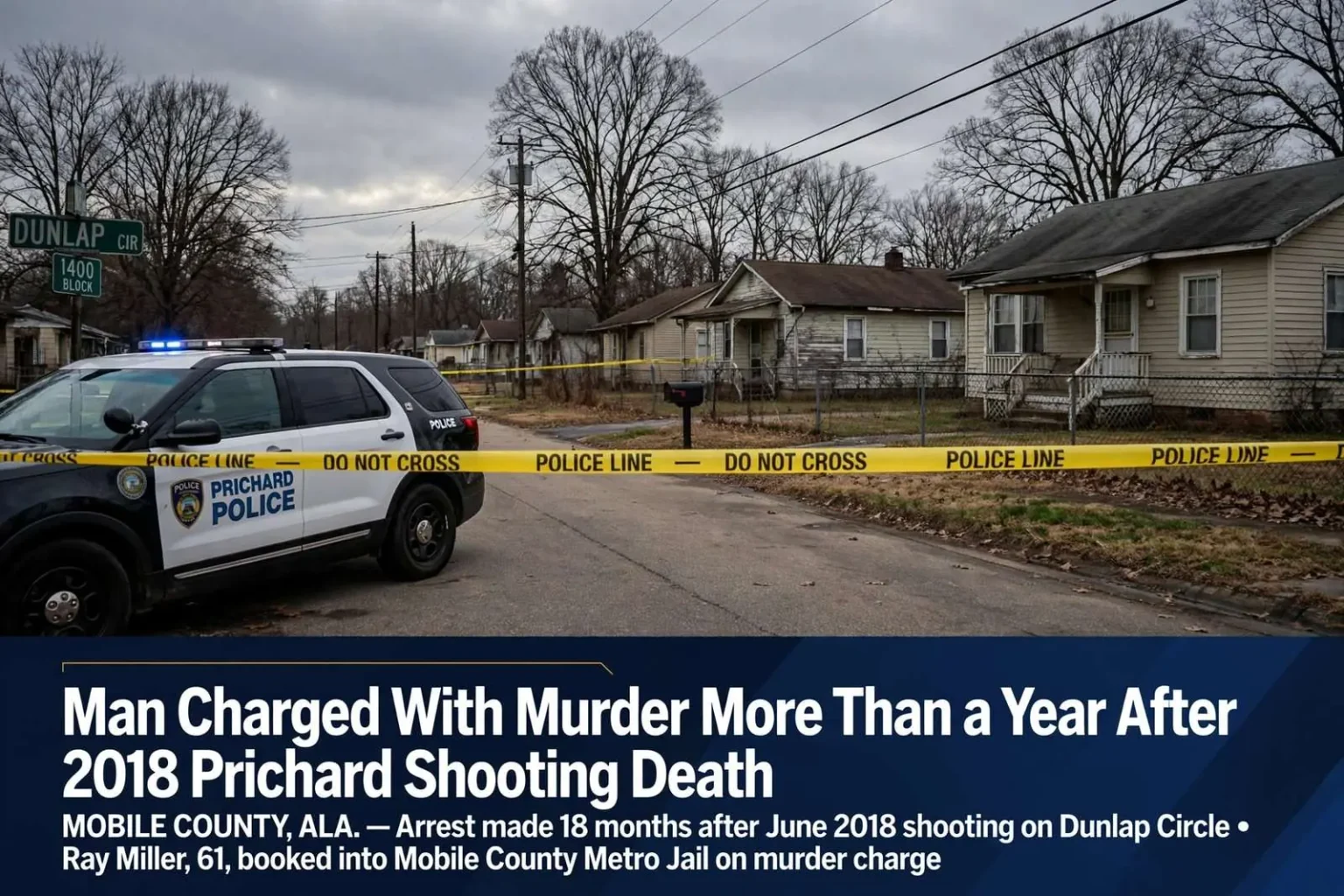
MOBILE COUNTY, Ala. — More than 18 months after a man was shot and killed during an argument in Prichard, investigators have made an arrest in the case. Ray Miller, 61, was taken into custody Friday, January 10, and booked into Mobile County Metro Jail on a charge of murder, according to jail records.
The arrest answers a question that had hung over the victim’s family since the summer of 2018: who fired the shot that killed 63-year-old George Earl Coleman on Dunlap Circle in Prichard.
A dispute that turned deadly
Miller is accused of shooting and killing 63-year-old George Earl Coleman on Dunlap Circle in Prichard in June 2018. Investigators with the Prichard Police Department said the shooting grew out of a heated argument between the two men. What began as a confrontation between neighbors or acquaintances ended with one man dead on a residential street in one of Prichard’s older neighborhoods, and with a case file that would stay open for a year and a half.
Prichard, the small city just north of Mobile, has long worked violent crime with a police department far smaller than the workload it faces, and cases there frequently depend on the cooperation of witnesses who live close to the events. Detectives in the Coleman case spent the months after the shooting building what they could — forensic results, witness interviews, evidence review — before the warrant that led to Miller’s arrest was finally signed and served.
Why homicide arrests take so long
The arrest came roughly a year and a half after the killing, a gap that is not unusual in homicide cases as detectives wait on forensic results, witness interviews and other evidence to come together. The public often expects an arrest within days, but prosecutors and detectives know a murder case is only as strong as the record behind it, and moving to an arrest too early risks a dismissal or an acquittal that ends the case forever.
The intervening period in cases like this typically involves work the public never sees. Forensic laboratories in Alabama process evidence with turnaround times measured in months, not weeks. Detectives re-interview witnesses whose memories sharpen or whose willingness to talk changes. Investigators test whether the physical evidence — shell casings, gunshot residue, phone records, surveillance video from nearby homes and businesses — supports the account the state will eventually have to prove beyond a reasonable doubt. Only when the file supports a charge that will survive a trial does the paperwork move to a judge.
The timing of the arrest, on a Friday in January, also reflects the ordinary mechanics of warrants: once the district attorney’s office reviews the file and agrees the evidence supports murder, the warrant is issued and served, frequently after a period of surveillance to confirm the suspect’s location. Miller’s booking into Mobile County Metro Jail on January 10 marked the point where the case moved from investigation to prosecution.
What a murder charge carries
Miller remained in Metro Jail following his booking. A murder charge in Alabama carries a potential sentence of twenty years to life in prison upon conviction.
The range depends on the circumstances — Alabama’s sentencing framework allows judges to weigh the facts of the killing, the defendant’s history and other statutory factors — but the floor alone means that a conviction on this charge would keep the man convicted of Coleman’s death in prison for at least two decades. Cases charged at this level are presented to a grand jury for indictment before they proceed to trial in Mobile County Circuit Court.
The neighborhood where it happened
Dunlap Circle sits in a residential section of Prichard, a city of roughly 20,000 that borders Mobile’s northern neighborhoods. Violent crime in Prichard has been a persistent civic challenge, and the city’s police department has relied heavily on community tips to close its homicide cases. The Coleman case followed that pattern: an argument between men known to each other, a street where neighbors heard or saw something, and an investigation that had to convert neighborhood knowledge into courtroom evidence.
For the residents of Dunlap Circle, the arrest eighteen months later was a reminder that these cases stay active even when the neighborhood has moved on. Detectives with the Prichard Police Department kept the file open through the interim — a span that covered two holiday seasons and the ordinary churn of life on a residential street — before the charges were ready.
What comes next in the case
From booking, Miller’s case follows the standard felony track. An initial appearance before a district court judge sets bond; a preliminary hearing tests whether probable cause supports the charge; and the file then goes to a Mobile County grand jury, which decides whether to indict. Only an indictment moves a murder case to circuit court for arraignment and, eventually, trial. The process can take many more months, and pretrial hearings in murder cases often stretch the timeline further as the defense challenges the evidence the state gathered during that long investigative period.
Prosecutors will now inherit the work of the Prichard investigators: the forensic results, the witness statements, the physical evidence assembled over eighteen months. The strength of that file — built slowly, as detectives waited on forensic results, witness interviews and other evidence to come together — will determine what the jury hears when the case finally reaches them.
A family’s long wait for an arrest
The families of homicide victims in the Mobile area have learned that an arrest is a milestone, not an ending. For the relatives of George Earl Coleman, the January 10 arrest of Ray Miller answered the question of who, in the state’s account, pulled the trigger in June 2018 — a fact they had carried without an answer for more than a year and a half.
The months ahead will bring court dates and decisions rather than answers, but the case now has what it lacked since the summer of 2018: a defendant, a charge and a path toward a courtroom. What Miller’s defense does with the state’s evidence, and what a Mobile County jury ultimately decides, will determine whether the argument that ended on Dunlap Circle concludes with the sentence Alabama law reserves for murder — twenty years to life.
How Prichard works its cold cases
Prichard’s experience with delayed homicide arrests is long enough that the department has built its process around them. Cases that go quiet are never closed in the informal sense — they are reassigned, re-reviewed and revisited as new information arrives. Tips called in months after a killing are compared against the existing file; forensic advances allow older evidence to yield results it could not produce before; and witnesses who were reluctant in the weeks after a shooting often become willing once the immediate fear of involvement has passed. The eighteen-month gap between Coleman’s death and Miller’s arrest sits within the range the department’s own history would predict.
The arrest also illustrates the division of labor in Mobile County’s justice system. The Prichard Police Department investigates; the Mobile County District Attorney’s Office reviews and presents; the grand jury indicts; the circuit court tries. Each stage filters the evidence once more, which is why the phrase “not unusual” in the context of an eighteen-month wait understates how deliberately each step is taken when the charge is murder and the sentence is measured in decades.
What neighbors and witnesses should know
For anyone who witnessed or knows something about the June 2018 shooting on Dunlap Circle, the arrest does not end the opportunity to come forward. Witness statements remain valuable through the preliminary hearing and beyond, and investigators continue to collect information after an arrest just as before. Tips can go directly to the Prichard Police Department or through Mobile Area Crime Stoppers, which keeps callers anonymous and pays rewards for information that advances a case.
Community cooperation has been the decisive factor in most of Prichard’s solved homicides, and cases that stall are usually the ones where no one will speak. The movement in the Coleman case shows that silence eventually gives way — sometimes through the forensic record, sometimes through a witness who decides, a year and a half later, that the time has come to tell what they saw.
The legal road ahead, step by step
The practical sequence from here is knowable in outline even if its dates are not. Bond is set at the initial appearance, and whether Miller remains jailed or is released pending trial will depend on that setting and any later motions. The preliminary hearing will produce the first public airing of the evidence in open court. A grand jury presentation follows, and an indictment — expected given the charge already filed — sends the case to circuit court, where the defense will receive the state’s full file and the slow work of pretrial litigation begins.
Murder trials in Mobile County take place with juries drawn from across the county, and the evidence at trial will be the same record built since June 2018: the argument, the shooting on Dunlap Circle, the forensic work, and the witnesses who carried the account forward. The twenty-years-to-life range attached to the charge frames what is at stake for both sides when that record is finally tested.
For now, the case’s status is simple: Ray Miller, 61, is in the Mobile County Metro Jail charged with the murder of George Earl Coleman, and the machinery that will decide the accusation has started to turn — eighteen months late by the calendar, but on schedule by the standards of the cases it carries.