Man rescued after entering Mobile Bay near causeway
Emergency crews rescued a man who entered Mobile Bay near the causeway while being transported from a Baldwin County mental health facility.
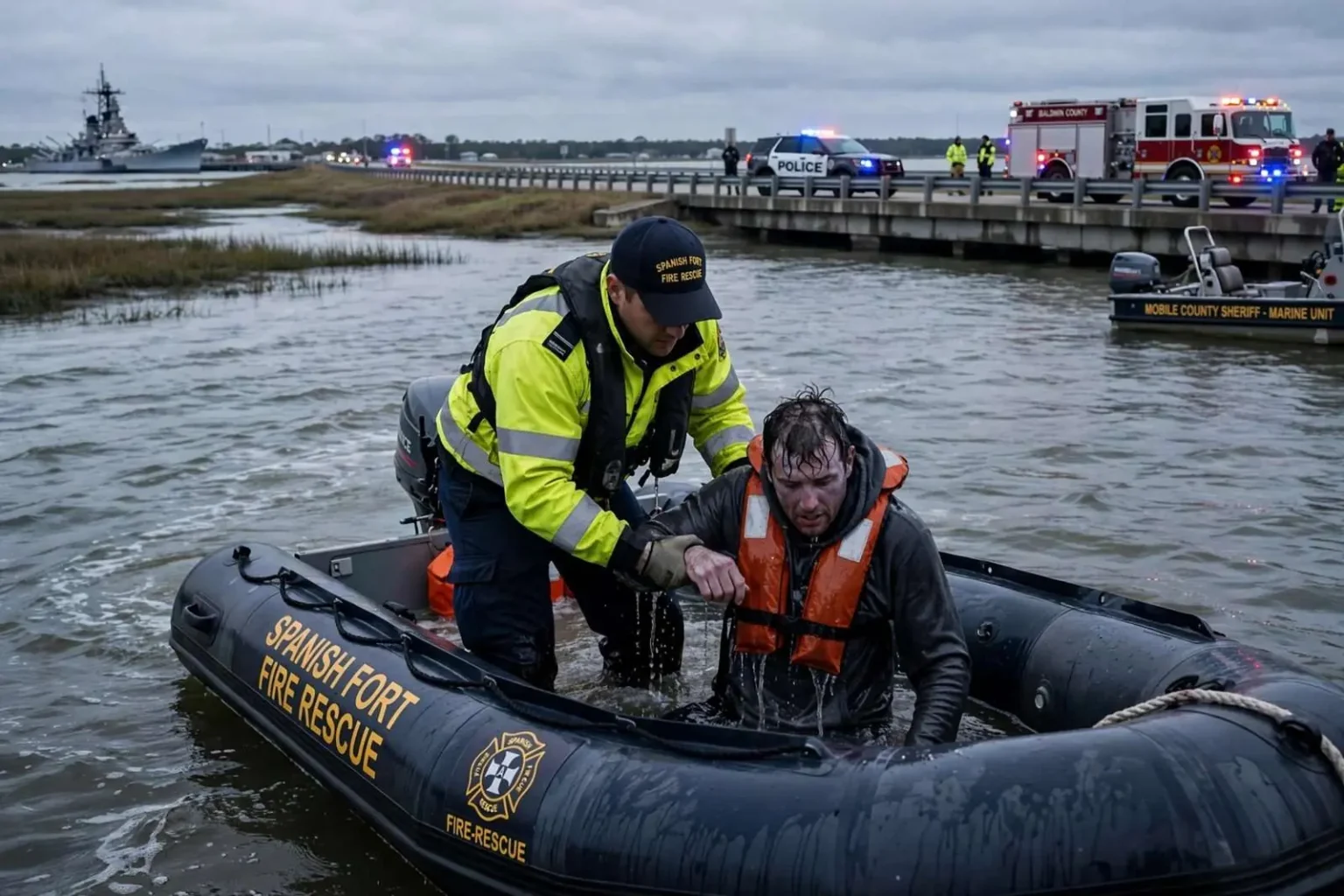
Emergency crews rescued a man from Mobile Bay Tuesday after authorities said he got out of a vehicle on the causeway and entered the water. According to Spanish Fort Police Chief David Edgars, the man had been traveling from a mental health facility in Baldwin County to a facility in Mobile when the incident occurred, and he either jumped from or got out of the vehicle in which he was being transported before going into the bay near the causeway.
First responders pulled the man from the water and took him to a hospital for treatment. Officials did not release his name or a detailed account of his condition, and the incident remains the kind of call that draws together multiple agencies along one of the busiest corridors in the Mobile Bay area. The causeway — the long, low bridge-and-roadway crossing officially known as the Battleship Parkway, carrying U.S. 90 between Spanish Fort and Mobile — stretches for miles across open water, and any emergency along it poses immediate challenges for the crews who respond.
Water rescues along the causeway are complicated by geography. The roadway sits only a few feet above the bay for much of its length, with no shoulders in many sections and limited access points where emergency vehicles can pull off safely. Wind and current on the bay can move a person in the water quickly away from the point where they entered, and visibility from the roadway is often poor in the areas where marsh and shallow water extend out from the shore.
How a Causeway Rescue Works
When a call comes in about a person in the water along the causeway, the response typically involves police, fire, and rescue units from both Baldwin and Mobile counties, depending on which end of the crossing the incident is nearest. Spanish Fort police and fire units cover the Baldwin County side, while Mobile authorities handle the approaches to the city. Boats from fire departments, marine police units, and sometimes the U.S. Coast Guard are dispatched to search the water while crews on the roadway try to keep the last known position in view.
Time is the critical factor in every water rescue. Water temperature, current, and the person’s ability to stay afloat all determine how long someone can survive in the bay, and responders train for quick deployment with flotation devices, throw ropes, and cold-water rescue equipment. In cases where the person is able to stay near the surface and mark their position, recovery can happen within minutes; in others, the search extends until darkness or weather forces a pause.
Once a person is pulled from the water, the medical work begins immediately. Hypothermia is a concern even in warm months, because immersion cools the body far faster than exposure to air at the same temperature, and inhaled water can cause delayed complications. Rescuers wrap patients in warming blankets, monitor their breathing, and transport them to the nearest appropriate hospital — often along the same causeway the incident occurred on, or to a facility in Mobile where higher levels of care are available.
Mental Health Transports and the Risks Along the Way
The fact that the man was being moved between mental health facilities when he entered the water highlights the challenges inherent in transporting people experiencing psychiatric crises. Transports between facilities happen regularly across Baldwin and Mobile counties, whether for admissions, transfers to specialized units, or moves between a hospital and a longer-term treatment placement. During those trips, patients are monitored by the staff or officers responsible for the transport, but unexpected actions — like exiting a moving or stopped vehicle on a busy causeway — can develop in seconds.
Law enforcement and medical transport personnel receive training in crisis intervention and de-escalation, and protocols generally call for continuous observation of patients who are considered at risk of self-harm. Agencies periodically review their transport procedures after incidents like this one, looking at everything from vehicle configuration to route planning. The causeway presents a particular hazard because there are few safe places to stop and pull over along the crossing, which limits a driver’s options if a passenger becomes agitated mid-route.
Mental health resources in the two-county area include hospital psychiatric units, community mental health centers, and crisis response teams that pair clinicians with officers on certain calls. Alabama has expanded mobile crisis capacity in recent years, and the state’s crisis system is designed to route people in psychiatric emergencies toward treatment rather than jail whenever possible. Still, transports between facilities remain a routine and necessary part of the system, and each one carries responsibilities for the people conducting it.
For anyone experiencing a mental health emergency in the area, the 988 Suicide and Crisis Lifeline provides a phone and text connection to trained counselors around the clock. Local crisis teams and hospital emergency departments also accept walk-ins from people in distress, and family members who are worried about a loved one can call the lifeline themselves for guidance on how to help. Officials emphasize that reaching out early — before a crisis reaches the point of hospitalization — gives people the best chance of getting care in the least restrictive setting.
The Causeway and Its Long History
The Battleship Parkway has carried traffic across Mobile Bay since the 1920s and 1930s, built along an old plank-road alignment that connected Mobile with the eastern shore. The route takes its common name from the USS Alabama, the battleship that has been moored as a memorial alongside the roadway on the Mobile County end since the 1960s. For decades, the causeway was the only direct road link across the bay, and it remains a working alternative to the higher, faster Interstate 10 crossing to the north.
Today the causeway serves commuters, fishing enthusiasts, and travelers who prefer the scenic route, and businesses line sections of the roadway on both the eastern and western ends. But its low profile across open water also makes it sensitive to weather. Storm surge from tropical systems regularly pushes water over sections of the roadway, and authorities close the causeway during high-water events because driving conditions become dangerous. Even on calm days, crosswinds and the water on both sides demand attention from drivers crossing it.
Emergencies along the causeway are responded to by a patchwork of agencies, and the incident Tuesday night demonstrated how that coordination functions. The Spanish Fort Police Department, whose chief confirmed the details of the rescue, covers the eastern approaches and works closely with fire and rescue crews from Spanish Fort and surrounding Baldwin County departments. Mobile County agencies stand ready on the western end, and mutual aid agreements let whoever is closest respond first regardless of jurisdictional lines.
What Happens After a Rescue
After a person is rescued from the bay and transported to a hospital, the immediate emergency gives way to a series of follow-up steps. Medical staff evaluate the patient for injuries, water inhalation, and exposure, and behavioral health professionals become involved as appropriate to the circumstances of the incident. Hospital social workers coordinate with the facilities involved in the original transport to determine the next steps in the person’s care once they are medically cleared.
Agencies involved in the response file their own reports, documenting the timeline, the resources used, and the condition of the person rescued. Those reports serve both operational review and potential legal purposes, particularly in cases involving a transport that was underway when the emergency occurred. Incidents like this one are typically reviewed within the transporting agency as well, to determine whether procedures were followed and whether any adjustments are warranted.
For commuters and residents who use the causeway regularly, the episode is a reminder of the range of emergencies that can unfold on the crossing — from vehicle collisions and weather events to medical and behavioral crises. Officials encourage anyone who witnesses a person in distress along the causeway to call 911 immediately and, if possible, to stay in a safe location where they can give dispatchers an accurate position. Precise location information — which bridge span, which mile marker, which direction — can shave critical minutes off a rescue response on a crossing that stretches for miles over open water.
Water rescues along the Alabama Gulf Coast are an established part of the region’s emergency response network, and the crews who perform them bring together skills from fire service, law enforcement, and emergency medicine. Fire departments on both sides of the bay maintain water rescue equipment, and several operate boats capable of responding directly from their stations. The Alabama Marine Police, part of the state’s law enforcement agency for natural resources, also patrols the bay and assists in searches, and Coast Guard Station Mobile provides another layer of capability for incidents farther from shore.
Training standards for water rescue emphasize scene safety first: rescuers are taught never to enter the water without proper equipment and backup, since a rescuer in trouble doubles the size of the emergency. Instead, responders work through a progression that starts with reaching the person from shore or from a vessel — using throw ropes, rescue rings, and poles — before any swimmer goes in. The same discipline applies to civilians who witness someone fall into the water: throwing a flotation device or a line is far safer than jumping in, and calling 911 immediately remains the single most important step.
The bay itself presents conditions that responders study and respect. Tidal currents move water in and out of the bay through the shipping channel at its mouth, and winds out of the south can push surface water northward toward the causeway, creating drift that carries a person in the water along the roadway. Shallow water near the shore can hide soft mud and oyster reefs that complicate both swimming and boat operations. Experienced rescue crews use all of that knowledge to predict where a person who entered the water at a given point will end up, and those calculations drive where boats are positioned during a search.
Area agencies have responded to a number of water emergencies along the causeway corridor over the years, involving drivers whose vehicles left the roadway, anglers swept off rocks and piers, and people in crisis. Each incident reinforces the same lessons about preparation, coordination, and the value of quick reporting from the people who are on the scene first. Tuesday night’s rescue added to that record, and ended the way responders hope every water call will end — with a person pulled alive from the bay and on the way to a hospital where their needs, both medical and behavioral, could be addressed.