Man Sentenced to 60 Years for Pensacola Home Invasion Attack on Elderly Woman
Tyler Owens drew 60 years in prison for a 2018 Pensacola home invasion that wounded an 82-year-old woman and cost her church collection money.
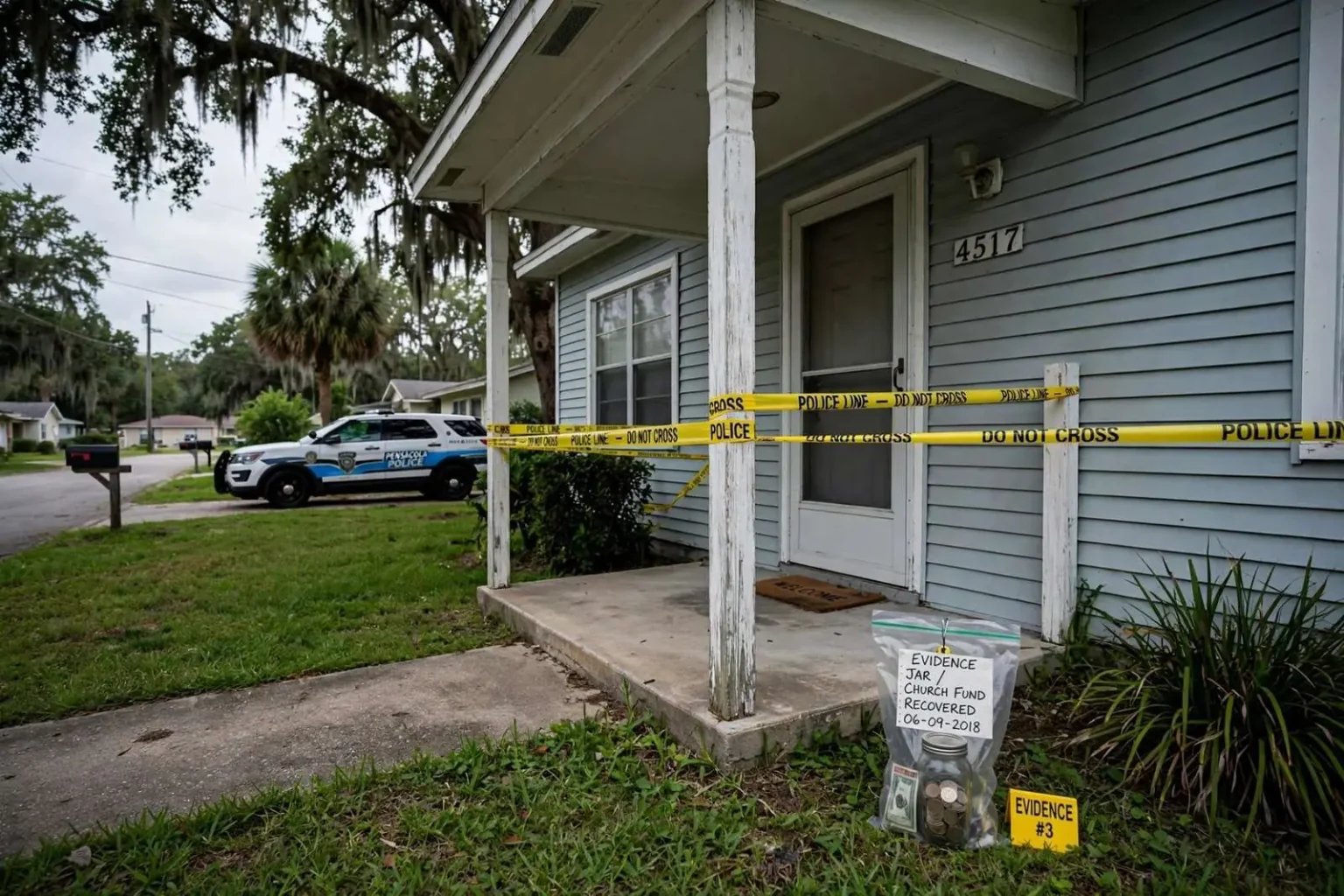
A 20-year-old Pensacola man will spend decades in state prison for a brutal home invasion that left an 82-year-old woman badly wounded inside her own home. Tyler Owens was sentenced to 60 years after pleading or being convicted of attempted first-degree premeditated murder with a weapon, home invasion robbery with a deadly weapon, and aggravated battery upon a person 65 or older causing great bodily harm — a stack of charges that reflected the savagery of the attack and the vulnerability of its victim.
Pensacola Police say Owens slipped into Carol Carmichael’s home on June 9, 2018, while she rested in her recliner, and slashed her face and neck. The attack, carried out in the middle of the afternoon on an elderly woman in her own living room, was among the most disturbing cases the city’s detectives handled that year — an intrusion so sudden and so violent that Carmichael had little chance to react before she was wounded.
Investigators said he also stole personal items along with a glass jar holding money the woman had collected for her church. That detail — a jar of church money carried out of an 82-year-old’s home — became part of what residents and officers alike cited in describing the case’s cruelty. Officers recovered several of the stolen belongings from Owens’ apartment, police said, tying him to the attack that shocked the neighborhood.
The sentencing closed a chapter that began with the June 2018 call to police and stretched through the investigation, arrest and court proceedings that followed. At 20 years old, Owens will spend his sentence in the Florida Department of Corrections, with the 60-year term ensuring he remains incarcerated well into his eighth decade of life.
How the case unfolded
The June 9, 2018, attack began, by police accounts, with an intruder entering the home while Carmichael dozed in her recliner — a detail that turned the case into a discussion far beyond the victim’s block about the safety of the city’s older residents. The wounds inflicted to her face and neck were life-threatening, and the response that followed drew on the full machinery of a major crime investigation: patrol officers securing the scene, detectives canvassing the neighborhood, and investigators working to connect the stolen property to whoever carried it away.
The breakthrough came through that property. When officers recovered several of the stolen belongings from Owens’ apartment, the items provided the physical thread between the suspect and the crime scene — the kind of evidence that anchors a prosecution when the only eyewitness is the victim herself. Police said the recoveries tied Owens to the attack, and the charges that followed were built on that foundation.
The charges themselves tracked the anatomy of the crime. Attempted first-degree premeditated murder with a weapon addressed the deliberate, armed assault on Carmichael’s life. Home invasion robbery with a deadly weapon covered the armed entry and theft within an occupied dwelling — under Florida law, a home invasion robbery is a burglary committed while the occupants are present and while the offender carries a weapon. And aggravated battery upon a person 65 or older causing great bodily harm reflected Florida’s enhanced protections for elderly victims, which escalate both the charge and the potential punishment when the person harmed is a senior.
The sentence and what it means
A 60-year sentence is among the substantial outcomes Florida’s courts can impose short of life, and in this case it reflected both the number and severity of the convictions and the vulnerability of the victim. Under Florida sentencing law, terms of that length mean Owens will remain in state custody essentially for the rest of his expected lifetime, with parole long abolished in the state and only limited gain-time mechanisms that could modestly shorten the term. For Carmichael’s family, the number carried a practical significance: a guarantee that the man who attacked her will age in prison, not in a neighborhood.
The case also illustrated how Florida’s felony sentencing architecture treats crimes against the elderly. The state’s statutes specifically enhance offenses committed against victims 65 and older, an acknowledgment that crimes against seniors produce not only greater physical harm — as the aggravated battery charge alleged here — but also lasting psychological injury to victims whose independence and sense of security are hardest to restore. Prosecutors across the state treat that enhancement as a central argument in cases like this one, and the 60-year term shows how the law’s tools can accumulate when a single act violates multiple statutes.
For Pensacola Police, the resolution capped an investigation that moved from a violent afternoon call to a courtroom outcome more than two years in the making. Detectives recovered the stolen property, built the case connecting Owens to the scene, and carried it through the judicial process in coordination with the State Attorney’s Office for the First Judicial Circuit, which covers Escambia County. The department pointed to the recoveries from Owens’ apartment as the decisive link — evidence that transformed a heinous but unsolved attack into a prosecution.
The neighborhood and the victim
The attack’s setting — an elderly woman at rest in her own living room in the early summer of 2018 — was what resonated most with the surrounding community. Neighbors described the shock of learning that an intruder had slipped into a home on their street in daylight hours, and the theft of the church collection jar gave the crime a cruelty that residents found hard to shake. Cases like this one tend to drive lasting changes in a neighborhood’s habits: lock checks, porch cameras, and watchfulness over the older residents who live alone.
Carmichael’s survival of the assault itself was a testament to her endurance. Wounded in the face and neck by an attacker who intended to end her life, the 82-year-old lived through the attack and became the central witness in the case against him. Her recovery, and the community’s response to it, framed the way Pensacola remembered the case — less as a story about a perpetrator than as one about a woman who outlasted him.
The courtroom outcome also drew attention to the work of the Escambia County court system in handling crimes against seniors. From the initial bond proceedings through pretrial hearings and sentencing, the case moved through the same docket pressures that weigh on every prosecution, but the severity of the charges and the age of the victim kept it among the priority matters on the State Attorney’s calendar. Victim advocates played a role as well — the standard companions to prosecutions like this one, coordinating with the victim’s family on court dates, keeping them informed of hearings, and presenting the impact of the crime on Carmichael’s life for the judge to weigh at sentencing.
The stolen church money, meanwhile, became the case’s defining image. A jar set aside for a congregation — saved by a woman whose faith community would have been the beneficiary — represented everything the invasion violated: trust in the home, care for the elderly, and the small accumulations of ordinary life. That investigators traced the stolen items to Owens’ apartment, rather than to a pawn transaction or a fence, meant the case’s evidence trail ran directly from the victim’s living room to the man who would ultimately answer for it.
Home invasion safety for seniors
Cases like Carmichael’s are why police departments across Florida and the Gulf Coast repeat the same guidance for older residents. Keep doors locked even during the day, when most residential intrusions occur. Do not open the door to unexpected callers — utility crews, delivery drivers, strangers asking for help — without verifying identities through a window or peephole. Consider a doorbell camera or an alarm system, and talk with neighbors or family members about a daily check-in routine. And if an intrusion does occur, the advice is to cooperate rather than resist, comply with demands, and call 911 at the first safe opportunity — property can be replaced; a life cannot.
The guidance is a sober acknowledgment of a pattern: seniors living alone are targeted precisely because attackers expect less resistance and slower reporting. Community policing programs in Pensacola and across Escambia County have leaned on senior centers, churches and neighborhood associations to spread that message, and officers frequently cite cases like this one as the reason vigilance among older residents matters.
The 60-year sentence, whatever comfort it offers, also closes the loop on the questions a case like this raises. The man who entered Carol Carmichael’s home on June 9, 2018, while she rested in her recliner, slashed her face and neck, and carried off her belongings — including a jar of money collected for her church — will spend the decades that follow in a state prison cell. The stolen items that survived were returned through the investigation, and the neighborhood that the attack shook watched the courts answer it with the severity it demanded.
For Pensacola, the case stands as both warning and reassurance: warning, that a home invasion can unfold in daylight against a woman in her own recliner; reassurance, that stolen property recovered from an apartment can become the thread that unravels a violent crime, and that a 20-year-old who inflicts such harm will answer for it for the rest of his life.