Man sentenced to 9 years after drug-impaired multi-state chase injures two Florida troopers
John Thomas Puckett was sentenced to nine years after a drug-impaired chase from Alabama into Florida crashed near Pensacola, injuring two troopers.
A man who led law enforcement on a drug-impaired, multi-state chase that injured two Florida Highway Patrol troopers has been sentenced to nine years in prison. Florida Circuit Court Judge Jan Shackelford imposed the sentence on John Thomas Puckett, closing out a case that began on a Mobile County highway and ended in a crash on a Pensacola interstate ramp — with a stolen vehicle, a pandemic-era checkpoint bypassed at more than 100 mph, and two troopers hurt along the way.
Prosecutors said the May 12, 2020, pursuit began when Puckett led the Baldwin County Sheriff’s Office in Alabama on a high-speed chase in a vehicle stolen from Mobile. The chase crossed the state line into Florida at more than 100 mph, passing the Perdido River corridor into Escambia County, where deputies and troopers picked up the pursuit as it moved east on Interstate 10.
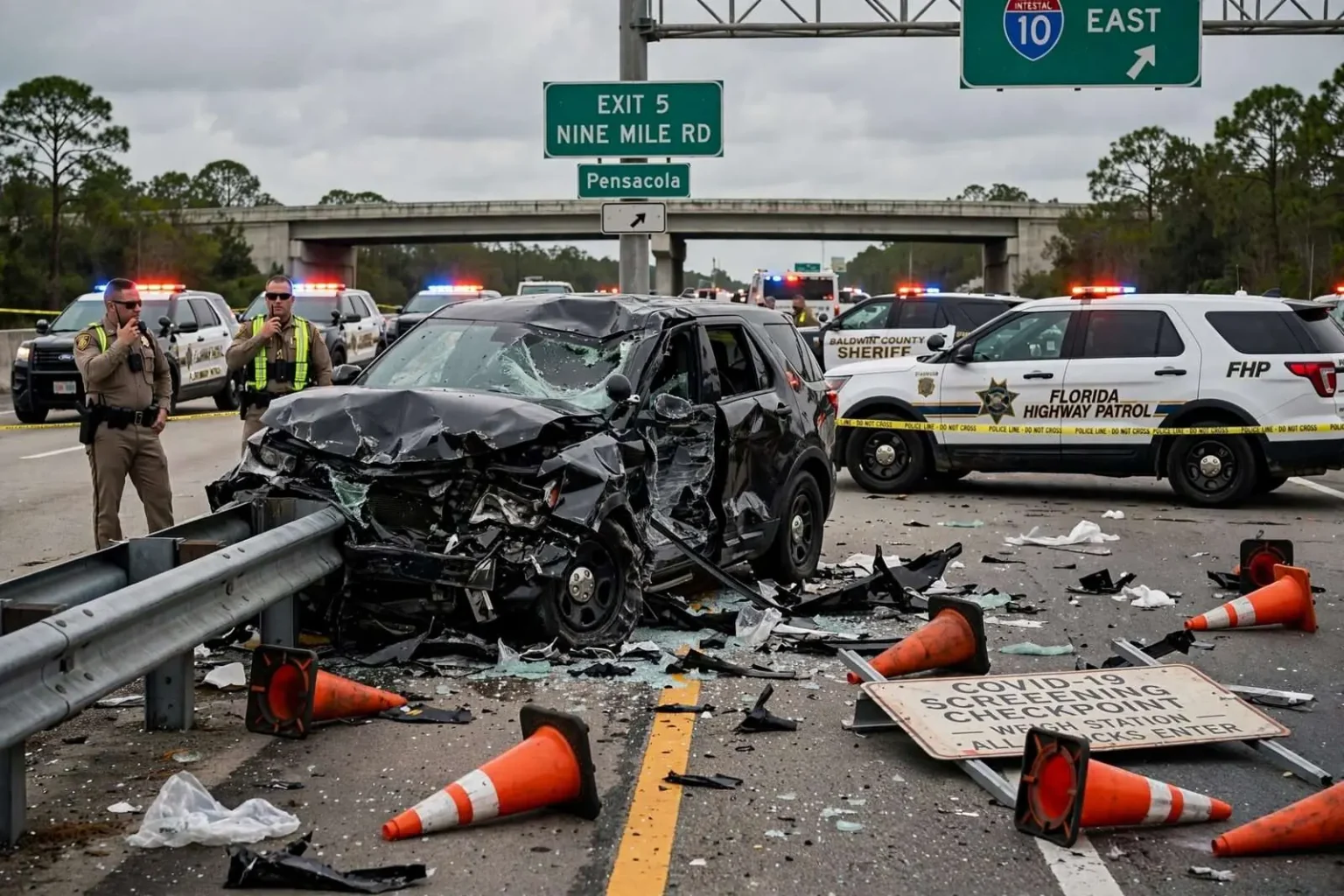
The end came near Pensacola. Puckett, prosecutors said, at one point drove over traffic cones to bypass a COVID-19 checkpoint set up near the weigh station — a roadside screening operation of the kind Florida operated during the pandemic months of 2020 — before crashing near Exit 5 at Nine Mile Road. The crash injured two Florida Highway Patrol troopers. Bloodwork drawn afterward showed Puckett was under the influence of methamphetamine and marijuana, according to the State Attorney’s Office.
A chase across two states
The pursuit’s route traced one of the busiest trafficking corridors on the Gulf Coast. Baldwin County deputies initiated the chase after the stolen Mobile vehicle came to their attention, and the driver chose the fastest available exit: westbound Baldwin County toward the Florida line, where Interstate 10 runs from Mobile through the Perdido area and into Pensacola. Crossing at triple-digit speeds turned a county-level vehicle theft case into a multi-agency pursuit spanning two states, two sheriff’s offices, and the Florida Highway Patrol.
Interstate pursuits end badly by their nature, and this one conformed to the pattern. The vehicle left the interstate near Exit 5 at Nine Mile Road, the interchange that funnels I-10 traffic into northwest Pensacola, and crashed there. The two FHP troopers injured in the incident joined the list of casualties that high-speed chases routinely produce — a toll that falls on officers, bystanders, and suspects alike, and one that agencies weigh every time a pursuit continues past the point of proportionality.
The timing added a period detail that underscored the recklessness alleged: Florida was operating COVID-19 screening checkpoints at its interstate weigh stations in the spring of 2020, directing arriving traffic into controlled lanes. Puckett’s route over the traffic cones at the checkpoint near the weigh station, prosecutors said, was an act of contempt for the roadblock that registered in the case file alongside everything that followed.
What the bloodwork showed
Bloodwork taken after the crash showed Puckett was under the influence of methamphetamine and marijuana, according to the State Attorney’s Office — evidence that converted the case from a fleeing-and-eluding prosecution into a DUI prosecution as well. In Florida, driving under the influence can be proven either by impairment observations or by blood-alcohol and controlled-substance evidence, and a positive toxicology screen for methamphetamine gave the state a scientific foundation for the DUI charge to accompany the pursuit counts.
The drug evidence also reframed the chase itself. Deputies and troopers pursuing a driver under the influence of stimulants face a suspect whose risk calculation is impaired in both directions — the willingness to flee at 100 mph and the inability to control a vehicle at that speed. The crash at Nine Mile Road, and the injuries to the two troopers, illustrated the combination.
While receiving medical care after the crash, prosecutors said, Puckett became violent toward an EMT and spit on her — conduct that produced a battery charge of its own. Health care workers and emergency responders treating patients in custody are protected by enhanced statutes in Florida, and spitting at a caregiver during a pandemic year was treated as more than an outburst; it became one of the charges on which Puckett was sentenced.
The charges and the sentence
Judge Jan Shackelford sentenced Puckett on a slate of charges that tracked the incident’s full arc: aggravated fleeing and eluding causing serious bodily injury — the count tied to the two troopers hurt in the crash — along with DUI causing property damage, driving without a valid license, and battery on an EMT. The nine-year prison term reflected the aggregation of those offenses, each representing a distinct phase of the same afternoon: the theft and flight in Alabama, the crossing into Florida, the checkpoint bypass, the crash, and the assault in the ambulance.
The aggravated fleeing count carries particular weight in Florida law. Legislatures have graded fleeing and eluding offenses by consequence, and when a flight causes serious bodily injury the potential sentence rises sharply — a legislative judgment that the person who starts a chase is responsible for what the chase does to everyone else on the road, including the officers pursuing him.
The DUI causing property damage and no-valid-license counts filled out the picture of the driving itself: an impaired, unlicensed operator in a stolen vehicle moving through two states at highway speeds. And the battery count acknowledged the injured EMT, whose encounter with Puckett came while she was doing the work of treating him after the crash he caused.
How multi-state pursuits unfold
Chases that cross state lines depend on coordination that the public rarely sees. Baldwin County deputies pursuing a stolen Mobile vehicle toward the Florida line radio ahead, and Escambia County units and Florida Highway Patrol troopers position themselves along I-10 to intercept or continue the pursuit when it crosses the Perdido. The fleeing driver’s speed and path dictate everything; the pursuing agencies’ policies dictate what they may do at each stage.
Interstate 10 through the region makes such handoffs routine in geography but hazardous in execution. The highway funnels long-haul traffic, local commuters, and — in the pandemic spring of 2020 — checkpoint screening lanes into the same corridor, and a vehicle running cones at more than 100 mph turns every one of those variables into a projectile. The crash near Exit 5 at Nine Mile Road was the pursuit’s endpoint, but the risk extended to every driver on the road between the state line and Pensacola.
The two injured troopers were part of that exposure. Officer injuries in pursuit and crash scenes are among the most common consequences of vehicle flights, and the serious-bodily-injury enhancement that shaped Puckett’s most serious charge exists precisely to account for them — to put a number on the harm done to the people whose job requires them to follow.
A case with two halves
The prosecution of John Thomas Puckett carried two distinct stories. The first was operational: a stolen Mobile car, a Baldwin County chase, a 100-mph border crossing, cones flattened at a COVID-19 checkpoint, and a crash near Nine Mile Road that sent two troopers to the injured list. The second was chemical and personal: methamphetamine and marijuana in the bloodstream, no valid license, and violence toward the EMT who treated him — the human fragility and volatility behind the wheel.
Judge Shackelford’s nine-year sentence answered both. The prison term removes a driver whose May 12, 2020, flight crossed jurisdictions, statutes, and every safety margin between Mobile and Pensacola, and the range of charges — fleeing, DUI, license, battery — ensures the record reflects each layer of the offense rather than compressing it into a single count.
For the two Florida Highway Patrol troopers injured at Nine Mile Road, and for the EMT who was spat on while providing care, the sentence closes a case that began with a stolen car and ended with accountability measured in years. For the agencies that coordinated the pursuit across the state line, it stands as the documented outcome of a chase that tested every policy they have for exactly this scenario — and that ended, at last, in a courtroom in Florida rather than on the interstate.
The courtroom where it ended
By the time the case reached Judge Jan Shackelford’s courtroom, the events of May 12, 2020, had been reduced to charging documents, toxicology reports, and the testimony of the deputies, troopers, and medics who lived them. The sentencing hearing covered ground familiar to any multi-count prosecution — the stolen vehicle from Mobile, the Baldwin County pursuit, the border crossing at more than 100 mph, the checkpoint cones, the Exit 5 crash, and the bloodwork — but the numbers at stake were concrete: nine years in prison, on charges spanning two states of conduct.
Sentencings in injury cases also give victims their formal moment. The two Florida Highway Patrol troopers injured in the crash, and the EMT who was spat on while providing care, are the human ledger of the case — the people whose injuries converted a fleeing-and-eluding incident into a serious-bodily-injury prosecution. Prosecutors from the State Attorney’s Office presented the evidence connecting each charge to the conduct it covered, and the defense presented whatever mitigation the record allowed.
The resulting nine-year term sits within the framework Florida law builds for exactly this kind of case: a graded fleeing statute that punishes the harm a chase causes, a DUI statute that punishes the impaired operation itself, a license violation that documents the driver’s status, and a battery statute that protects the responders. Each count answered one piece of the afternoon; together they composed the sentence.
Pursuit policy and the price of running
Behind the courtroom outcome is the operational question every agency confronts during a pursuit: continue or break off. Baldwin County deputies began the chase over a stolen vehicle — a serious offense, but one agencies weigh against the risk a high-speed pursuit poses to everyone in its path. The decision to continue across the state line, and the FHP troopers’ participation as the flight reached Pensacola, reflected that calculus in real time, with the suspected danger of an impaired, fleeing driver at highway speed tipping the scale toward keeping the vehicle in sight.
Chase outcomes like the Nine Mile Road crash are why those policies are written in blood, figuratively and literally. Pursuits that end in crashes injure pursuing officers at rates the public rarely appreciates, and the two troopers hurt here were injured not by gunfire or an assault but by the ordinary physics of a collision — the same physics that threatens every motorist a fleeing driver passes at 100 mph.
The checkpoint detail added its own layer. The COVID-19 screening operations at Florida’s weigh stations in 2020 were civil-health measures, not enforcement roadblocks, and driving over their cones to escape a criminal pursuit treated a public-health line as a mere inconvenience. Prosecutors included the detail in their account of the flight because it captured, in a single image, the driver’s approach to every rule he met that afternoon.
Accountability measured in years
Nine years is a long sentence by the standards of cases that begin with a car theft, and that is the point the prosecution’s charging structure was designed to make: the theft was the smallest part of the harm. The methamphetamine and marijuana in Puckett’s blood, the two injured troopers, the battered EMT, the crossed state line, and the flattened cones at a pandemic checkpoint each demanded their own answer under Florida law, and the sentence aggregated those answers into a single term.
For the Gulf Coast agencies involved — the Baldwin County Sheriff’s Office, which began the pursuit; the Florida Highway Patrol, whose troopers were hurt ending it; and the State Attorney’s Office, which carried the case to Judge Shackelford’s courtroom — the resolution closes a file that spanned jurisdictions from the start.
The record now reads as a complete account of May 12, 2020: a stolen Mobile vehicle fleeing Baldwin County at highway speed, an impaired driver crossing into Florida over the Perdido at more than 100 mph, a COVID-19 checkpoint bypassed over its cones, a crash near Exit 5 at Nine Mile Road that injured two troopers, and a nine-year prison sentence pronounced in a Florida circuit court — the last stop of a chase that ran out of road.