Man Strangled Partner, Tried to Set Fire to Mobile Apartment Before Fleeing, Police Say
Mobile Police say a man strangled his partner and tried to set fire to their Murray Hill Court apartment before fleeing the scene.
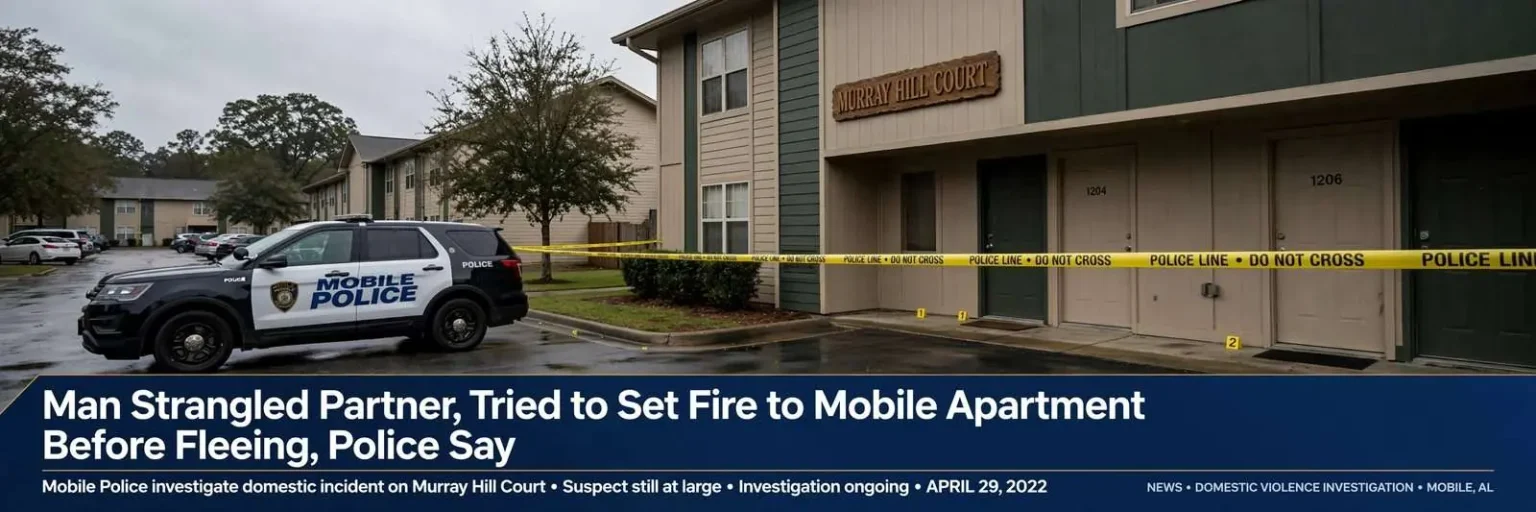
Mobile Police are investigating after a man allegedly broke into an apartment, strangled his partner and attempted to set the unit on fire before officers could arrive. According to an MPD news release, officers responded Friday, April 29, to a domestic complaint in the 1200 block of Murray Hill Court. Investigators determined the victim’s boyfriend had broken into the apartment and tried to strangle them. While still inside, police say the man attempted to start a fire. He fled the scene before officers arrived. The extent of the victim’s injuries was not immediately known. The investigation remains open as police work to identify and locate the suspect.
The sequence described in the release — a forced entry, an assault, and then an attempt to burn the unit — represents one of the most dangerous patterns domestic-violence investigators see. Strangulation is treated by prosecutors and victim advocates as a major warning sign in abusive relationships: research on domestic violence nationwide has repeatedly found that victims whose partners strangle them face dramatically elevated risk of later homicide compared with victims of other assaults. That is one reason strangulation cases draw close attention from investigators even when visible injuries are minor or slow to appear.
Strangulation can cause internal injuries that do not show on the surface of the skin. Medical providers in domestic-violence response are trained to look for subtle signs — petechiae in the eyes, voice changes, difficulty swallowing, swelling — and to document them carefully, because the absence of dramatic bruising does not mean the absence of serious injury. Victims who have been strangled are generally urged to be evaluated promptly even if they feel fine, since airway and vascular damage can worsen hours after the assault.
The attempted fire adds a further dimension to the case. Setting fire to an occupied dwelling is among the most serious arson classifications under Alabama law, and when combined with an assault inside the home, investigators examine the sequence as part of a single violent event rather than as separate property and personal crimes. Fire investigators were part of the response to determine what materials had been used and how far the attempt progressed before the suspect fled.
The domestic violence response in Mobile
Murray Hill Court sits in a residential section of Mobile where apartment and duplex units stand close together, the kind of setting where a break-in at one unit is often heard, if not witnessed, by neighbors. In domestic cases, those neighbors frequently become important witnesses, both to the noise of the incident and to anything they saw before or after — a vehicle, a direction of travel, a person leaving on foot. Canvassing for exactly those details is a standard early step for detectives working a case where the suspect is not yet in custody.
When officers respond to a domestic complaint and the suspect has fled, the investigation shifts to evidence collection and victim support. Investigators document the scene, photograph injuries when the victim consents, obtain medical records if the victim was treated, and help the victim pursue a protection order if they want one. Alabama’s Protection from Abuse Act allows judges to issue emergency orders that remove an abuser from a shared home and prohibit contact, and advocates are available through the court process to help victims navigate the paperwork.
Mobile is also home to Penelope House, one of the region’s longest-serving domestic-violence shelters, which operates a 24-hour crisis line and provides emergency housing, safety planning, court advocacy, and counseling for survivors and their children. Advocates stress that the most dangerous period in an abusive relationship is often the time surrounding a separation or after a violent incident like this one, and they encourage victims to build a safety plan rather than assume the danger has passed once a partner leaves the scene.
For investigators, a case like this one proceeds on two tracks at once: identifying and locating the suspect, and building the evidence for the charges that will follow. Suspects who flee domestic scenes are often located within days through a combination of known addresses, vehicle records, phone information, and tips from people in the suspect’s circle. Until an arrest, though, the victim’s immediate safety is the priority, which is why officers in these cases typically offer to remain in contact, refer the victim to advocacy services, and document everything needed for a protection order the same day.
The charges available to prosecutors once the suspect is located would depend on the evidence: strangulation and assault counts tied to the attack, and arson counts tied to the attempted fire, potentially combined with burglary counts for the forced entry into the apartment. Alabama law has, in recent years, specifically addressed strangulation in domestic contexts, and prosecutors in Mobile County have a dedicated unit for domestic-violence cases that handles charging decisions and victim coordination from arrest through trial.
Why strangulation changes a case
Victim advocates and prosecutors across Alabama have pushed for years to make the public aware that strangulation is not “just another” assault. Because it involves cutting off oxygen, it carries risk of death or lasting brain injury even in a short encounter, and it frequently leaves little physical evidence — which is why specialized training in documentation has become standard for officers and nurses who handle these cases. When strangulation appears in a domestic incident, it is factored into risk assessments that determine the level of protection and follow-up a victim receives.
The attempted arson complicates the risk picture further. Fire used against a partner or an ex-partner is a known escalation behavior, and investigators treat an attempt to burn an occupied home as evidence of intent that goes beyond the assault itself. Had the fire taken hold, the consequences would not have stopped at one apartment: units that share walls and attics put every neighboring household at risk. That fact shapes how seriously the attempted burning is charged and how the case is presented in court.
What residents can do
Police released few details about the suspect beyond the relationship to the victim, in part because the investigation was still developing when the initial information was made public. Residents of the Murray Hill Court area who saw or heard anything in the early hours of that Friday — an argument, someone forcing a door, a person leaving the complex quickly — were encouraged to share it with investigators. In domestic cases as in robbery cases, those small observations often prove decisive.
Anyone experiencing domestic violence, or concerned about someone who is, can reach Penelope House’s 24-hour crisis line from anywhere in the Mobile area, and the National Domestic Violence Hotline is available around the clock for callers anywhere in the country. Advocates can help with safety planning, shelter, protective orders, and connecting victims to legal and medical resources — and contacting an advocate does not require a person to be ready to leave a relationship or to press charges.
As of the initial report, the victim’s condition and the full extent of injuries had not been made public, and no arrest had been announced. The Mobile Police Department said the investigation remains open, and updates — including any identification of the suspect or announcement of an arrest — are expected through the department’s public information channels as detectives continue working to locate the man described in the news release.
The April 29 response also illustrates how domestic calls differ from other police work. Officers arriving at a domestic complaint approach with limited information: they know only that something happened between people who share or shared a home, and the scene may involve children, pets, or extended family. That is why domestic-response protocols emphasize separating the parties, photographing the scene, and writing detailed reports — the report written that night becomes the foundation of whatever prosecution follows months later, when memories have faded and victims may be reluctant or unable to testify.
For the neighborhood, an incident like this one often raises questions about what residents could or should have done. Domestic-violence educators encourage neighbors who hear an alarming disturbance to call 911 rather than intervene directly, and to follow up afterward with the victim through quiet, nonjudgmental support. Bystander intervention in these situations is about bringing trained help, not confronting an aggressor, and a call made during an incident can be the difference between a near-miss and a fatality.
The man described in the release had not been publicly identified or located as of the initial reporting, and police did not release a description of him in the first information made available. Detectives were continuing to develop leads, and anyone with information about his whereabouts was asked to contact the Mobile Police Department. Tips about a person’s location, vehicle, or recent contacts can be provided directly to investigators or, for those who prefer anonymity, through Mobile Area CrimeStoppers, which passes information to the relevant detectives without collecting the tipster’s name.
Once the suspect is located, the case would join the docket of Mobile County’s domestic-violence court process, where cases are handled with attention to victim safety at each stage — from bond conditions that typically prohibit contact, through no-contact orders issued as a condition of release, to prosecution. Judges in these cases routinely consider strangulation and fire-setting as factors in setting bond conditions, and violation of a protection order is itself a criminal offense in Alabama, giving victims an additional layer of legal protection while the case is pending.
In the meantime, the apartment building where the incident occurred returned to something like normal life, with neighbors aware of what had happened and investigators having completed their initial documentation of the scene. For the victim, the days after such an incident typically involve medical follow-up, conversations with advocates, and decisions about housing and safety that no one should have to make alone — which is why the network of services that mobilizes around these cases, from police report-takers to shelter staff to prosecutors, exists across the Gulf Coast.
The Mobile Police Department asks anyone with information about this incident to come forward, and reminds residents that emergency domestic situations should always be reported through 911 as they are happening. Non-emergency information can be directed to the department’s tip channels at any time, and the investigation, according to the department, remains open and active.