Marco Perez and the Killing of Officer Sean Tuder: How the Case Reached Alabama’s Death Row
Marco Antonio Perez was 19 and hiding from a federal warrant when he shot and killed Mobile Police Officer Sean Tuder in January 2019. A jury convicted him of capital murder in February 2024 and returned a death verdict 11-1 — a vote that, under Alabama law, the trial judge had no power to override.
Editor’s note: This article was reviewed and corrected on September 8, 2026. Earlier versions misstated the jury’s votes, the trial and sentencing dates, the statute of conviction, and the posture of a separate federal case, and included details that could not be substantiated. The account below is sourced to the Alabama Attorney General’s Office, the Alabama Court of Criminal Appeals’ opinion in Perez v. State, and contemporaneous local reporting.
Marco Antonio Perez was 19 years old and hiding from a federal warrant when he shot and killed Mobile Police Officer Sean Tuder in an apartment complex parking lot on January 20, 2019. Five years later a Mobile County jury convicted him of capital murder and returned a death verdict by a vote of 11-1. In 2026 the Alabama Court of Criminal Appeals affirmed that judgment and then refused to reconsider it. This is how the case moved from a staged kidnapping to Alabama’s death row.
The Night Everything Changed: January 20, 2019
It started with a text message. In mid-January 2019, messages went out from Marco Perez’s phone saying he had been taken and would not be coming back. One read: “Marco won’t be able to make it. He won’t be able to make it to anything ever again in his life.”
According to the Alabama Attorney General’s Office, Perez had staged his own kidnapping. It was the opening move in what prosecutors would later describe as a ten-day crime spree, and it set off a search that ended with a police officer dead.
Perez, who was from Theodore, had been on the run after skipping a federal pretrial services meeting on a gun charge, and a federal warrant had been issued for his arrest. He had left home and was being hunted by police.
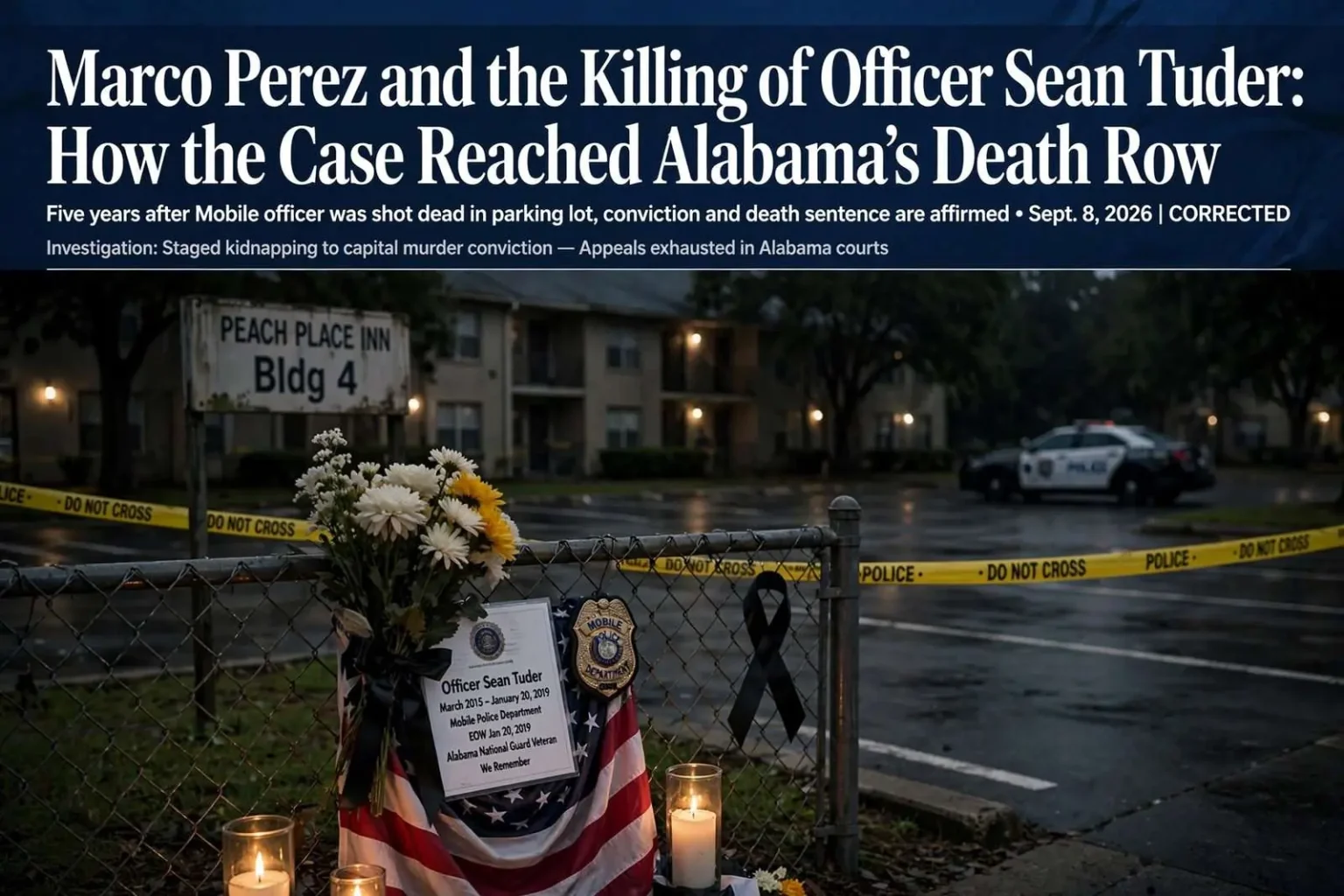
Officer Sean Tuder had joined the Mobile Police Department in March 2015 and worked the 1st Precinct. He was 31, an Alabama National Guard veteran, and he was off duty at his home in Daphne on January 20 when he received a tip about where Perez could be found. He went to the Peach Place Inn apartment complex off Jeff Hamilton Road in west Mobile to make the arrest.
The two struggled in the parking lot. Perez, armed with a stolen Smith & Wesson .40-caliber pistol taken from a vehicle days earlier, fired. Tuder was shot three times and died of his wounds. Perez ran into the woods surrounding the complex, where officers cornered him a short time later and took him into custody with a Taser.
The killing was captured on a surveillance camera at the complex, and that recording became a central piece of the state’s case at trial.
The Ten Days Before
The shooting was the end of a sequence, not an isolated event. At the time, Perez was on probation and subject to federal pretrial-release conditions tied to a pending firearms charge.
The staged kidnapping drew police into a search for a young man who was not missing. On January 17, 2019, officers arrested Perez’s mother, Tiffany Perez, then 38, and charged her with filing a false police report, a misdemeanor. Police alleged she had reported to them that her son had been kidnapped and killed. She entered a plea of not guilty through her attorney. The disposition of that charge could not be established for this account.
The vehicle thefts during this stretch are documented in the indictment the state later returned. Perez was charged with stealing a 2013 Honda Accord, a 2009 Lincoln MKX and a 2011 GMC 1500 truck, with breaking and entering a 2016 Ford F-150, and with stealing a Smith & Wesson .40-caliber pistol.
That last count is the one that mattered most. The stolen pistol was the weapon used to kill Officer Tuder, and ballistics testing tied it to the shooting.
By January 20, Perez was a fugitive wanted on both state and federal matters.
The Separate Federal Case
Before the state tried him for capital murder, Perez faced a separate federal prosecution, and it did not go entirely the government’s way.
On October 7, 2021, after three days of deliberation, a federal jury returned a split verdict. It acquitted Perez of the two most serious counts — obstruction of justice by killing a witness, and using and discharging a firearm during a crime of violence — while convicting him on two firearms counts: possession of a stolen firearm and receiving a firearm while under indictment. Those convictions carried a maximum of 15 years, and prosecutors sought the maximum.
The federal acquittals did not bar the state prosecution. Federal and state governments are separate sovereigns, and each may prosecute conduct that violates its own laws without triggering double jeopardy. The capital murder charge belonged to Alabama, and Alabama pursued it.
The Trial
Perez went to trial in Mobile County Circuit Court in February 2024, five years after the shooting, on six counts: capital murder, three counts of theft, breaking and entering a vehicle, and theft of the pistol.
Under Alabama law, the murder of an on-duty police officer is a capital offense (§ 13A-5-40(a)(5), Ala. Code 1975). The central factual dispute was therefore not whether Perez fired, but whether he knew who Tuder was.
The defense argued he did not. In an interrogation recorded the day of the shooting and played for the jury, Perez gave shifting accounts.
“I don’t know why I did what I did.”
He said at one point that “the voices told me in my head to pull the trigger,” and at another that he did not remember “shooting again and again and again.” On Tuder’s identity he was insistent:
“He didn’t identify himself. … He had a gun in my face.”
“I didn’t know who the [expletive] he was,” he told investigators, describing a stranger approaching him with a weapon. Defense counsel built on that account, arguing Perez acted out of fear and in self-defense. Prosecutors pointed to the surveillance video, the stolen gun and Perez’s status as a wanted man.
On the second day of trial, prosecutors called Perez’s parents to establish that certain text messages recovered from his phone had come from family members rather than from him. Perez became emotional and left the courtroom; the court recessed, and he returned before his mother took the stand. Tiffany Perez testified that she had violated her son’s probation by allowing him to leave the family home without notifying police, and confirmed that she had received messages from his phone and turned them over to authorities.
The jury convicted Perez of capital murder.
The Sentence, and Why the Jury’s Vote Was Final
At the penalty phase the jury returned a death verdict by a vote of 11-1. Mobile County Circuit Judge Ben Brooks imposed that sentence on February 10, 2024. Perez was 19 at the time of the shooting and 24 when he was sentenced.
The arithmetic of that vote matters, and it is specific to Alabama.
Until 2017, Alabama was the only state that allowed a trial judge to override a jury’s recommendation of life and impose death anyway. The Legislature abolished judicial override that April. For offenses after the change, the jury’s sentencing verdict binds the judge.
Alabama also remains the only state that permits a death sentence on a non-unanimous jury vote. Ten of twelve is the threshold. The panel that heard Perez’s case could have returned life without the possibility of parole; eleven jurors voted for death, one did not, and that was enough. Judge Brooks had no discretion to impose anything else.
The Appeal: Affirmed, Then Rehearing Denied
Perez appealed his conviction and death sentence to the Alabama Court of Criminal Appeals.
The court reviewed the trial proceedings and found no reversible error. It rejected the argument that the death sentence had been imposed under the influence of passion, prejudice or any other arbitrary factor. It also rejected the self-defense claim, holding that the evidence supported the jury’s finding that Perez knew Tuder was a police officer.
On May 1, 2026, the Court of Criminal Appeals issued its opinion affirming both the conviction and the sentence. Perez’s legal team applied for rehearing. On August 7, 2026, the court overruled that application.
Alabama Attorney General’s Office staff handled the appeal, with Assistant Attorney General Paxton Weeks arguing the case.
Where the Case Stands
Marco Perez remains on Alabama’s death row. No execution date has been set.
The remaining step within the state court system is a petition for a writ of certiorari to the Alabama Supreme Court. Beyond that, capital cases in Alabama typically proceed to post-conviction review in the trial court under Rule 32 of the Alabama Rules of Criminal Procedure, and then to federal habeas corpus review. That sequence routinely takes years, and death sentences are sometimes disturbed at those later stages on grounds — ineffective assistance of counsel, undisclosed evidence — that a direct appeal is not designed to reach.
Nothing in the record so far suggests the sentence is in immediate jeopardy. The conviction and the death verdict have been affirmed once and left undisturbed on rehearing.
Officer Sean Tuder
Tuder was 31 when he died. He joined the Mobile Police Department in March 2015, worked the 1st Precinct, and was named the department’s Officer of the Month in July 2016. He had served in the Alabama National Guard.
He was killed on a Sunday, off duty, having gone out on a tip about a fugitive rather than waiting for someone else to handle it. A memorial fund was established for his family. The Mobile Police Department has marked the anniversary of his death each January since.
Two families were altered by roughly fifteen seconds in a parking lot on Jeff Hamilton Road. One buried a police officer. The other has a son on death row. The courts have now had seven years with the case, and their answer has not changed.
Perez, now 27, remains one of 14 people on death row for murders committed in Mobile County, according to the Alabama Department of Corrections. The Court of Criminal Appeals’ refusal to rehear the case came by brief order on the morning of Aug. 7, 2026, exhausting his direct appeal in the state courts. A date has not yet been set for his execution.