Mardi Gras Park Opened in Downtown Mobile in 2018
After more than a year of construction, Mardi Gras Park opened to the public in downtown Mobile in January 2018.
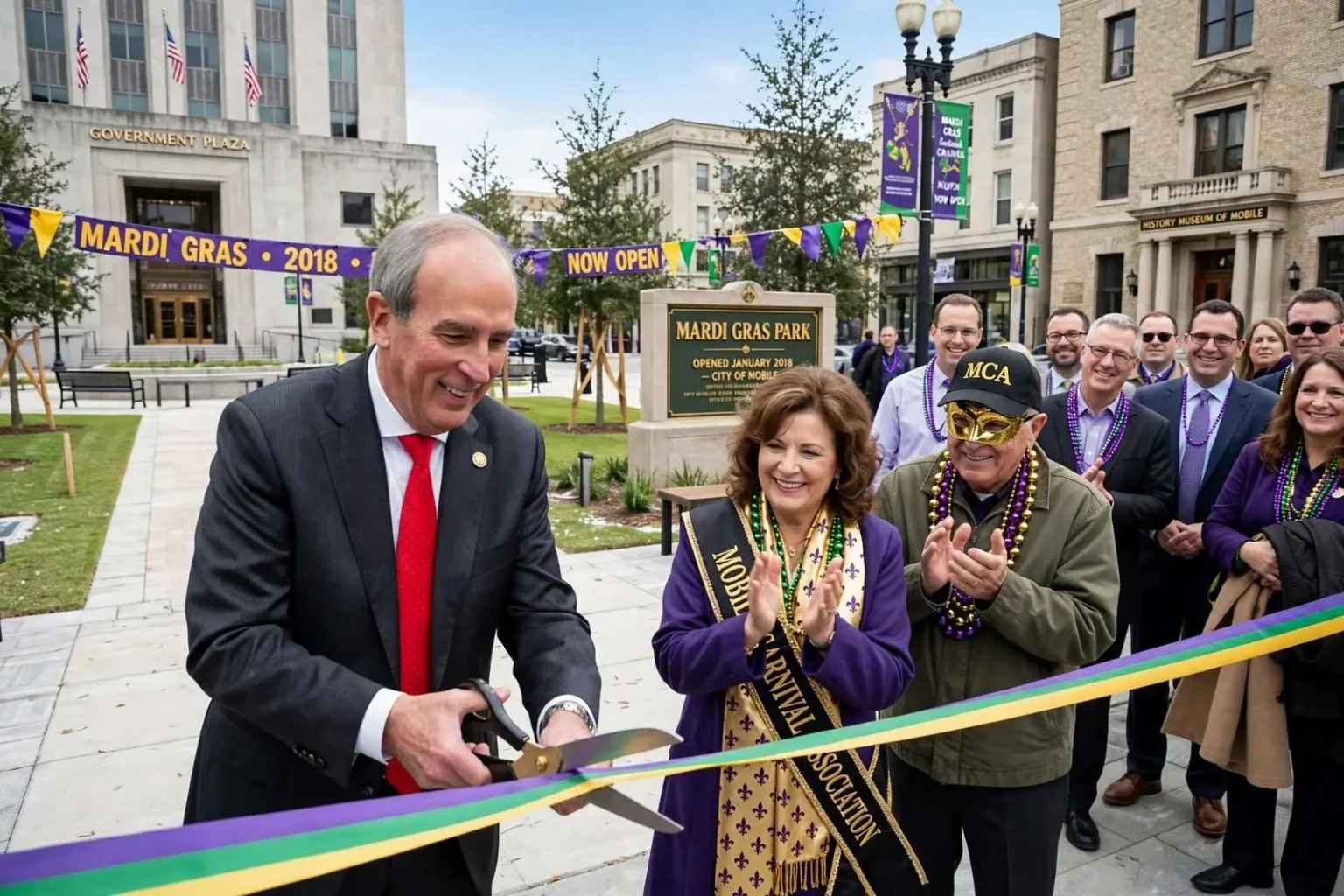
After more than a year of construction, Mardi Gras Park opened to the public in downtown Mobile in January 2018, according to a local station’s report of the milestone. Mayor Sandy Stimpson and the Mobile Carnival Association marked the opening of the park, which occupies a prominent block between Government Plaza and the History Museum of Mobile in the heart of the city’s civic district. Stimpson said the park could become a central corridor for visitors as downtown attractions continued to develop, and the city was already seeking funding for a second phase of the project, including a pavilion with an open-air market, estimated at $2.5 million.
The opening capped a project years in the making and gave downtown Mobile a purpose-built public space tied directly to the city’s oldest cultural tradition. The park’s name was no accident: Mobile’s Carnival celebration predates the American Revolution, and the new green space was designed in part to serve the crowds, stages and festivities that descend on the downtown each Carnival season.
A downtown transformed
The park’s location placed it at the crossroads of Mobile’s civic and cultural geography. Government Plaza, the shared city-county office complex on Government Street, houses municipal and county government and anchors the western edge of the site, while the History Museum of Mobile, housed in the old City Hall complex on Royal Street, documents more than three centuries of the city’s past from the block immediately east. Between them, the new park filled a long-underused block with lawns, walkways and gathering space designed for everything from lunch crowds to festival stages.
For the Stimpson administration, the project fit into a broader strategy of downtown revitalization that had gained momentum through the 2010s. Mobile’s city center had spent decades losing residents and activity to the suburbs, but by the mid-2010s signs of reversal were visible: new restaurants and bars along Dauphin Street, renovation of historic buildings, the growth of the biomedical and technology corridors nearby, and a steady calendar of downtown events from Mardi Gras parades to concerts. City leaders argued that public spaces like Mardi Gras Park were essential connective tissue — places that gave people a reason to walk from one attraction to another and linger between destinations.
That was the substance of Stimpson’s remarks at the opening. The park, he suggested, could become a central corridor for visitors as downtown attractions developed, linking the civic core with the historic districts and the waterfront a few blocks to the south. In a city whose tourism identity is inseparable from Carnival, branding a downtown gathering space as Mardi Gras Park was also a statement about Mobile’s place as the home of the first Mardi Gras celebration in what is now the United States, a tradition dating to the early eighteenth century when French colonists observed the festivities in the city that would become Mobile.
The Mobile Carnival Association’s role
The participation of the Mobile Carnival Association in the opening ceremonies underscored the bond between the park and the celebration it was named for. The MCA, one of the oldest Carnival organizations in the United States, has been a central steward of Mobile’s Mardi Gras traditions for generations, coordinating with the city each year on parade routes, schedules and the crowning of Mardi Gras royalty. Its presence at the ribbon-cutting signaled that the park was intended not merely as an ornament but as working infrastructure for Carnival — a stage platform, a rally point and a viewing area woven into the annual rhythm of downtown celebration.
Mobile’s Carnival season transforms downtown every winter. Parade routes move through the streets around the park, society halls fill for bal masques, and tens of thousands of visitors pack the blocks around Government Street and Dauphin Street during the final weeks before Ash Wednesday. A dedicated park in the middle of that footprint gave the season a new anchor — a place for families to gather between parades, for vendors to serve crowds, and for the city to stage ceremonies that mark the opening and closing of the season.
Built after more than a year of work
The park arrived after more than a year of construction, a span in which the block between Government Plaza and the History Museum was fenced, excavated and rebuilt. Projects of this kind in a downtown core involve more than landscaping: utilities must be relocated or protected, drainage addressed, and surfaces designed to withstand both everyday foot traffic and the heavy loads of festival equipment and parade crowds. The delay between concept and completion reflected those realities, and residents who had watched the block under construction through 2016 and 2017 finally saw the finished space open to the public in January 2018 — timing that placed the opening squarely at the start of the Carnival season the park was built to serve.
Opening in January also positioned the park to be immediately tested. Mobile’s Mardi Gras season runs from early January, with parades and balls building toward Fat Tuesday, and the downtown streets fill repeatedly through the season. A new public space at the center of that activity would see some of its heaviest use in its first weeks of existence, a fact city officials regarded as a feature rather than a risk — proof that the investment was already serving its intended purpose.
Plans for a second phase
Even as the park opened, the city was looking ahead. Officials were seeking funding for a second phase of the project, estimated at $2.5 million, centered on a pavilion with an open-air market. Such a structure would give the park covered, flexible space — shade for summer visitors, shelter for rainy Carnival days, and stalls that could host farmers markets, craft vendors and festival sellers on a regular schedule rather than only during special events.
The pavilion concept reflected a common formula in downtown revitalization: permanent public markets have proven to be reliable foot-traffic generators in cities across the country, drawing shoppers on a recurring basis and giving nearby restaurants and shops spillover business. For Mobile, an open-air market adjacent to Government Plaza and the History Museum could also serve workers from the surrounding office buildings on weekdays and visitors on weekends, extending the park’s usefulness well beyond the Carnival calendar. The city’s funding search — running in parallel with the opening rather than after it — showed that officials viewed the 2018 opening as the first stage of a larger plan rather than a finished project.
Mobile’s park tradition
Mardi Gras Park joined a lineage of public spaces that have shaped downtown Mobile. Bienville Square, a few blocks west on Government Street, has served the city since the nineteenth century as its classic town green. Cooper Riverside Park connects downtown to the Mobile River waterfront along the southern edge of the business district. Spanish Plaza, near the convention center, honors the city’s colonial past. Each of these spaces was created to serve a particular vision of the city’s life, and each became part of the routine of downtown workers and visitors. Mardi Gras Park, named for the tradition that most defines Mobile to the outside world, was intended to stand with them and to stitch them together — a node in a walkable downtown where a visitor could move from a museum to a park to a parade route without leaving the city’s historic core.
What the opening meant for the city
The January 2018 opening was received as more than the completion of a construction project. It was a visible sign that the momentum of downtown Mobile’s revival had reached the civic block at the center of government — a block that for years had been dominated by surface parking and underused land despite its location between two of the city’s most important institutions. Cities that succeed in reviving their cores tend to do it in layers, adding destinations until the whole becomes more attractive than its parts, and Mardi Gras Park was presented by city leaders as exactly such a layer: an amenity that made the History Museum and Government Plaza more connected, made Carnival crowds more comfortable, and gave downtown workers a green space within a short walk of their offices.
The park also carried symbolic weight. Naming a downtown public space for Mardi Gras asserted Mobile’s claim to the celebration’s history at a time when the broader public often associated the holiday exclusively with New Orleans. Mobile’s Carnival tradition is older — it began with French colonial celebrations in the early 1700s, more than a century before New Orleans was founded — and local institutions, from the MCA to the museums, have long worked to keep that history in view. A park bearing the name at the center of downtown served as a daily, physical reminder of that heritage for residents and visitors alike.
As with any public project, the park’s ultimate measure would come in use: whether families gathered there between parades, whether the proposed second-phase pavilion found funding, and whether the surrounding blocks grew more active as a result. In January 2018, though, the immediate facts were straightforward. After more than a year of construction, Mobile had a new public park at the junction of its government, history and celebration — opened with the mayor and the Mobile Carnival Association on hand, and with plans already drawn for what would come next.
This article preserves the record of the park’s January 2018 opening and the early plans for a second phase as they were reported at the time. It does not describe the park’s current amenities, the current status of the proposed pavilion and open-air market, or subsequent changes to the site. Readers seeking present-day information about Mardi Gras Park, its facilities or the city’s downtown plans should consult current City of Mobile sources and the park’s official information.