Martin Luther King Jr. Day events planned across south Alabama
Marches, services and volunteer projects mark Martin Luther King Jr. Day across Mobile and Baldwin Counties in south Alabama.
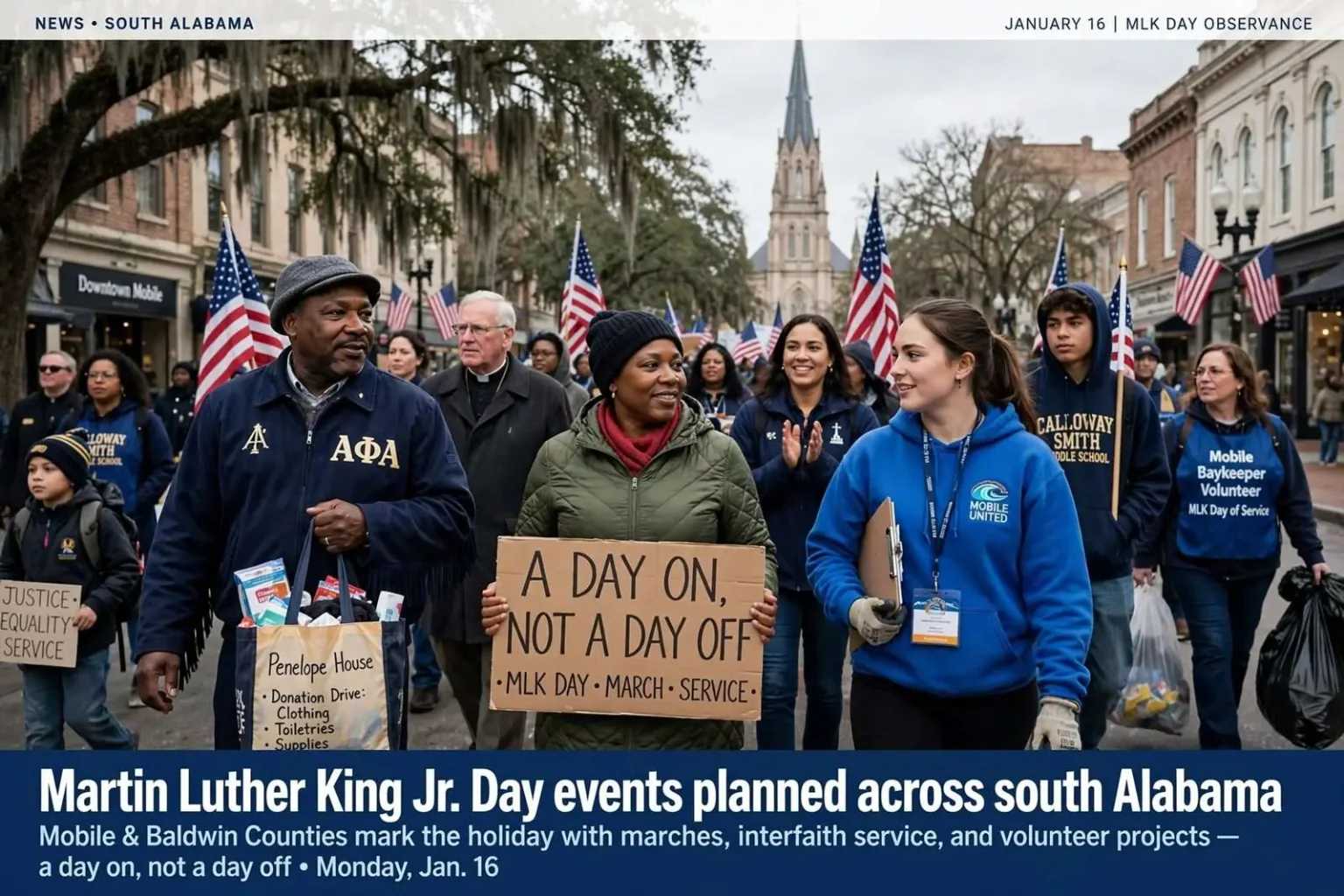
Communities across Mobile and Baldwin Counties are marking Martin Luther King Jr. Day on Monday, Jan. 16, with a full slate of marches, worship services and volunteer projects built around the legacy of the civil rights leader. The federal holiday, observed each year on the third Monday of January, has long been one of the most active dates on south Alabama’s civic calendar, drawing churches, schools, fraternities, neighborhood associations and environmental organizations into a shared program that blends remembrance with hands-on community work. Organizers across both counties frame the day as a day on rather than a day off, and this year’s lineup gives residents plenty of opportunities to take part, whether along a downtown parade route, at a memorial breakfast or at one of several cleanup sites spread across the city.
In Mobile, the centerpiece event remains the annual march organized by People United to Advance the Dream. The march kicks off at noon at Calloway Smith Middle School and concludes at Cathedral Park, carrying participants through the historic core of downtown. Processions of this kind have been a fixture of the Mobile observance for decades, and they typically draw a broad cross-section of the city: students and school groups, clergy from congregations across the area, elected officials, civic organizations and families who line the route or walk it themselves. The noon start allows church morning services to conclude before participants gather, a scheduling convention that has shaped King Day programming in Black communities across the Gulf Coast for generations.
Ceremonies at the school
Calloway Smith Middle School will serve as the hub of the Mobile celebration for the entire afternoon. The school will also host a city-wide interfaith service at 1 p.m., followed by a rally at 2 p.m., keeping the focus on one campus from the march’s departure through the final afternoon events. Interfaith services held on the King holiday bring together religious leaders from different traditions to reflect on King’s ministry and the moral dimensions of the civil rights movement, and they have become a standard part of the observance in cities across the South. The rally that follows typically features remarks from local officials and community advocates, along with music and presentations aimed at connecting King’s message to current conditions in the city.
The concentration of events in downtown Mobile places the observance at the heart of the city’s history. Cathedral Park sits near the Cathedral-Basilica of the Immaculate Conception and within walking distance of neighborhoods where the struggle for civil rights played out locally in the 1950s and 1960s. The Jan. 16 date also falls just ahead of the Mardi Gras season that dominates Mobile’s public life each winter, meaning the King Day march is one of the last major downtown processions before Carnival parades begin rolling in the weeks that follow.
Why the holiday lands where it does
The timing of the observance follows from federal law. King’s birthday was signed into law as a national holiday in 1983 and first observed in 1986, with the date fixed to the third Monday of January under the Uniform Monday Holiday Act’s approach to federal observances. States across the South, including Alabama, adopted the holiday in the years that followed, and local communities filled the official day off with their own traditions. In Mobile and Baldwin Counties, those traditions now span morning breakfasts, midday marches, afternoon services and all-day volunteer shifts, giving the holiday a reach that extends well beyond a single ceremony.
A citywide day of service
Mobile United’s 9th annual MLK Day of Service takes place throughout the day, with city council members working in their districts to improve public rights-of-way and waterways. Mobile United, a civic organization that has spent decades convening local leaders around quality-of-life initiatives, launched the day of service as a way to translate the holiday’s message into visible improvements in the neighborhoods where residents live. The district-by-district structure puts each member of the Mobile City Council to work in the area they represent, directing attention and volunteer labor toward ditches, drainage ways, roadside strips and other public spaces that often go overlooked between organized cleanup campaigns.
Residents can register and view the seven service sites through the Mobile Baykeeper website. Mobile Baykeeper is the clean-water advocacy organization based in Mobile that has monitored and defended the waterways of the Mobile Bay watershed for decades, and its role as the registration hub ties the service day to the region’s broader environmental stewardship efforts. The organization’s work on stormwater, litter and water quality across Mobile and Baldwin Counties aligns closely with the rights-of-way and waterway projects on the day’s agenda, since debris that accumulates in ditches and along roadsides frequently ends up in the creeks and bays downstream.
The emphasis on service reflects a national tradition that grew alongside the holiday itself. The King Day of Service concept, promoted nationally since the mid-1990s under the motto “a day on, not a day off,” encourages Americans to mark the holiday through volunteer work rather than rest, and south Alabama’s observances have embraced that model. Cleanup projects in particular have become a popular fit for the January date, when cooler weather makes outdoor labor more comfortable and winter rains make drainage and waterway maintenance especially visible concerns for local neighborhoods.
Memorial breakfast downtown
The Port City Chapter of Blacks in Government hosts its 33rd Annual Dr. Martin Luther King Jr. Memorial Breakfast at 8:30 a.m. at The Calirojae. Blacks in Government, the national organization known as BIG, was founded to advocate for Black government employees and to promote excellence in public service, and its local chapter has made the memorial breakfast one of the longest-running King Day observances in the city. Reaching a 33rd year means the breakfast predates many of the other events on the calendar and has outlasted shifts in city leadership, venue scenes and civic priorities.
Breakfast observances of this kind traditionally combine a meal with a program of remarks, awards and recognitions honoring individuals whose work reflects King’s commitment to public service and equality. The 8:30 a.m. start positions the breakfast as the opening event of the day, allowing attendees to move from the meal to the noon march and the afternoon activities at Calloway Smith Middle School. That sequencing, from a morning meal through a midday march to an afternoon rally, gives Mobile’s observance a continuous arc that stretches across most of the holiday.
From city to suburbs
The breadth of the Mobile program also reflects how the holiday has evolved locally. What began for many communities as a single church service or march has grown into a coordinated slate involving city government, environmental groups, professional associations and fraternal organizations. For residents, the practical effect is choice: those inclined toward ceremony can fill the day with the breakfast, march, interfaith service and rally, while those inclined toward service can spend the day at one of the seven cleanup sites or support the collection efforts happening across the bay.
Baldwin County’s observance
In Baldwin County, the Martin Luther King Day March begins at 10 a.m. at the Mike Ford Tennis Center and ends at the Fairhope Civic Center for a program. The route ties the eastern shore city’s observance to two of its most familiar public facilities: the tennis center, a community recreation site that hosts leagues and youth programs throughout the year, and the civic center, which serves as Fairhope’s main gathering space for public meetings, exhibitions and community events. Starting two hours earlier than the Mobile march gives Baldwin County participants their own morning program and, for some families, time to attend events on both sides of Mobile Bay.
Marches in Baldwin County communities have followed a similar pattern for years, with participants gathering at a landmark on one side of town and processing to a venue where a formal program awaits. The closing program at the civic center typically serves as the educational and ceremonial heart of the observance, with speakers, music and reflections on King’s life and the ongoing work of building the community he envisioned. Holding the event in Fairhope, one of Baldwin County’s best-known cities, gives the eastern shore observance a prominent downtown setting that is easy for residents from across the county to reach.
Fraternity service project
Members of the Beta Omicron Lambda Chapter of Alpha Phi Alpha Fraternity will also hold a day of service, collecting needed items for Penelope House. The service project carries particular symbolic weight for the fraternity: Alpha Phi Alpha, founded in 1906 at Cornell University as the nation’s first intercollegiate Black fraternity, counts King among its most celebrated members, and chapters across the country have long made the King holiday a signature day of service. The Beta Omicron Lambda chapter’s decision to direct its collection toward Penelope House connects that national tradition to a specific local need.
Penelope House is Mobile’s domestic violence shelter, providing emergency housing, advocacy and support services to survivors of family violence and their children since the 1970s. Shelters of this kind run on a steady stream of donated household goods, clothing and personal items, and collection drives organized around holidays and days of service form an important part of that supply. For the fraternity members working the drive, the project extends the King Day emphasis on service into direct material support for families in crisis.
A regional day of remembrance
Taken together, the events across Mobile and Baldwin Counties show how deeply the King holiday has taken root in south Alabama’s civic culture. On the same Monday, residents can choose a memorial breakfast in downtown Mobile, a noon march ending at Cathedral Park, an interfaith service and rally at Calloway Smith Middle School, a districtwide cleanup organized through Mobile Baykeeper, a morning march in Fairhope or a fraternity collection drive for Penelope House. The variety reflects the range of institutions that claim the day as their own, from churches and schools to city councils and fraternal chapters.
The shared date also connects the region’s observance to a national one. Communities across the Gulf Coast and the country will hold parallel marches, services and volunteer projects on the same day, all commemorating the same life. In south Alabama, where the civil rights era’s local history remains a living presence in neighborhoods, churches and city institutions, the holiday has become both a look back at how far the region has come and a recurring check on the work still ahead. Organizers in both counties say the goal is the same each January: to make sure the federal day off is spent doing something that matters in the community.