
Mary Montgomery High School video tops half a million views
A student-made spoof video from Mary G. Montgomery High School in Semmes has topped 500,000 views on YouTube and earned a like from Hugh Jackman.
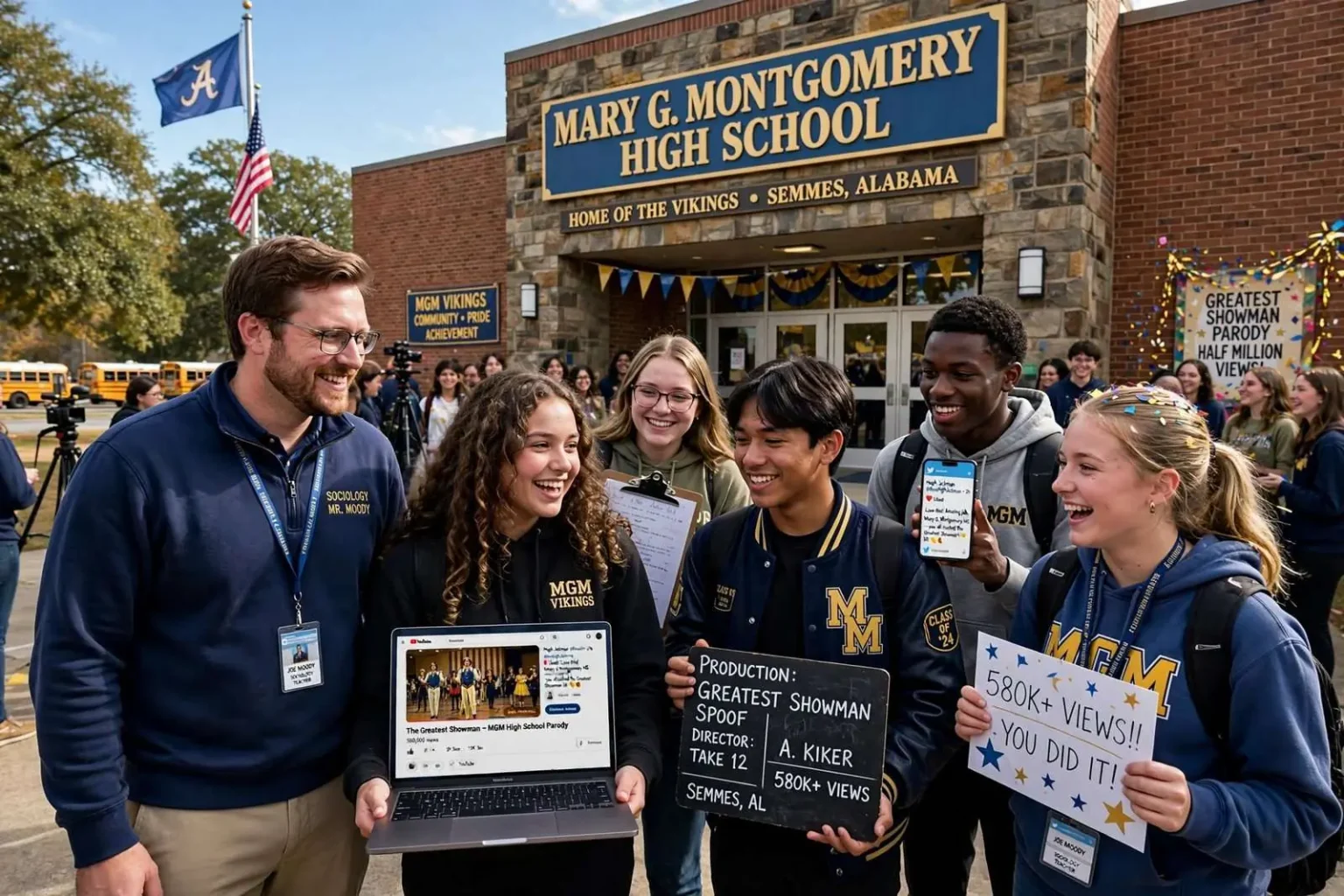
SEMMES, Ala. — A video produced by students and staff at Mary G. Montgomery High School in Semmes has racked up more than half a million views on YouTube, turning a school project into one of the most-watched things ever made in the small Mobile County community.
The clip, created by former student Alex Kiker, is a spoof of the movie “The Greatest Showman,” the 2017 musical starring Hugh Jackman as P.T. Barnum. At last count the video had drawn roughly 580,000 views, and it earned a “like” on Twitter from Jackman himself — a nod from the film’s star that sent students, teachers and parents across Semmes checking their phones.
From a sociology class to YouTube
The idea for the video came out of teacher Joe Moody’s sociology class, where students study group behavior, culture and the ways communities build shared identity. A video project fits that subject naturally: producing a parody together requires planning, roles, rehearsal and the kind of collective effort that sociology itself describes. Moody’s classes have turned the assignment into a tradition, and the “Greatest Showman” spoof is the third such video students have made in three years. Last year’s project was built around “La La Land,” the 2016 musical that, like “The Greatest Showman,” lent itself to colorful costumes and large ensemble numbers.
Producing a school-wide parody is a logistical project as much as a creative one. Students take on filming, editing, costuming and performing, while teachers coordinate locations in the school and sign off on the schedule. Former student Alex Kiker handled the production work that pulled the project together, and the finished clip runs like a compressed version of the film’s set pieces, with hallways, gymnasiums and classrooms standing in for the circus world of the original.
Why the video caught fire
Half a million views is a striking number for a school production, but the ingredients of its spread are familiar. Parody videos of popular songs perform well because viewers already know the source material, and “The Greatest Showman” had a fervent fan base whose social media presence kept the film’s music charting long after its theatrical run. A well-made high school version taps into that audience and adds the charm of seeing familiar institutions — teachers, principals, the school building itself — repurposed as musical theater.
Local pride did the rest. In a community like Semmes, a city in western Mobile County with its own strong identity, a video celebrating the high school gives graduates, current families and neighbors something to share. Each share on Facebook or Twitter exposed the clip to new circles of viewers, and the Hugh Jackman “like” provided a second wave of attention, since news of a celebrity’s nod travels fast in local media and school alumni networks.
The tradition at Mary G. Montgomery
Mary G. Montgomery High School serves students in Semmes and the surrounding rural-suburban stretches of western Mobile County. The school has built a reputation for programs that pull the whole student body into shared projects, from athletics to arts, and the annual video has become one of those unifying traditions that students anticipate and alumni circulate for years afterward. Three videos in three years has been enough to establish the expectation that each new class will try to top the last.
The choice of musicals matters to that continuity. Both “La La Land” and “The Greatest Showman” are built on big, recognizable musical numbers that translate naturally to a school setting — marching through hallways, filling a gymnasium, choreographing large groups. The films’ soundtracks were widely known by the time each video was made, which meant viewers outside the school could follow the parody without explanation.
What the numbers mean
For context, most high school videos reach a few thousand views. Reaching 580,000 put Mary G. Montgomery’s production in the company of the small number of school projects that break out nationally, and the attention reflects both the effort students put into the production and the power of social media to carry local content far beyond its origin. Every view came from someone choosing to watch a video about a school in Semmes, Alabama — an audience the students could never have reached through any local channel alone.
For the students involved, the project delivers lessons that outlast the view count: coordination, deadline discipline, performance under pressure and the experience of seeing a large creative effort through to completion. For the school, it delivers visibility that no marketing budget could buy, and for Semmes it adds a bright entry to the community’s shared story.
The “Greatest Showman” spoof now sits on YouTube alongside its “La La Land” predecessor, part of a three-year run that has made Mary G. Montgomery’s video projects a fixture of the school year — and, with a half million views and a movie star’s approval, one of the most successful school productions on the Gulf Coast.
The viral success also reflects changes in how school communities communicate. A decade earlier, a project like this would have lived on a DVD sold at the school or played at an assembly, reaching only the families directly involved. YouTube and social media removed that ceiling. Now a single upload can be shared across alumni Facebook groups, retweeted by local businesses, picked up by Mobile-area television stations and seen by fans of the source film around the world. The students who made the video were, in effect, publishing to a global audience from a classroom in western Mobile County.
Schools across the country have noticed the pattern, and parody videos have become a recognized genre of school promotion. Administrators who once worried about students and social media now regularly endorse projects that showcase school spirit, because the content is positive, student-driven and far-reaching. A video that draws half a million views accomplishes what glossy recruiting brochures cannot: it shows the school’s people laughing together, and it lets viewers draw their own conclusions about the culture behind the camera.
The work behind a spoof
Turning a Hollywood musical into a school parody takes more planning than viewers might guess. The students select the songs, rewrite or adapt lyrics where needed, assign roles, schedule filming around classes, gather costumes and props, and shoot each scene — often multiple takes — before the editor assembles the final cut. Alex Kiker’s production role meant managing footage from many shooting sessions and shaping it into a video with a coherent arc. For students used to consuming polished media, the project is an education in how much work sits behind every three-minute clip.
The teachers’ role is equally practical. Joe Moody’s class provides the academic frame, but filming in a functioning school requires coordinating with administrators, working around bells and class changes, and keeping dozens of students productive in front of a camera. The finished videos suggest that coordination succeeded: each production has been ambitious in cast size and staging, and each has landed well enough with its audience to justify the next year’s effort.
Semmes and its schools
The video’s reception also says something about Semmes itself. Incorporated as a city in 2011, Semmes has grown rapidly while holding onto the identity of a close-knit community on the western edge of Mobile County, an area historically rooted in nurseries and agriculture that has filled in recent decades with new subdivisions and families. Mary G. Montgomery High School is one of the community’s anchors, and achievements by its students travel quickly through local churches, civic groups and family networks. A viral video from the school became a shared point of pride in a community that celebrates its own.
That community amplification is precisely how small-town videos go viral. The first thousand views come from locals; the next hundred thousand come because locals sent the link to relatives out of state; the rest come from algorithmic momentum once the view count signals broader appeal. Each stage of that funnel was visible in the “Greatest Showman” spoof’s climb past the half-million mark.
The celebrity moment
The Hugh Jackman “like” deserves its own note in the story. Celebrities of his stature receive enormous volumes of mentions, and a member of his team — or Jackman himself — choosing to engage with a high school parody of his film is a small act with outsized local effect. For the students, it validated the work in the most direct way possible: the person who made the original looked at their version and approved. For the school, it converted a local success story into a national one, and for local media it provided the hook that carried the story beyond Semmes.
Three videos in three years, a half million views and a movie star’s nod add up to a tradition with real momentum. Students entering Mary G. Montgomery now grow up knowing that the annual video is something their school does, and that their class’s turn will be measured against the parodies before it. That expectation is exactly the kind of shared identity a sociology teacher might hope a class project would build.


