Self-Defense Claim Goes to the Jury in Matthew Sanders Murder Trial Over Alabama Bar and Lounge Shooting
Prosecutors pointed to autopsy findings, surveillance video and a Snapchat post. The defense says Sanders feared for his life. A Mobile jury is now deliberating in the death of Hunter Lins.
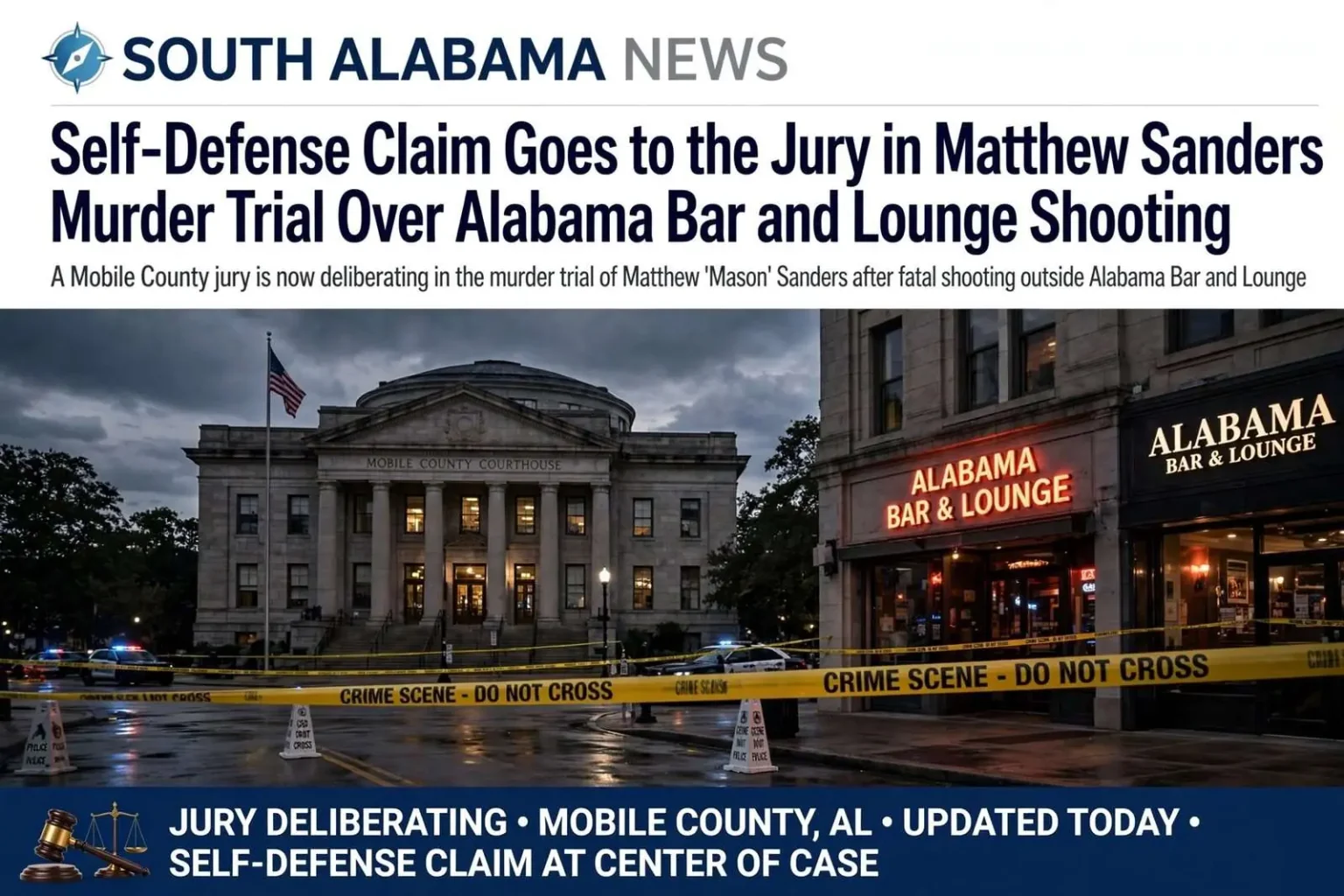
A Mobile County jury is deliberating in the murder trial of Matthew “Mason” Sanders, who is accused of killing Hunter Lins after an altercation outside Alabama Bar and Lounge.
The state and the defense presented sharply different versions of what happened during closing arguments, with the question of self-defense at the center of the case.
The Defense Case
Sanders testified that he shot Lins in self-defense, telling jurors that Lins was attacking him as he reached into his truck for a gun.
The defense maintains that Sanders feared for his safety at the moment he fired — the core requirement of a self-defense claim. Under Alabama law, a person may use deadly physical force when he reasonably believes another person is using or about to use unlawful deadly physical force against him. The word doing the work in that standard is “reasonably”: the belief must be one a reasonable person in the same circumstances would hold, not merely one the defendant sincerely held.
The Prosecution’s Evidence
Prosecutors built their rebuttal around physical evidence, video and Sanders’ own conduct after the shooting.
They pointed first to the autopsy, telling jurors there was no stippling or gunpowder residue on Lins’ body. The medical examiner testified that the absence of those markers indicates the shot was fired from three to four feet away.
That distance matters directly to the self-defense claim. Stippling — the pattern of unburned powder particles driven into skin at close range — is generally present when a firearm is discharged within roughly two feet, depending on the weapon and ammunition. Its absence is the state’s argument that Sanders was not in the grip of a hands-on struggle when he fired, but several feet away from the man he shot.
The Video and the Words
The state also pointed to surveillance and body-camera video, telling jurors that defense witnesses gave conflicting accounts of how the fight unfolded.
Prosecutors said Lins was being held back by a friend when Sanders went to his truck and said, “I got something for you.” That statement, if the jury accepts it, cuts against a self-defense theory in two ways: it suggests Lins was physically restrained rather than advancing, and it frames Sanders’ trip to the truck as a decision rather than a reaction.
The state additionally played a video Sanders posted on Snapchat after the shooting, showing Lins on the ground.
Post-incident conduct is not itself proof of intent, but prosecutors routinely present it because it speaks to a defendant’s state of mind. A jury weighing whether a shooting was a frightened act of self-preservation will inevitably consider what the shooter did in the minutes that followed.
Two Competing Accounts
Stripped to essentials, the jury is being asked to choose between two readings of the same few seconds.
In the defense’s account, Sanders was under attack, retreated to his vehicle, armed himself and fired at a man who was on him. In the state’s account, Sanders disengaged from a fight in which the other man was being restrained, retrieved a firearm, announced his intent and fired from several feet away.
The forensic evidence about distance is the point where those two accounts are most directly testable, which is why the medical examiner’s testimony featured so prominently in closing arguments.
What the Jury Must Decide
In Alabama, once a defendant raises self-defense with some supporting evidence, the burden falls to the state to disprove it beyond a reasonable doubt. The state argued in closing that there is no reasonable basis for the self-defense claim at all.
If the jury finds the state has not carried that burden, the result is an acquittal. If it finds the state has, it moves on to whether the elements of murder — or a lesser included offense — have been proven.
Where the Case Stands
With closing arguments complete, the case is now in the jury’s hands. South Alabama News will report the verdict when it is returned.