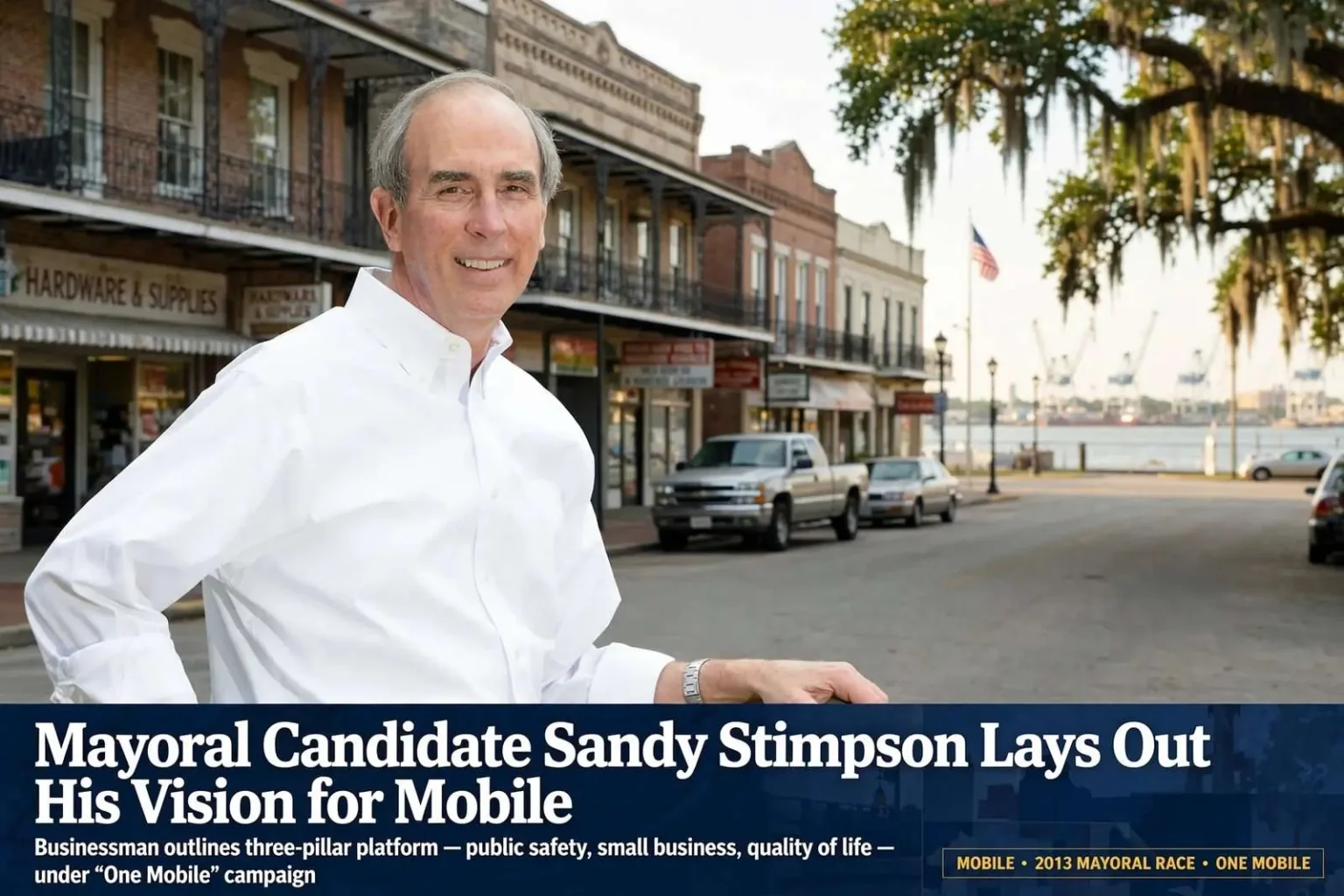
Businessman Sandy Stimpson entered the 2013 Mobile mayoral race saying he could no longer stand on the sidelines while the city fell short of its potential. In an interview, the first-time candidate laid out a platform built on three pillars — public safety, small business and quality of life — wrapped in a theme he calls “One Mobile.” The framing set up a challenge to the incumbent administration on both competence and vision, and it established the themes that would define a campaign watched closely across a city of roughly 195,000 people that has struggled for decades to translate its port, its industries and its historic charm into broad prosperity.
Safety, small business and quality of life
Stimpson argues that residents do not feel safe, and that fear drives them to lock doors, avoid going out and eventually leave the community. In his telling, public safety is not simply a crime statistic but the foundation on which everything else in the city rests: families decide where to buy homes, businesses decide where to locate, and young professionals decide whether to stay based on whether they feel secure in their neighborhoods after dark. A city that cannot answer the safety question, he contends, will keep losing the very people it needs to retain, no matter what else it does well.
On the economy, he says the city has rolled out the red carpet for large outside corporations while strangling mom-and-pop shops with red tape, and he pledges a City Hall that makes it easy to start and run a small business. The critique taps a long-running frustration among Mobile entrepreneurs, who describe permitting, licensing and inspection processes that can stretch projects for months and push would-be restaurateurs and shop owners toward the suburbs, where approvals move faster. Stimpson’s argument is that big-employer recruitment, however valuable, cannot substitute for the jobs and neighborhood vitality that locally owned businesses generate — the hardware stores, restaurants and service firms that keep money circulating close to home.
On quality of life, he points to parks, bike trails, cultural arts and recreation as essentials the city must actively improve. He ties the city’s brain drain directly to those failures, noting that Mobile’s “biggest export” is young college graduates who leave for jobs and lifestyle elsewhere. A more vibrant, walkable downtown — he cites urban planner Andres Duany’s form-based code — is central to drawing them back. Duany, a founder of the New Urbanism movement and a planner whose work influenced redevelopment efforts across the Gulf South, advocates zoning codes that regulate building form rather than use, encouraging the dense, pedestrian-friendly streetscapes that young workers increasingly demand. Stimpson’s point is that Mobile competes for talent not just on salaries but on whether the city offers a life worth staying for.
Infrastructure, education and finances
A civil engineer and former chief financial officer, Stimpson calls for proactive — not crisis-driven — infrastructure spending on drainage and roads. The credential matters in a city where flooding is a recurring fact of life: Mobile’s low-lying neighborhoods and its aging drainage network have produced chronic street flooding in heavy rains for years, and residents of flood-prone districts have grown accustomed to watching stormwater pool in their streets after ordinary summer storms. Stimpson’s argument is that City Hall too often pays for infrastructure only when failure forces its hand, and that a disciplined, engineer-led maintenance and capital plan would cost less over time than emergency repairs and repeated claims against the city.
He embraces the Mobile Area Education Foundation’s 80-20 plan to raise the high-school graduation rate and vows to meet monthly with school leaders, arguing a mayor must champion education even without direct control over it. The 80-20 initiative set a goal of graduating 80 percent of students on time, a target the community campaign pursued through tutoring, mentoring and dropout-prevention programs across the county school system. Mobile’s mayor does not run the schools — an appointed superintendent and an elected school board do — but Stimpson insists the bully pulpit and convening power of the mayor’s office can move educational outcomes, particularly in a city where workforce development and school quality shape employer decisions.
On city finances, Stimpson faults what he calls a lack of transparency and says he would move on day one to rescind the one-cent sales tax, which he argues has not increased revenues. The temporary tax, adopted during the recession era as a budget stopgap, has outlived its justification in his view; he maintains that the economy it taxed either shifted spending or shrank the taxable base enough to offset the new rate. He warns that without fiscal discipline the city risks the fate of municipalities that have gone broke, a reference to the municipal bankruptcies that had already reshaped public finance discussions in Alabama by 2013, most notably in Jefferson County. His pitch is that a chief financial officer’s habits — budgeting to revenues, disclosing numbers openly, planning for capital needs in advance — belong in city hall.
“One Mobile”
Stimpson frames his campaign around the idea that every citizen deserves a seat at the table and a voice in planning the city’s future. The theme is aimed, in part, at the perception that Mobile’s decisions get made by a small circle of downtown business and political interests while neighborhoods across the city — from Spring Hill to Toulminville to Tillman’s Corner — hear about them afterward. Under the “One Mobile” banner, he promised a more open city hall, with neighborhood concerns treated as a first draft of policy rather than an afterthought to it.
The theme also carries a deliberate message about division. Mobile’s civic history includes long-running tensions across racial, geographic and economic lines, and candidates for the city’s top office have campaigned on bridging them for a generation. Stimpson’s argument is that the city cannot afford to pull in different directions — that a port city with Mobile’s assets, sitting where the Mobile River meets Mobile Bay and the Gulf beyond, competes with the region’s boomtowns for investment and people, and wins only if the whole community pulls together.
His entry into the race also marked a personal turn. A civil engineer by training, he built a career in Mobile’s business community, serving in financial leadership roles before deciding to run, and he presented his candidacy as the extension of a lifetime in the city rather than a step in a political career. First-time candidates for Mobile mayor have historically faced steep odds against established incumbents, but Stimpson’s campaign bet that a platform of competence — engineers and CFOs, budgets and drainage — would resonate with voters tired of watching talent and businesses leave.
Between now and the August election, the campaign will test whether that message moves voters across all of Mobile’s districts. The three pillars are designed to connect: safer streets keep families in the city, small businesses give them places to work and shop, quality-of-life investments make young graduates stay, and transparent finances pay for it all. Whether the combination can unite what he calls “One Mobile” is the question the election will answer.
The small-business plank deserves particular attention because it connects directly to the city’s geography. Downtown’s storefronts, the commercial corridors along Government Street, the shops near the University of South Alabama and the businesses along Dauphin Island Parkway and Government Boulevard all live or die on how quickly a proprietor can get an occupancy permit, pass inspection and open the doors. When those processes stall, the vacancy stays visible — a shuttered storefront on a corner is a small tax on the confidence of an entire block. Stimpson’s pledge to make city hall easy to deal with is, in practice, a pledge about those corridors’ future.
His infrastructure critique likewise translates into specific stakes for neighborhoods. Drainage failures concentrate in the older, lower-lying parts of the city, where stormwater systems were designed decades ago for a smaller population and have been patched rather than rebuilt. Road resurfacing, meanwhile, has lagged across wide swaths of Mobile, and residents routinely rank potholes and street conditions among their top complaints. A capital plan that prioritizes by condition rather than by council district — Stimpson’s implied standard — would be a visible change in how the city allocates its street money.
The education piece rounds out the economic argument. The Mobile Area Education Foundation has spent years building community support around graduation-rate gains, and a mayor who attends to that work gives the campaign continuity beyond any single budget cycle. Employers evaluating Mobile consistently ask about the skill level of the local workforce, and the graduation rate is among the first metrics they see. Stimpson’s monthly-meetings pledge is his answer to the question of what a mayor without authority over schools can actually do: keep the city’s leadership engaged, its resources pointed at the problem, and its public attention fixed on the outcome.