
Mayors of Alabama’s five largest cities meet with state lawmakers in Montgomery
The mayors of Alabama's five largest cities, including Mobile's Sandy Stimpson, met with Gov. Kay Ivey and lawmakers in Montgomery to push their agendas.
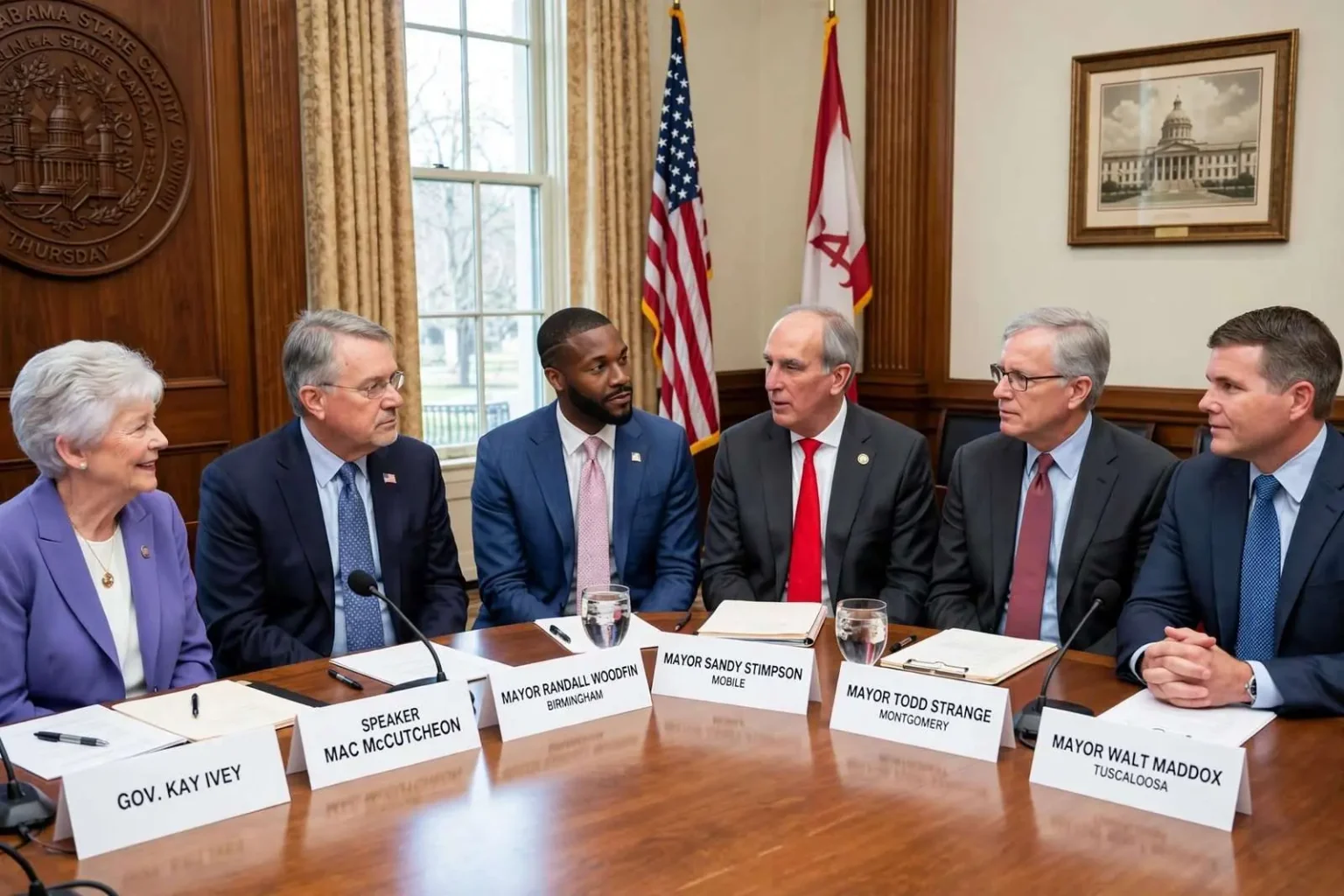
MONTGOMERY, Ala. — The mayors of Alabama’s five largest cities gathered in Montgomery on Thursday to press their legislative agendas with state leaders. Mayors Randall Woodfin of Birmingham, Tommy Battle of Huntsville, Sandy Stimpson of Mobile, Todd Strange of Montgomery and Walt Maddox of Tuscaloosa met with Gov. Kay Ivey, House Speaker Mac McCutcheon and other state officials. The discussions centered on priorities the cities hope to advance during the legislative session.
The gathering put the state’s urban leadership in the same room as the officials who control the flow of state money and legislation, and it underscored a reality of Alabama politics: the five biggest cities drive a disproportionate share of the state’s economy, yet their fortunes depend heavily on decisions made in the State House. Mobile’s inclusion in the group underscores the issues facing the state’s only large coastal city alongside its inland counterparts.
The mayors at the table
Each mayor arrived in Montgomery representing a city with its own agenda and its own relationship with the legislature. Randall Woodfin, elected mayor of Birmingham in 2017, led the state’s largest municipality, a city rebuilding its downtown around health care, banking and technology while contending with persistent questions about schools, transit and neighborhood investment. Tommy Battle of Huntsville represented a city in the midst of an economic boom driven by aerospace, defense and federal installations, where rapid growth strained roads, utilities and housing.
Sandy Stimpson of Mobile brought the concerns of the Gulf Coast’s major port city, where the state’s maritime economy meets the challenges of coastal infrastructure and storm readiness. Todd Strange, then mayor of the capital city itself, played host in a sense, representing Montgomery’s efforts around downtown revitalization and economic development. Walt Maddox of Tuscaloosa, a veteran mayor who had overseen his city’s recovery from the 2011 tornado, completed the group. Together they represented millions of Alabamians’ daily urban reality.
What cities need from the legislature
The wish lists brought to such meetings are remarkably consistent across Alabama’s cities, and they tend to start with money and authority. Cities rely heavily on sales tax revenue and on state-shared funds, and they lobby the legislature on how those streams are distributed and whether new restrictions are imposed. Infrastructure is a perennial priority: road and bridge funding, transit support and broadband expansion all run through state government, and Alabama’s gas tax levels and road programs are set in Montgomery.
Authority matters alongside appropriations. Municipalities seek the power to manage their own growth through zoning and annexation, to address blighted property, and to fund local projects without seeking legislative permission bill by bill. Legislators, in turn, watch over measures that affect municipal elections, occupational taxes and the balance between city councils and their legislative delegations — a relationship that has historically given Alabama’s county delegations unusual influence over local affairs.
The officials they met
Gov. Kay Ivey, who had assumed the governorship in 2017 and won election in her own right, brought a background as state treasurer that informed her attention to fiscal questions, and her administration’s relationship with the state’s cities shaped what municipal leaders could hope to accomplish in a session. House Speaker Mac McCutcheon of Madison County represented the chamber’s northern Alabama leadership and controlled which municipal legislation reached the House floor.
Meetings of this kind rarely produce announced deals, but they serve a purpose in Montgomery’s political culture: they let urban executives make their cases directly to the officials who set the session’s agenda, and they signal to legislators from those cities where their mayors’ priorities lie. For the mayors, a Thursday in Montgomery is an investment in the bills that follow.
Mobile’s seat at the table
For Mobile, participation in a five-city delegation carries particular weight. The city is Alabama’s only major port, home to a deepwater harbor that handles container traffic, bulk cargo and a growing shipbuilding industry, and its economic fortunes rise and fall with decisions made far inland. Port expansion, the Interstate 10 Mobile River Bridge crossing, and coastal insurance and storm-preparedness issues all require state partnership and, in many cases, state money.
Coastal cities also face questions their inland counterparts do not: hurricane recovery funding, floodplain management, and the division of revenue from coastal resources. Bringing Mobile’s mayor into a unified urban delegation signals to legislators that the state’s economic centers — the port city included — share common ground on municipal authority and funding even where their specific challenges differ.
Why the five largest cities matter to the state
Alabama’s five biggest cities anchor the metropolitan areas that generate the bulk of the state’s gross domestic product. Birmingham’s medical and financial sectors, Huntsville’s aerospace and defense economy, Mobile’s port and industry, Montgomery’s government and military presence, and Tuscaloosa’s university-driven economy together form the tax base that funds state services. When those cities thrive, state revenue follows; when they struggle, the whole budget feels it.
That interdependence is the mayors’ fundamental argument in Montgomery. Investment in urban infrastructure, public safety and schools is not charity toward the cities but maintenance of the state’s economic engine. The annual budget debates in the legislature — over the Education Trust Fund and the General Fund — determine how much of that argument turns into appropriations, and urban legislators argue for their cities within those constraints every session.
The rhythm of a legislative session
Alabama’s regular legislative sessions run in the spring, limited to thirty meeting days, which makes pre-session meetings like this one valuable for setting priorities before the calendar compresses. Mayors use the period to brief their legislative delegations, and delegations use the mayors’ lists to draft bills and budget requests. The governor’s State of the State address and budget proposals then frame what is realistically achievable.
For municipal leaders, the session’s outcomes are measured in concrete terms: whether a road project received funding, whether a local bill advanced, whether new unfunded mandates were imposed. A Thursday meeting with the governor and the House speaker is one step in that process — less a negotiation than an alignment of agendas before the session begins.
City halls and the State House
The relationship between Alabama’s cities and its legislature has long been defined by the state’s unusual system of local legislation, in which many local matters require bills passed by the full legislature rather than decisions made by city councils. That structure gives every legislator leverage over municipal affairs and gives mayors a standing reason to maintain good relationships in Montgomery. Meetings among the big-city mayors and state leaders are part diplomacy, part advocacy, and part simple maintenance of the channels through which local business gets done.
For the five mayors, the Thursday gathering was a chance to speak with one voice on the questions that unite them — funding, authority, infrastructure — while preserving the individual agendas each brought for their own city. For the state officials across the table, it was a reminder that Alabama’s urban centers are watching, and that the session’s decisions will be judged in city halls from Huntsville to Mobile.
Regional identities within one agenda
Though the five mayors stood together in Montgomery, their cities operate in distinct economic worlds. Huntsville’s expansion around Redstone Arsenal and its federal contractors has made it one of the South’s fastest-growing cities, with growth pressures that other Alabama cities envy. Birmingham’s agenda centers on revitalizing a core city whose population has declined while its suburbs have flourished, along with transit and education questions that follow from that split. Tuscaloosa’s economy moves with the University of Alabama, whose enrollment drives housing, service jobs and city planning decisions.
Montgomery, as capital, carries both a government workforce and the challenges of a mid-sized Southern city working to retain residents and employers. Mobile blends all of these with its port economy and coastal geography. The diversity is the point: when five mayors with different constituencies ask for similar things — flexibility, funding, respect for municipal authority — the request carries more weight than any single city’s lobby could.
What residents can take from it
For city residents, meetings like the one on Thursday translate into the practical details of local life: whether a transit system expands, whether a street project is funded, whether the city can pursue an industrial prospect without waiting on the legislature. State decisions ripple downward into property tax debates, infrastructure quality and public safety budgets. The mayors’ presence in Montgomery is ultimately about those downstream effects.
Residents of Mobile and the other four cities also see in such gatherings a reminder of their cities’ standing in state politics. Alabama’s political map is dominated by rural districts and suburban growth corridors, and urban concerns compete for attention within that map. A united delegation of mayors keeps city priorities visible at the state level, session after session, regardless of which officials occupy the governor’s office or the speaker’s chair.
A snapshot of urban Alabama
The meeting of the five mayors with Gov. Ivey, Speaker McCutcheon and other state officials captured urban Alabama at a particular moment — new leadership in Birmingham, sustained growth in Huntsville, a port city pushing for its share, and a capital and college town working through their own transitions. The agendas they pressed would play out across the legislative session in bills, budgets and local measures, most of them far less visible than the meeting itself.
What endures from such a gathering is the structure it reflects: Alabama’s largest cities, though often divided by geography and rivalry, recognize that their best route through the State House runs together. Whether the subject is a bridge over Mobile Bay, a bus line in Birmingham, or a research park road in Huntsville, the path leads through the same offices the mayors visited on Thursday.


