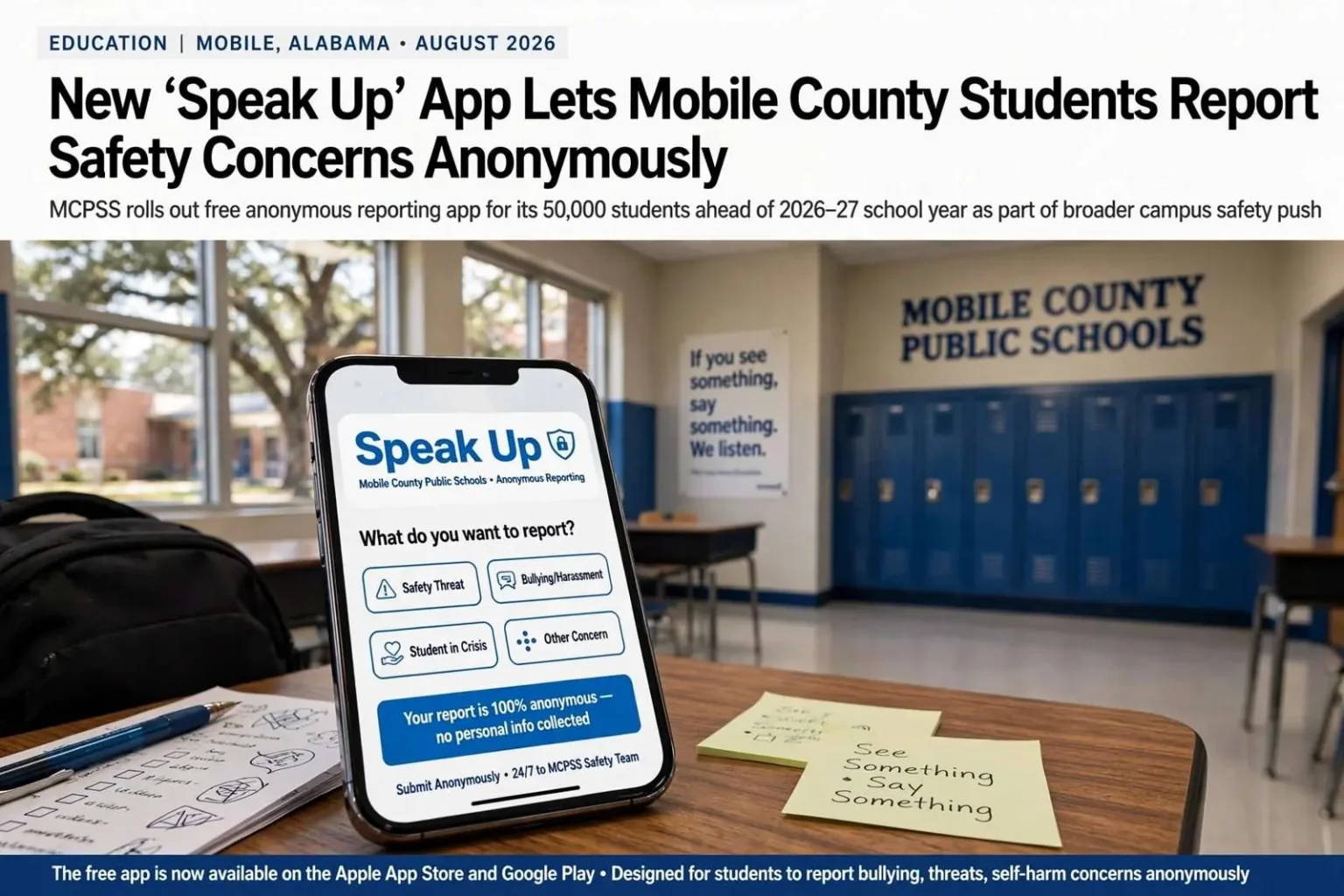
MOBILE, Ala. — As Mobile County Public Schools welcomes students back to class, the district is rolling out a new app that lets students anonymously report safety and security concerns, part of a broader “see something, say something” push to encourage kids to speak up. The tool, called “Speak Up,” is designed to put a reporting channel in every student’s pocket at the moment they see or hear something troubling — a threat, a plan, a classmate in crisis — without forcing them to confront the social cost of being identified as the one who told.
MCPSS Director of Communications Rena Phillips said the “Speak Up” app gives students a direct, private channel to flag concerns they might otherwise hesitate to raise in person, whether that’s a safety threat, bullying or another security issue on campus. The design premise is well established in school safety work: students are almost always the first to know about a threat circulating in a school, whether it is a fight being planned for after dismissal, a weapon rumor or a peer talking about self-harm, and most of that knowledge never reaches an adult because students fear retaliation, awkwardness or being labeled a snitch.
Anonymous reporting aims to remove that last barrier. A student using the app does not have to walk to an office, approach a counselor between classes or tell a teacher who might ask follow-up questions in front of peers. The report goes in through the phone, and school officials receive it and act on it without needing to know who filed it.
How students get the app
The Speak Up app is available as a free download on Google Play and the Apple App Store, alongside the separate Mobile County Public School app, which helps parents stay connected to what’s happening at their child’s school. The two apps serve different audiences. The district app is the family-facing information hub — calendars, announcements, and communication tied to a specific school — while Speak Up is the safety channel, deliberately built around anonymity rather than account-linked messaging.
That separation matters for student trust. If the reporting tool lived inside the main district app, students might reasonably worry that their identity traveled with the report. Keeping Speak Up as its own download, focused solely on safety tips, signals that the report itself is the point and that the district is not trying to build a profile of the student sending it.
Once a tip arrives, the practical response depends on what it describes. Reports about imminent threats are treated as emergencies and routed immediately to school administrators and, where warranted, to school resource officers or Mobile police. Reports about bullying, fights being planned, or a student who appears to be struggling go to the adults at that campus best positioned to intervene quietly — counselors, assistant principals, or the SRO assigned to the school. Nothing about the process requires the reporting student to come forward later.
Part of a wider safety push
The rollout comes as MCPSS, Alabama’s largest school system with about 50,000 students across 90 schools, continues to expand student and family support tools heading into the 2026-27 school year, including continued progress on reducing chronic absenteeism districtwide.
The scale of the district is the context that makes a tool like this significant. With roughly 50,000 students spread across 90 campuses — from downtown Mobile to Citronelle, Theodore, Semmes, Prichard and the communities in between — MCPSS cannot staff its way to constant adult awareness in every hallway and bus. Students themselves, present in every classroom, locker room and group chat, are by far the district’s largest information network, and Speak Up is essentially an invitation to that network to report what it sees.
Anonymous reporting systems have become standard practice across Alabama and the nation in the two decades since the Columbine shooting reshaped school security. Investigations into school attacks have repeatedly found that the perpetrators told peers beforehand, and that the peers said nothing. That finding drove the development of tip lines and apps at the state level — including reporting systems promoted by the Alabama Law Enforcement Agency and school safety initiatives statewide — and at the district level, where apps of this kind now operate in systems large and small.
The same logic covers more than catastrophic threats. Chronic bullying, fights, vaping in restrooms, students bringing weapons to settle disputes, and self-harm warning signs are all far more likely to surface through an anonymous tip than through an adult’s direct observation. Districts that operate these systems typically see the tip volume dominated not by dramatic threats but by ordinary campus problems that adults genuinely did not know about.
What families should know
For parents, the app is a companion to the conversations that safety experts recommend at the start of every school year. Children should know the tool exists on their phone, that using it carries no penalty and no identity trail, and that reporting a concern about a friend is not betraying that friend — it is often the act that connects the friend with help. Parents who notice their own child distressed by something at school can encourage the child to report it, or use the district app and direct school contact to raise the issue themselves.
The free downloads remove the usual cost barrier, and the app store placement means families do not need to hunt for the tool on the district website to find it. Districts typically publicize the app during the first weeks of school, through back-to-night presentations, classroom announcements and the district’s social channels, so that students learn how it works before they ever need it.
The launch also fits the arc of a district working its way through a demanding recovery period. Mobile County schools, like systems across the Gulf Coast, have spent recent years rebuilding attendance habits, expanding mental health support and tightening campus security simultaneously. Chronic absenteeism — students missing a tenth or more of the school year for any reason — has been a focal point because missing school is both a symptom and an accelerant of nearly every other problem a district confronts, from academic gaps to disengagement.
Why anonymity works
Skeptics sometimes ask whether an anonymous tip line invites false reports. The experience of districts that run these systems suggests the concern is manageable. False tips do occur, but the overwhelming majority of reports are genuine, and school officials are experienced at weighing a tip’s specificity and corroborating it against what they know before acting. The cost of occasionally chasing a prank report is small measured against the cost of missing a real one, and the anonymity that protects students from retaliation also protects the accuracy of what they are willing to share.
For a district the size of Mobile County’s, the arithmetic is straightforward: a system of 50,000 students in 90 schools will have safety issues somewhere on any given day, and the earlier adults hear about them, the smaller they stay. An anonymous app does not replace school resource officers, counselors, cameras or locked doors. It adds the one layer those measures cannot provide — the knowledge that already exists inside the student body — and makes it available to the people who can act on it.
Looking ahead to the school year
District officials will also be watching the balance between the two apps. The family-facing Mobile County Public School app consolidates the everyday logistics of school life — calendars, grades portals, alert messages — while Speak Up handles the safety mission alone. Keeping those functions distinct is deliberate: a parent checking a lunch menu and a student filing a fearful report should never be working in the same interface, and the separation helps each audience trust the tool built for it.
The app’s arrival ahead of the 2026-27 school year places it at the start of the calendar, when habits form and when families are most receptive to new tools. Students downloading it in August will have it in hand for the full year — for the homecoming season, exam weeks, and the spring months when campus tensions historically spike. The district’s communications team, led by Phillips, will be responsible for keeping the tool visible through the year so that it does not fade into another unused icon on a phone’s home screen.
What the district has committed to so far is the mechanism: a free, anonymous, student-controlled channel available on both major phone platforms, paired with the family-facing district app, operating inside Alabama’s largest school system as it pushes simultaneously on attendance and campus safety. The measure of the tool will be its use — the tips that let an assistant principal break up a planned fight, or a counselor reach a student before a crisis — and Mobile County’s students now have a direct, private way to make that happen.