
MCPSS weighs two calendar options for 2019-2020 school year
The Mobile County Public School System is weighing two calendar proposals for 2019-2020 and seeking public input at hearings in February.
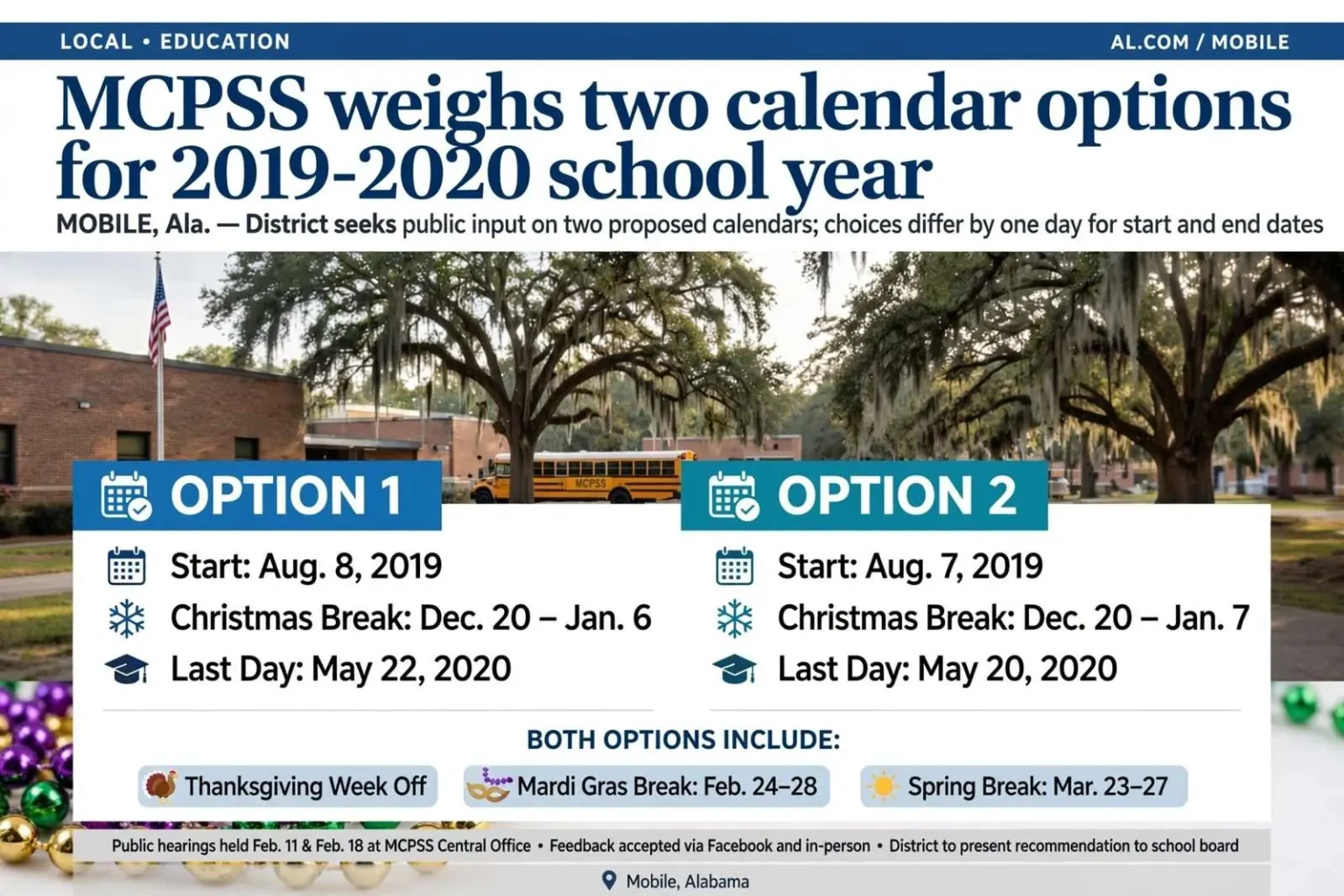
MOBILE, Ala. — The Mobile County Public School System is weighing two proposed calendars for the 2019-2020 school year, and district leaders want to hear from the people the schedule affects most: teachers, staff and parents. The school system posted both options on Facebook last week, giving the public a side-by-side look at how the academic year could take shape.
The two proposals differ by a single day at the front end, but that small shift ripples through holidays, breaks and the final day of class. Under Option 1, students would start school on Aug. 8, break for Christmas on Dec. 20 and return to class on Jan. 6, wrapping up the year on May 22. Option 2 would begin a day earlier, on Aug. 7, with students returning from Christmas break on Jan. 7 and finishing the year on May 20.
Where the calendars agree matters just as much as where they part ways. Both options include a full week off for Thanksgiving, and both build in a Mardi Gras break for Feb. 24-28 as well as an early Spring Break, scheduled for March 23-27. The Mardi Gras holiday is a distinctly Mobile tradition, with the school system historically coordinating its calendar around the parades that fill downtown streets in the weeks before Lent.
Public input has already been built into the process. The school system held hearings for input on Feb. 11 and Feb. 18 at 4 p.m. in the board room at its Central Office campus, giving families and employees a chance to comment in person before the board finalizes the schedule.
What each option means for families
For parents, the choice between the two calendars comes down to how the first and last weeks of the year line up with work schedules, childcare arrangements and family travel. A start date of Aug. 7 versus Aug. 8 may look trivial on paper, but for households juggling daycare transitions, summer camps or vacations that run into early August, a single day can be the difference between a smooth first week and a scrambled one.
The end of the year follows the same logic. Option 1’s May 22 finish gives families two extra days of summer compared with Option 2’s May 20 start to the break, a consideration for anyone planning trips or summer programs that begin right after the school year ends. Because both calendars are so closely matched, district officials have framed the decision as a matter of preference rather than a substantive difference in instructional time.
The Christmas break window shifts in the same way. Under Option 1, students are out of class from Dec. 20 until they return Jan. 6, while Option 2 holds the return until Jan. 7. Families with relatives out of town, or parents whose workplaces follow different holiday schedules, will weigh those days differently, which is exactly why the district is seeking public comment rather than simply adopting one option.
Why Mobile schools break for Mardi Gras
The Mardi Gras week built into both proposals is one of the most recognizable features of any Mobile County school calendar. Mobile lays claim to the oldest Mardi Gras celebration in the United States, with carnival societies parading through downtown for more than two centuries, and the festivities have long been woven into the region’s civic life. School systems across the area schedule a break around the parades, both because attendance dips as families take part and because the celebrations are a source of community pride and student participation.
In the 2019-2020 proposals, that break falls on Feb. 24-28, immediately after Mardi Gras Day, which lands on Feb. 25 that year. The placement gives families the holiday itself plus surrounding days for travel or rest, and teachers a natural midpoint between the winter and spring stretches of the semester.
The early Spring Break, set for March 23-27 in both options, is the other distinctive choice. A March break splits the second semester into more even segments and avoids the Easter-week travel crunch that affects districts elsewhere in the country. For families planning vacations, knowing the break falls in late March — rather than the week of Easter — shapes everything from booking timelines to destination choices.
How the district gathers input
Mobile County Public Schools is among the largest school systems in Alabama, serving tens of thousands of students across the county from Citronelle to Dauphin Island, and calendar decisions at that scale touch tens of thousands of households. A start date or holiday break that works for one community may not work for another, which is why the district combines online feedback through its Facebook post with in-person hearings at the Central Office campus.
The two public hearings, held Feb. 11 and Feb. 18 at 4 p.m. in the board room, gave teachers and staff a formal channel as well. School employees often have the most practical stake in a calendar: instructional planning, professional development days and the rhythm of grading periods all hinge on how the year is laid out. Teachers also see firsthand how breaks affect student attendance and momentum, making their input a key part of the process.
Once the input window closes, district staff typically compile the feedback and present a recommended calendar to the school board for approval. The board’s adopted calendar then becomes the reference point for everything from athletic scheduling to bus routing to family vacation planning across the county.
What stays the same
Whichever option is adopted, the broad architecture of the school year will look familiar. Students will attend roughly the same number of instructional days, with the year starting in early August and ending in late May — a span that reflects Alabama’s state law requiring a minimum number of instructional days and limiting how early or late the year can run. The week-long Thanksgiving break, the Mardi Gras holiday and the early Spring Break appear in both proposals, preserving the break pattern Mobile families have come to expect.
That consistency matters for the district’s operations teams as much as for families. Transportation departments build bus routes around the calendar, food service plans staffing for serving days, and after-school programs synchronize with the school schedule. Keeping the shared framework intact while adjusting only the start and end dates minimizes disruption to all of those systems.
For now, district officials are continuing to collect feedback through the posted options and the hearing record. Parents, teachers and staff who want a voice in which calendar is adopted can review both proposals online, attend remaining hearings at the Central Office board room, or reach out to their school’s administration to weigh in before the board makes its final choice.
The bigger picture on school calendars
Calendar debates have become a recurring feature of public education across Alabama, as districts balance state requirements, standardized testing windows, community traditions and family preferences. Start dates have crept earlier in many systems over the past two decades, a trend that has drawn both support — for aligning the first semester with winter holidays — and criticism from families and tourism interests who prefer later August starts.
Mobile County’s approach of publishing two nearly identical options and asking the public to choose reflects an effort to keep the decision in the community’s hands. The differences are small, but small differences in a calendar are exactly what families notice: the day summer ends, the day Christmas break begins, and the afternoon the last bell rings in May.
The district has not announced a timeline for adopting the final 2019-2020 calendar, but with hearings completed in mid-February and the proposals already public, a board decision is expected in advance of the new school year. Families can track updates through the school system’s official channels, and principals typically share the confirmed calendar with households as soon as it is approved.
Until then, the two options stand as the district’s attempt to answer the same question every system faces each spring: how to fit holidays, breaks, testing and instructional days into a schedule that works for the most students, families and employees possible.
Dates parents should note now
Even before the board adopts a final calendar, families can plan around the dates that appear in both proposals. The Thanksgiving week off, the Mardi Gras break on Feb. 24-28 and the early Spring Break on March 23-27 are locked into each option, meaning the only dates still in flux are the first day of school, the return from Christmas break and the final day of class. Childcare providers and summer programs that schedule around the school year can already work from the shared framework.
The same is true for the district’s own employees, whose contracts, professional development days and leave planning depend on the calendar. Because the two options differ by only a day on either end of the year, the practical impact on staffing is minimal, and school administrators have treated the choice as a matter of fine-tuning rather than redesign.
That narrow difference is also a sign of how constrained the process has become. State law, testing windows, weather make-up contingencies and the desire to preserve Mobile’s Mardi Gras break leave calendar drafters limited room to maneuver, which is why the public choice comes down to a single day in August and a pair of days in the spring. Whichever option wins the most support, the 2019-2020 school year will look overwhelmingly like the year Mobile families are used to — with an early start, a week of carnival in late February and a spring reset in March before the final push to graduation.