Meet the Prichard City Council: Five Districts, One Legislative Body
The Prichard City Council's five district representatives, led by Council President Traci D. Hale, work with the mayor to set policy and adopt ordinances for the city.
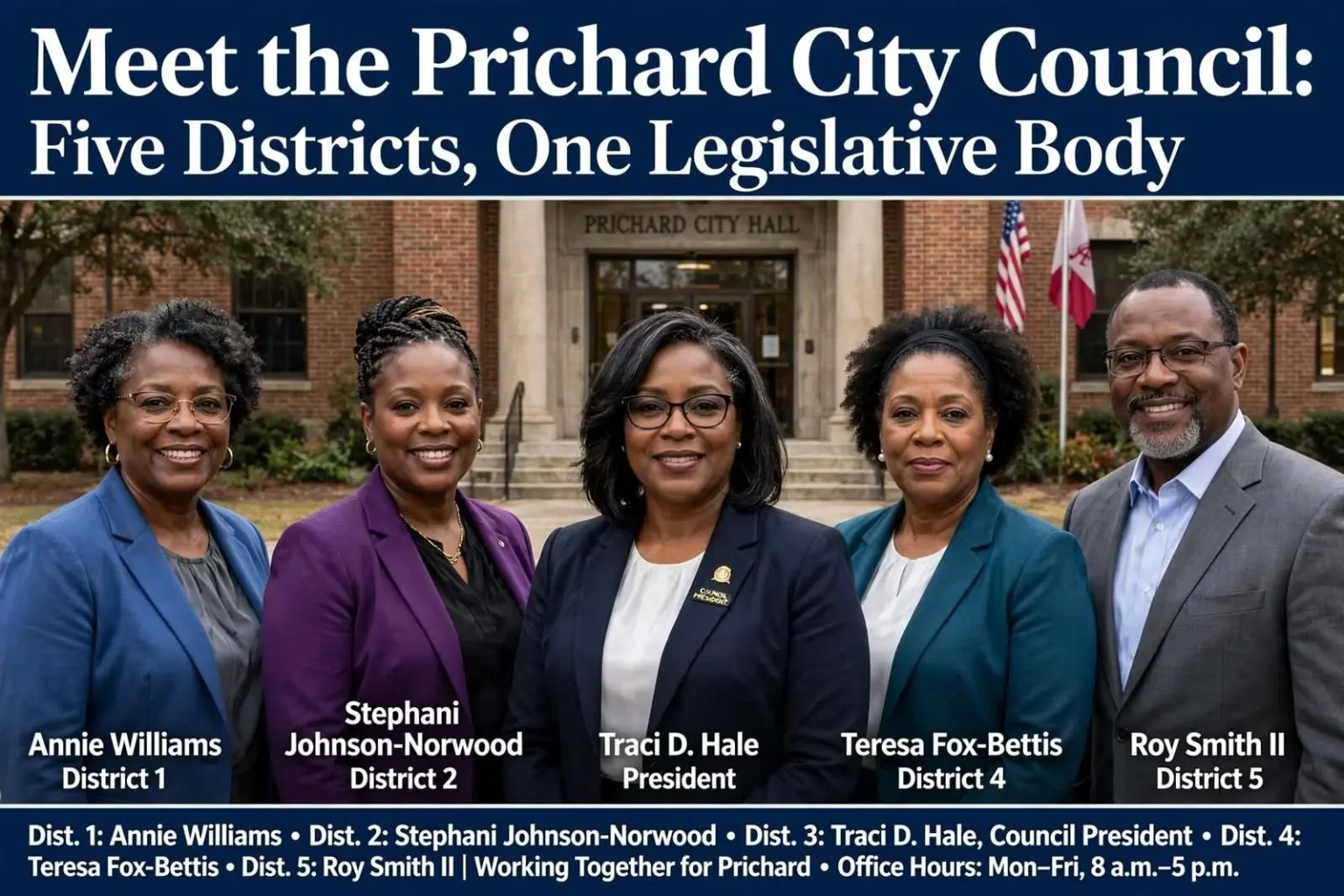
The Prichard City Council serves as the legislative body for the City of Prichard, working alongside the mayor to adopt ordinances, set policy and address issues affecting residents across the city’s five council districts. For residents looking to understand how local decisions get made, the council offers a starting point: five district representatives, each accountable to a distinct part of the city.
Who Represents Each District
Prichard’s council members are Annie Williams, representing District 1; Stephani Johnson-Norwood, representing District 2; Traci D. Hale, representing District 3; Teresa Fox-Bettis, representing District 4; and Roy Smith II, representing District 5. Together, the five council members are tasked with representing their districts’ interests while working collectively on citywide policy.
The council’s office hours run Monday through Friday, from 8 a.m. to 5 p.m., giving residents a regular window to reach their representatives.
Under the mayor-council form of government that governs Alabama municipalities, the division of labor is straightforward: the mayor runs the day-to-day administration of city departments, while the council functions as the city’s legislature. Council members propose and vote on ordinances, approve the annual budget, authorize contracts and purchases above set thresholds, and confirm appointments to city boards. No ordinance passes and no budget is adopted without a majority of the five districts represented, which makes each council seat a genuine seat of power rather than a ceremonial one.
District representation matters in a city like Prichard because neighborhood needs differ from one end of the city to the other. Paving schedules, drainage projects, code enforcement, park improvements and public safety staffing all get weighed through the lens of what each district requires, and the council member who knows those priorities firsthand is the resident’s most direct advocate at city hall.
A Closer Look at the Council President
Traci D. Hale, the District 3 councilwoman, currently serves as president of the Prichard City Council. Hale holds dual MBAs in Public Administration and Business Administration and is a licensed insurance adjuster, with professional experience spanning banking and accounting. That background, city officials note, gives her a strong foundation in financial management, administrative leadership and analytical problem-solving — skills that carry directly into her work overseeing council business.
Hale is a mother of two and has lived in District 3 for the past 18 years, giving her both the professional expertise and the lived community experience to inform her work on the council. She has described her focus as transparent, fiscally responsible governance aimed at improving quality of life for all Prichard residents.
The council president’s role carries particular weight in the council’s daily functioning. The president presides over meetings, sets much of the working agenda in coordination with city staff, and represents the council in its dealings with the mayor’s administration. When votes split, the president is also the figure charged with building consensus, which makes the office as much about negotiation and communication as about procedure.
Following Council Business
Prichard, located in Mobile County, holds regular council meetings where the body takes up ordinances, budget matters and other items of city business. Meetings are open to the public under Alabama’s Open Meetings Act, which requires that the business of local government be conducted in public view with limited exceptions, and residents who attend gain a firsthand look at how their city allocates its resources.
For residents who cannot attend in person, meeting minutes and adopted ordinances provide a paper trail of council action. Agendas typically lay out everything from routine approvals — prior meeting minutes, travel requests, standard intergovernmental agreements — to the items residents care most about: rezoning requests, paving contracts, demolition of blighted structures and changes to local ordinances.
The budget is the council’s single most consequential annual responsibility. City government touches residents’ lives through police and fire protection, sanitation, street maintenance, parks and senior services, and every one of those functions competes for a share of limited revenue. Council members who can read a balance sheet and question a line item — as Hale’s financial background positions her to do — shape how well the city’s dollars match its needs.
Prichard’s Place in Mobile County
Prichard sits just north of Mobile in Mobile County, part of the greater Mobile metropolitan area and one of the county’s larger municipalities. The city grew up as a railroad and industrial community, and its neighborhoods — from Whistler to the areas along U.S. Highway 45 and toward Chickasabogue Creek — carry the history of the workers and families who settled there over more than a century.
That industrial heritage has shaped the challenges the city faces today. Like many older communities, Prichard contends with aging infrastructure, vacant properties and a tax base that requires careful stewardship, all matters that pass through the council chamber in one form or another. The city also benefits from its location: minutes from downtown Mobile, bordered by recreational assets such as Chickasabogue Park, and connected to the port economy that drives the Gulf Coast region.
Regional cooperation is another recurring theme in Prichard’s civic life. Mobile County’s municipalities share issues that cross city limits — transportation planning, drainage, economic development, emergency management — and the council’s members represent the city in those conversations alongside the mayor, county commissioners and state legislators.
Elections for the city’s district seats take place on Alabama’s municipal election calendar, and every four years each district’s voters decide who will carry their concerns into the council chamber. Between elections, the ward system means a resident’s questions about a pothole, a neglected lot or a neighborhood crime concern start with the council member elected to represent that specific part of the city.
How Residents Can Make Their Voices Heard
For Prichard residents who want to engage with their city government, several practical routes are open. The council’s weekday office hours mean a phone call or a visit during business hours can reach a representative’s office directly. Many council members also keep contact with their districts through community meetings at churches, schools and neighborhood associations, which remain the backbone of civic life in the city’s residential areas.
Public comment periods at regular council meetings give residents a chance to speak on the record, and Alabama’s open meetings framework guarantees that the public can watch the city’s business being conducted. Residents with a specific problem — a street repair, a sanitation issue, a code violation on a neighboring lot — are generally best served by documenting the issue with dates and addresses before bringing it to their district representative, who can then route it to the appropriate city department and track the response.
The five-district structure also gives voters a clear accountability chain at election time. When services lag in a particular part of the city, the ballot offers a direct remedy, and council members who face their districts’ voters every cycle have a built-in incentive to stay responsive between elections.
Why the Council’s Composition Matters
A council whose members bring varied professional backgrounds — finance, insurance, education, business, public safety — is better equipped to examine the wide range of decisions that cross its agenda in any given year. Hale’s dual master’s degrees and her years in banking, accounting and insurance work illustrate the kind of expertise that matters when a small city is weighing multi-year contracts, bond decisions and budget priorities.
Just as important is the continuity that comes from members who have lived in their districts for decades. Representatives who raised their families on the same streets they now represent bring an understanding of neighborhood history that no briefing book can supply — knowing which drainage ditch floods first, which intersection needs a crossing guard, which park the children actually use. The combination of professional skill and local memory is what makes a city council function well, and Prichard’s current council reflects both.
For a city working to strengthen its finances, improve its neighborhoods and chart a stable future, the council chamber is where those goals become ordinances, budgets and concrete projects. Residents who follow the council’s work — by attending meetings, reading agendas or simply staying in touch with their district representative — are participating in the same tradition of local self-government that has sustained Prichard for generations.
The five members who hold those seats today, from Annie Williams in District 1 to Roy Smith II in District 5, preside over decisions that will shape the city for years to come, and their office doors in Prichard city hall remain open to the residents they serve, Monday through Friday, 8 a.m. to 5 p.m.
City hall itself serves as the physical anchor of that engagement, housing the council chambers alongside the departments residents deal with most often. Keeping the lines between districts and city staff short is one of the practical advantages of local government at this scale, where a resident can speak to the people who make the decisions without traveling outside the city limits.