Memoir Author Dale Kueter to Share Family Story-Writing Tips at Spring Hill College
Author Dale Kueter will discuss his book on writing family memoirs at Spring Hill College on Thursday, Feb. 26, offering local readers tips on preserving their own family stories.
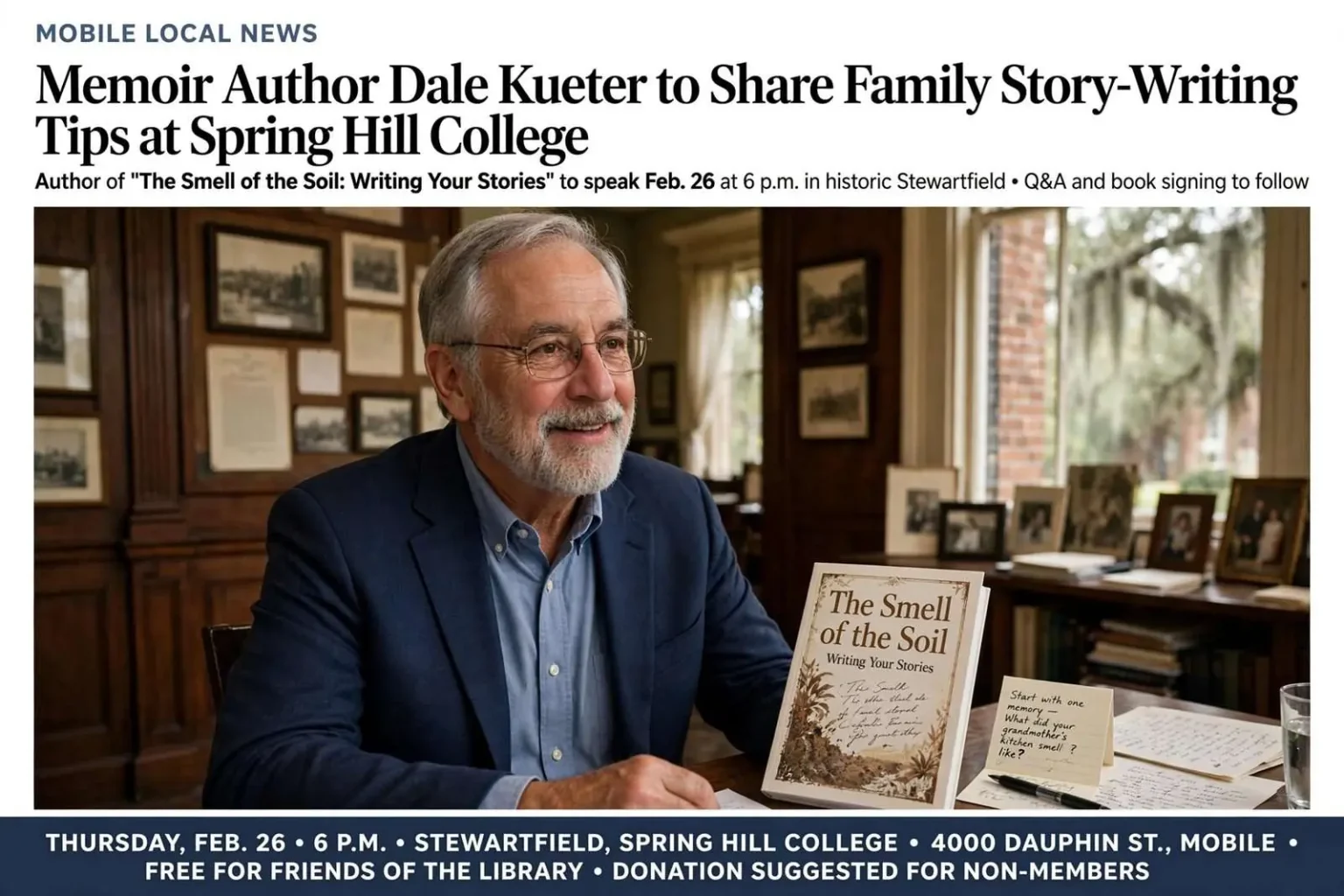
A Mobile-area author known for encouraging families to preserve their own stories will visit Spring Hill College this week to talk about the craft of memoir writing and why he believes every family has a book worth writing. Dale Kueter, author of “The Smell of the Soil: Writing Your Stories,” will speak Thursday, Feb. 26, at 6 p.m. at Stewartfield on the Spring Hill College campus, 4000 Dauphin St. A question-and-answer session will follow his remarks, and copies of his book will be available for purchase.
The setting fits the subject. Stewartfield, the historic residence on the Spring Hill campus, offers the kind of room that lends itself to storytelling, and the evening format, with a talk followed by open questions, is designed to draw out the practical concerns that keep people from starting: where to begin, what to include, and how to write honestly about the people closest to them. Kueter’s appearance gives local writers and family historians a chance to hear from someone who has worked through those questions both in his own writing and in guiding others.
Kueter’s book is part memoir and part how-to guide. Each chapter pairs a personal story with a writing prompt, an approach designed to help readers move from simply reading about the past to recording their own family histories. The structure reflects a conviction about how people actually learn to write: that a well-told example followed by an invitation is more effective than a lecture on technique. Rather than positioning the book solely as an account of his own life, Kueter built it to function as a springboard for other writers, encouraging readers to use his stories as a model for capturing their own.
That pairing of story and prompt also lowers the barrier that stops most family historians. Many people who intend to write down their parents’ and grandparents’ stories never produce a first page, defeated by the scale of the project. A chapter that demonstrates one kind of memory, a childhood chore, a family joke, a hardship weathered together, and then asks the reader to record the equivalent from their own household, converts an intimidating book-length ambition into a page at a time.
The Philosophy Behind the Book
“The importance of recording the stories of all the people in one’s life … is a step beyond the normal genealogical process,” Kueter has written. “What could be more precious to preserve than the stories that comprise your family’s life? What greater gift could you give to your family than a book of family stories?” The passage captures the argument that runs through his work: that a family history assembled only from records is a skeleton, and that the flesh of it, the anecdotes, habits, and voices of relatives, exists only in living memory and disappears with each generation that fails to write it down.
That philosophy has resonated with readers who are increasingly interested in genealogy and family history but often find that names, dates and family trees only tell part of the story. The past two decades have made the factual side of family research dramatically easier, with census records, military files, ship manifests and newspapers searchable from a laptop, and millions of people have built family trees as a result. What no database supplies is texture: what a grandfather’s workshop smelled like, how a grandmother spoke when she was angry, which stories the family told at every reunion and which it avoided.
Kueter’s approach argues that the anecdotes, habits and voices of relatives are just as essential to preserve as the bare facts of when and where they lived. His title points to the same idea from another direction: the smell of the soil is a sensory memory, the kind of detail that official documents never capture and that gives a written family history its power to make earlier generations real to the ones who follow. A memoir built on such details becomes a usable inheritance rather than a filing cabinet.
For Mobile audiences, the subject carries particular weight. The Gulf Coast has absorbed waves of migration and change, from the steamship era through the growth of the port, the shipbuilding booms, and the storms that have scattered and reunited families across the region, and the people who lived those decades are now in their final years. Every talk of this kind reaches some listeners who go home and start writing that same week.
The Friends of the Library Connection
Thursday’s program is being presented by the Friends of Spring Hill College Library, a support group that hosts author talks and literary events throughout the year to benefit the campus library. Friends-of-the-library organizations play a quiet but essential role in the cultural life of campuses and communities, raising funds for collections and programs that budgets alone cannot cover and serving as the bridge between an institution and the readers around it. At Spring Hill, that mission connects the college’s oldest Catholic liberal-arts traditions to the wider Mobile community, which is invited onto the campus for exactly this kind of evening.
Admission to the discussion is free for Friends members, and a donation is suggested for those who are not members. The structure is typical of the group’s events, which aim to be welcoming to newcomers while sustaining the membership that funds the library’s work. For attendees, the evening doubles as an introduction to the Friends organization and its calendar of author talks, book discussions and literary programs scheduled across the year.
The event offers local residents interested in genealogy, family history and memoir writing a rare chance to hear a working author address the practical side of the craft, from organizing material to finding the discipline to keep writing. Question-and-answer sessions at events like this often produce the most valuable exchanges, as audience members describe their own stalled family-history projects and hear concrete suggestions in return. Copies of “The Smell of the Soil” will be available for purchase, and for many attendees the talk will serve as a starting point for a project they have postponed for years.
The Campus and Its Setting
Spring Hill College, founded in 1830 on a hill south of the city, is the oldest institution of higher learning in Alabama and one of the oldest Catholic colleges in the South, and its shaded campus along Dauphin Street has long been a landmark of the Spring Hill neighborhood. Stewartfield, the venue for Thursday’s talk, is among the historic properties on that campus, and events held there draw on the setting’s sense of continuity, a fitting backdrop for a conversation about handing memory from one generation to the next.
The college’s location at 4000 Dauphin Street places it within easy reach of much of Mobile, and the evening hour makes the program accessible to working residents as well as retirees, the audience most likely to be actively gathering family history. Parking and access on campus are straightforward for evening events, and the Friends group’s tradition of welcoming non-members keeps the door open for first-time visitors.
Why Memoir Writing Matters Now
The interest Kueter’s work taps into is part of a broader cultural moment. As families scatter and as older generations pass, the urgency of capturing stories before they are lost has become a common motivation, and memoir writing has grown from a niche pursuit into one of the most popular forms of personal writing. Community classes, online groups, and library programs across the Gulf Coast now serve residents working on exactly the projects Kueter describes.
His method, story first and prompt second, offers those writers a way past the two most common obstacles: perfectionism and scale. A writer who tries to compose the definitive family history often stalls before finishing a chapter, while a writer who completes one remembered scene, then another, builds a manuscript almost without noticing. The approach also honors the idea at the heart of his philosophy, that ordinary lives, faithfully recorded, are worth more to the people who come after them than any polished literary performance.
Kueter belongs to a generation of writers whose careers crossed the transition from typewriters and carbon paper to word processors and self-publishing, and his practical advice reflects that long view of the craft. He encourages writers not to wait for polished prose, reminding them that a plainly written, honest account serves a family better than an unwritten masterpiece. He also stresses that the interviews matter as much as the writing: recording a relative telling a story in their own words, on a phone or a tape, preserves a voice that no summary can reproduce. For attendees wondering where to begin, his counsel is consistent with the design of the book itself, which is to start with a single memory, write it down plainly, and let the next one follow.
Thursday’s talk begins at 6 p.m. at Stewartfield on the Spring Hill College campus. Residents interested in attending can plan for a talk, a question-and-answer session, and the chance to take home the book that has already prompted many families around the Gulf Coast to start writing their own stories down.