Merry Widow to Ring in the New Year With Punk, Doom Metal Triple Bill
Criminal Class USA & the Hush-Hush Revolution, Black Titan and Future Hate headline a New Year's Eve weekend show at The Merry Widow in downtown Mobile.
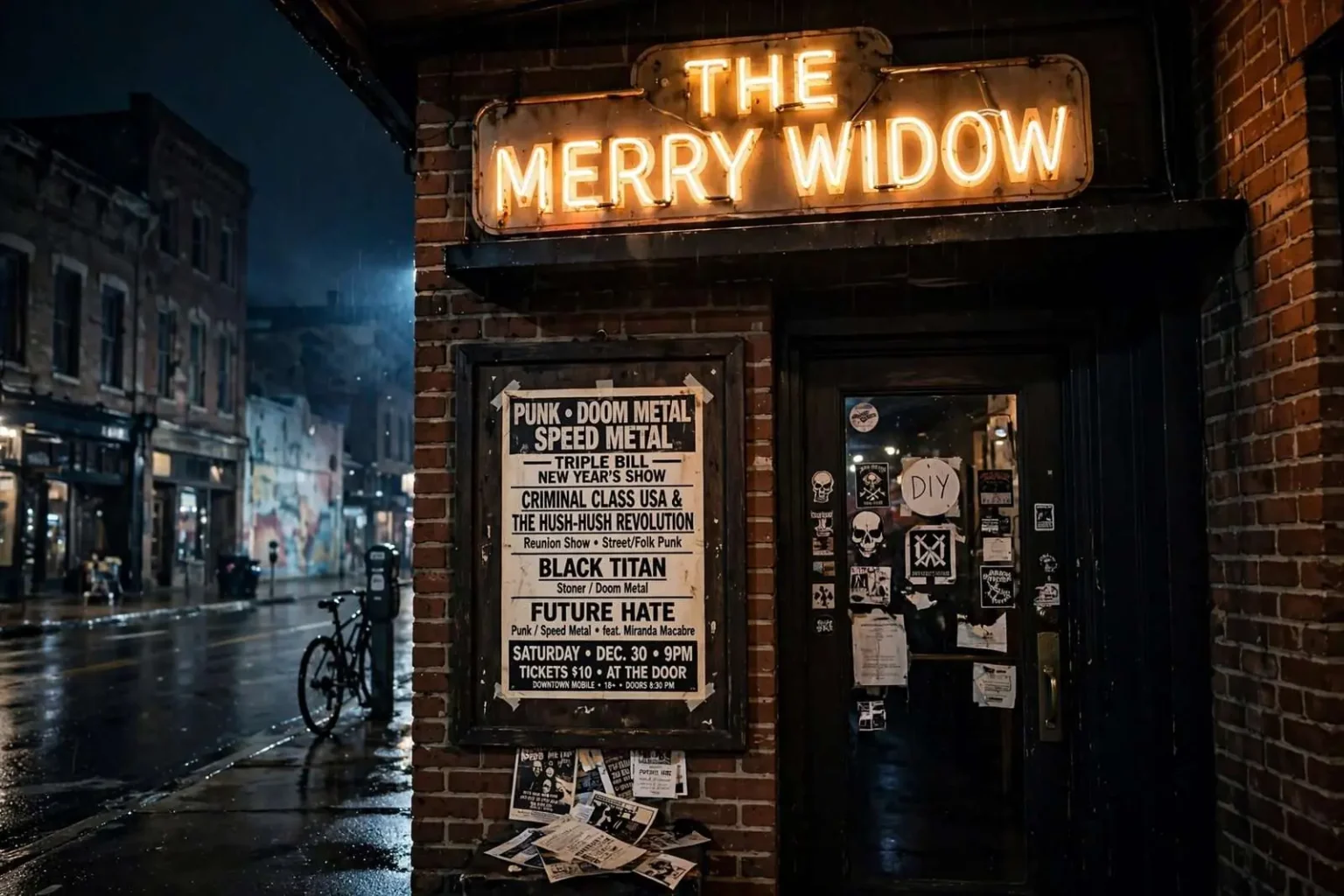
Downtown Mobile’s underground music scene will get one last showcase before 2018 arrives when The Merry Widow hosts a three-band bill on Saturday, Dec. 30, at 9 p.m. Tickets are $10 at the door for a lineup that spans several corners of the city’s heavier and more politically charged musical traditions, giving the holiday weekend a stop for fans of original, loud and uncommercial music before the new year’s celebrations take over.
The date puts the show in the dead zone between Christmas and New Year’s Eve, a stretch when most touring bands are off the road and most venues rest on their regular crowds. For Mobile’s underground scene, though, the holiday lull has long been a natural time for local bills — the regulars are in town visiting family, the big downtown parties haven’t started yet, and a $10 door charge is an easy sell for a night out. The Merry Widow’s calendar has consistently filled those gaps, and this bill stacks three acts whose audiences overlap more than their styles differ.
Headlining the night is a reunion of Criminal Class USA & the Hush-Hush Revolution, a street and folk punk outfit known for politically charged lyrics and a devoted local following. The band built its reputation on high-energy live shows that mix punk urgency with folk instrumentation — acoustic textures and singalong arrangements driving through songs aimed squarely at power and inequality. Its return to the stage after time apart is expected to draw longtime fans back out for the holiday weekend, the kind of crowd a reunion show pulls that ordinary bookings never do: people who were at the band’s early shows, who remember the old lineups, and who treat a homecoming set as an event on its own terms.
The heavy middle and the fast finish
Also on the bill is Black Titan, a stoner and doom metal band that spent much of 2017 rebuilding momentum after solidifying its lineup. The group leans on heavy, bottom-end riffs, punishing rhythms and growled vocals to deliver the kind of immersive, weighty sound associated with the doom metal genre — slow-to-mid-tempo, amplifier-crushing music that prizes tone and patience over flash. Doom’s regional scene rewards bands that can sustain that density live, and Black Titan’s retooled lineup spent the year proving it could, working back onto local bills after the disruption of personnel changes.
Rounding out the show is Future Hate, fronted by vocalist Miranda Macabre, whose blend of punk and speed metal stands out in a Mobile scene where female-fronted underground acts remain relatively rare. The band’s sound runs at the opposite tempo from Black Titan’s — fast, aggressive, riff-driven material that leans toward the thrash side of the divide — and Macabre’s presence at the front gives the group a distinct identity in a scene where most underground bills look and sound much the same. Speed metal’s revival circuit has been growing across the Southeast, and Future Hate has positioned itself as one of the Gulf Coast’s standard-bearers for the style.
The band has been touring behind its latest release, “Potboiler,” which has found an audience both in the U.S. and in Japan, suggesting the group’s fast, aggressive sound is resonating well beyond the Gulf Coast. For a band operating at the underground level — self-booked tours, small presses, DIY distribution — international attention of any kind is a meaningful marker, and it has made Future Hate one of the more intriguing exports of Mobile’s heavy-music scene. Home shows carry extra weight for a band like that: the hometown crowd gets to see an act that has been building a reputation on the road, and the band gets the kind of welcome that only a room full of familiar faces can give.
The pairing of the three acts on one bill says something about how the scene organizes itself. Punk, doom and speed metal occupy different niches commercially, but in a city Mobile’s size, the underground draws from a shared pool of listeners who move between styles without much regard for genre boundaries. Show bookers build nights that way deliberately — pairing an act with a devoted following like Criminal Class USA & the Hush-Hush Revolution alongside bands on the way up gives each bill a spine, and gives the opening acts a reason to expect a real audience rather than a bar full of the last band’s friends.
The Merry Widow’s role downtown
The show continues The Merry Widow’s role as one of downtown Mobile’s key stages for original and underground music, giving local acts across genres, from folk punk to doom metal to speed metal, a home for shows that might not fit neatly into a more mainstream venue’s booking calendar. Downtown’s larger rooms chase touring cover bands, tribute acts and DJ nights that fill a room predictably; a venue that books original underground acts takes on risk those rooms never touch, trading steady covers revenue for the scene loyalty that keeps a neighborhood venue alive between big nights.
Venues like The Merry Widow exist in nearly every mid-sized American city, and they function as infrastructure for local music in ways that are easy to miss. They are where new bands play their first shows and old bands stage their reunions, where touring acts on the small-club circuit find a room between bigger markets, and where the audiences that sustain original music form in the first place. Without such rooms, local scenes thin out — bands stop forming because there is nowhere to play, and fans stop going out because there is nothing to see. Mobile’s underground has persisted in large part because The Merry Widow and rooms like it kept their doors open to the strange end of the bill.
For the performers, a year-end hometown show carries its own logic. The holiday weekend brings former residents back to town, friends and family are available, and the year’s last local bill becomes an informal scene reunion — a chance for the musicians who share stages all year to catch each other’s sets instead of loading out past each other. By the time the headliner’s reunion set wraps up in the early hours of the morning, the city’s underground will have closed its 2017 account the way it lived all year: locally, cheaply, and loud.
For fans of heavy and politically charged music, the bill’s spread matters as much as any single act. A night that moves from folk punk’s acoustic anger to doom’s slow crush to speed metal’s sprint gives the crowd three distinct experiences in one room, and it showcases the range that a healthy scene quietly accumulates — different bands answering the same impulse in different keys. That variety is what separates a living local scene from a bar with a house band, and it is what The Merry Widow’s booking has consistently offered the city’s underground audience.
The $10 door price is typical of how the underground economy of local music works. Original acts at this level do not draw the crowds that support big guarantees, so shows are priced to cover the touring band’s gas, the sound engineer’s time and a modest split for the openers — with the door divided among the performers rather than skimmed by anyone upstream. Fans who come out understand the money goes directly back into the scene, funding the next record, the next van repair and the next tour leg, which is how a regional underground sustains itself without label support or radio play.
Saturday’s bill also offers a snapshot of where Mobile’s heavier bands stand heading into 2018. Criminal Class USA & the Hush-Hush Revolution return with their catalog and their reputation intact; Black Titan enters the new year with a settled lineup and rebuilt momentum; and Future Hate arrives with a release that has traveled further than most hometown bands ever see. Each is positioned to treat the show as a starting line rather than a capstone, and each will be measured — as always in a scene this size — by who shows up, how loud the room gets, and whether the audience comes back the next time one of the three plays. For a $10 cover on the Saturday before New Year’s Eve, downtown Mobile could hardly offer a better return.
Holiday-weekend shows also test a scene’s staying power in a quiet way. Between Christmas and New Year’s, even devoted concertgoers have a dozen competing claims on their evening — family obligations, office parties, the pull of simply staying home — so a well-attended local bill in that window signals an audience that genuinely shows up for its own scene rather than waiting for a touring name to justify the trip downtown. Promoters in every city watch those dates closely, and the ones who keep booking them year after year tend to be the ones whose rooms outlast the bands that play them.